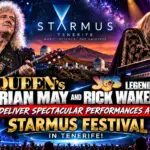

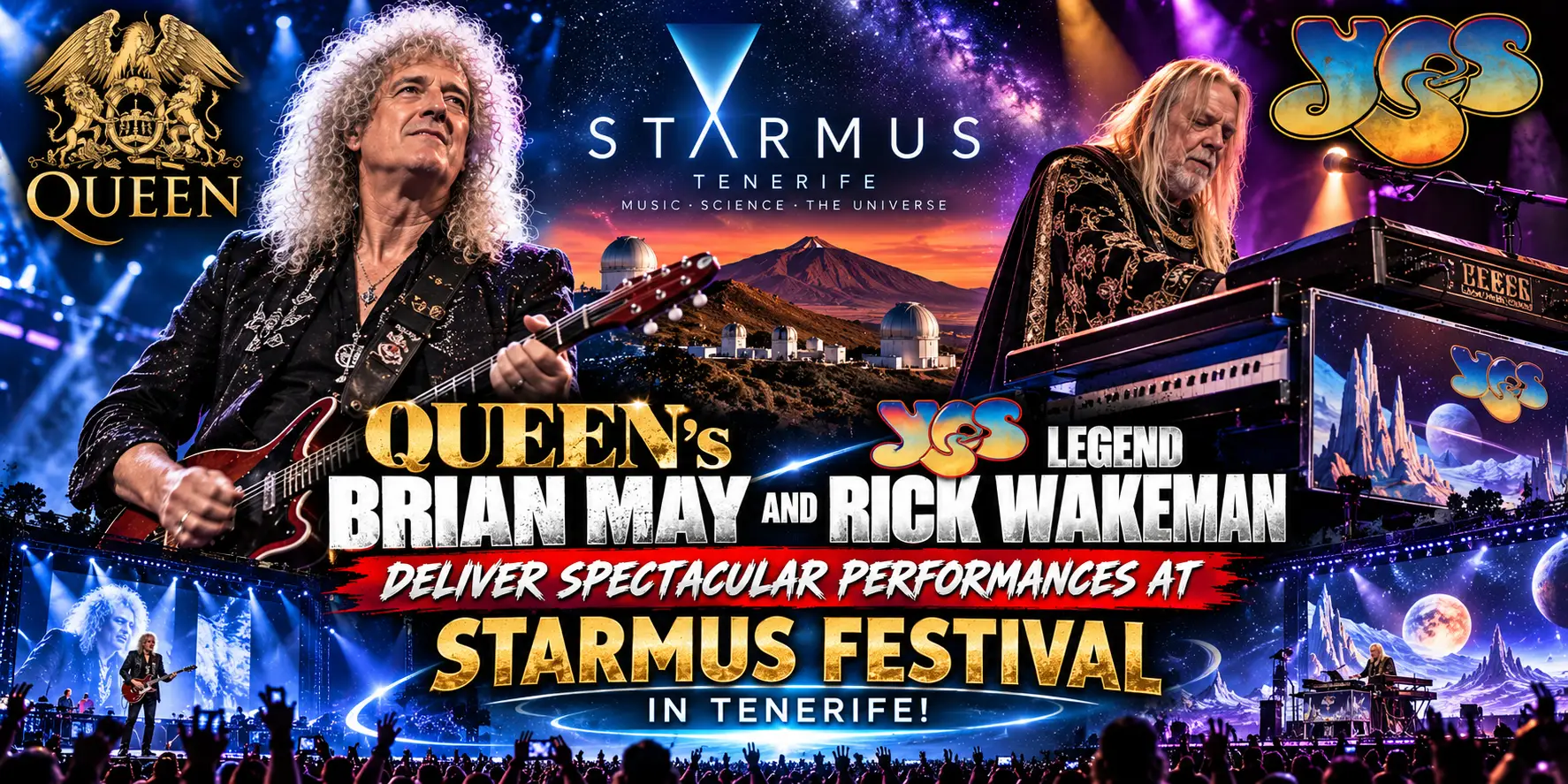
Two legends of British rock helped bring science and music together for an extraordinary weekend in the Canary Islands! QUEEN guitarist BRIAN MAY and former YES keyboard wizard RICK WAKEMAN took centre stage at STARMUS VIII, joining an incredible collection of world-class musicians, astronauts and scientists for a celebration of creativity, discovery and the mysteries of the universe.
There are rock concerts, there are science festivals, and then there is STARMUS – an event that somehow manages to combine the two into something completely extraordinary!
Taking place across Tenerife and La Palma in the Canary Islands from 17–22 October 2026, this year’s festival has brought together some of the biggest names in rock, classical music, astronomy and space exploration.
And the opening weekend certainly delivered something special.
QUEEN guitar legend Brian May joined internationally acclaimed tenor Andrea Bocelli, soprano Sarah Brightman and an impressive selection of musicians for a spectacular opening concert entitled The Symphony of Stars.
Meanwhile, former YES keyboardist Rick Wakeman contributed to the opening celebrations before presenting the world premiere of an ambitious new composition inspired by black holes and the universe.
With orchestral arrangements, legendary rock music, spectacular performances and appearances from astronauts who have travelled around the Moon, it was a weekend that demonstrated just how naturally music and science can come together.
And for anyone who enjoys progressive rock, QUEEN, YES or the more adventurous side of music, STARMUS VIII has already provided plenty to celebrate!
🔥 STARMUS VIII Opens With ‘The Symphony Of Stars’
The festival officially began on Saturday 17 October 2026, with an extraordinary opening ceremony in Santa Cruz de Tenerife.
The event, titled The Symphony of Stars, transformed the city’s waterfront into a celebration of science, creativity and music.
The programme included performances from an outstanding collection of musicians.
Among the featured artists were:
- Brian May – QUEEN guitarist and astrophysicist
- Rick Wakeman – Former YES keyboardist and progressive rock pioneer
- Andrea Bocelli – Internationally acclaimed Italian tenor
- Sarah Brightman – Celebrated British soprano
- Dino Jelusick – Croatian rock vocalist
- Rusanda Panfili – International violinist
- Chris Hadfield – Canadian astronaut and musician
- STARMUS All Stars Band
- Las Palmas Symphony Orchestra
Combining rock music with classical arrangements, the concert provided a fitting introduction to a festival dedicated to exploring the connections between art and scientific discovery.
But this was far more than a conventional concert.
The evening also featured presentations of prestigious awards recognising achievements in science communication, environmental protection and humanity’s understanding of the universe.
And with a stage filled with musical legends, it was inevitable that something rather special would happen.
🎸 BRIAN MAY Joins ANDREA BOCELLI For Emotional QUEEN Classic
One of the evening’s standout moments came when Brian May was joined by Andrea Bocelli for a performance of QUEEN’s magnificent ballad ‘Who Wants To Live Forever’.
Originally released on QUEEN’s 1986 album A Kind Of Magic, the song was written by May for the film Highlander.
Its sweeping arrangement, emotional lyrics and unforgettable melody have made it one of the band’s most celebrated recordings.
The combination of May’s distinctive guitar playing and Bocelli’s operatic vocals brought a different musical character to the composition.
With orchestral accompaniment adding further depth, the performance was particularly appropriate for a festival exploring humanity’s place in the universe.
The song’s reflections on time, mortality and the fleeting nature of existence also connected naturally with STARMUS’s wider scientific themes.
For May, whose career has combined rock music with a lifelong passion for astronomy, the performance represented another opportunity to bring his two worlds together.
And for the audience, hearing one of QUEEN’s most emotional compositions performed in such an unusual setting was undoubtedly a memorable experience.
🤘 ‘Bohemian Rhapsody’ Brings The Opening Concert To A Spectacular Conclusion
The evening concluded with a celebration of one of the greatest rock songs ever recorded.
‘Bohemian Rhapsody’ brought the participating musicians together for a grand finale, with Brian May leading the performance alongside the orchestra and other featured artists.
Originally released in 1975, the QUEEN masterpiece remains one of rock music’s most ambitious and recognisable recordings.
Its extraordinary combination of balladry, operatic harmonies and explosive hard rock has helped establish it as an essential part of musical history.
Performing such a composition with an orchestra and an ensemble of internationally celebrated musicians was particularly fitting.
The finale captured the musical diversity that makes STARMUS such an unusual event.
Rock guitar, classical instrumentation and theatrical presentation came together for a celebration of a song that has entertained generations of listeners.
More than five decades after its original release, Bohemian Rhapsody continues to demonstrate just how adventurous popular music can become.
And with Brian May leading the celebrations in Tenerife, it was a fitting conclusion to an extraordinary opening night.
🎹 RICK WAKEMAN Unveils Spectacular New Composition ‘Echoes From Black Holes’
While Brian May helped bring the opening concert to a spectacular conclusion, fellow British rock legend Rick Wakeman had another extraordinary performance planned.
On Sunday 18 October 2026, the former YES keyboardist presented the world premiere of Echoes From Black Holes at the Pirámide de Arona in Playa de las Américas, Tenerife.
Created exclusively for STARMUS VIII, the composition explored the mysteries of black holes and the wider universe.
Rather than presenting a conventional progressive rock concert, Wakeman combined his unmistakable keyboard playing with a chamber ensemble featuring strings, flute and oboe.
Specially created visual projections accompanied the music, bringing an additional cinematic dimension to the performance.
The project was conceived as a one-off musical experience, bringing together scientific inspiration, classical instrumentation and Wakeman’s distinctive compositional style.
For a musician whose career has been defined by ambitious concepts and extraordinary keyboard arrangements, the subject was particularly appropriate.
🌌 Progressive Rock Meets The Mysteries Of The Universe
Rick Wakeman has spent decades exploring subjects that extend far beyond conventional rock songwriting.
From historical figures to mythology, literature and science fiction, his solo albums have frequently transformed ambitious ideas into elaborate musical compositions.
His latest STARMUS project continued that tradition.
Black holes are among the most mysterious objects in the universe.
Created when sufficiently massive concentrations of matter collapse under gravity, they represent regions of space where gravity is so strong that even light cannot escape beyond the event horizon.
Their extraordinary properties have fascinated scientists for generations.
For composers, they also provide a wealth of creative possibilities.
The concepts of enormous gravitational forces, distorted spacetime and the unknown regions of the cosmos offer considerable inspiration for atmospheric and dramatic music.
Wakeman’s Echoes From Black Holes approached those ideas through progressive composition, orchestral instrumentation and visual storytelling.
The result was a project that connected his musical creativity with the scientific curiosity at the heart of STARMUS.
🎸 BRIAN MAY – Rock Legend And Qualified Astrophysicist
Few musicians are better suited to STARMUS than Brian May.
For millions of rock fans, he is the guitarist responsible for some of QUEEN’s most recognisable recordings.
His distinctive guitar sound, created with his famous Red Special instrument, helped define songs including Bohemian Rhapsody, We Will Rock You, Tie Your Mother Down, Brighton Rock and Hammer To Fall.
But beyond his extraordinary musical career, May is also a qualified astrophysicist.
He began studying physics at Imperial College London during the 1960s before QUEEN’s success interrupted his academic work.
Decades later, he returned to complete his doctorate.
In 2007, May was awarded a PhD in astrophysics for research into the motion of interplanetary dust.
His longstanding enthusiasm for astronomy has subsequently led to involvement in scientific research, educational initiatives and public outreach.
May also helped establish STARMUS alongside astrophysicist Garik Israelian.
The festival brings together two subjects that have played enormous roles throughout his life: music and scientific discovery.
And with the 2026 edition marking the tenth anniversary of the Stephen Hawking Medal, this year’s celebrations carried particular significance.
🏆 BRIAN MAY Receives Surprise Jane Goodall Earth Medal
The opening ceremony also featured an unexpected moment for the QUEEN guitarist.
Brian May was presented with a surprise Jane Goodall Earth Medal, recognising his commitment to animal welfare and wildlife protection.
The honour celebrated May’s work supporting rescued animals and organisations dedicated to protecting wildlife.
The guitarist has been an outspoken advocate for animal welfare for many years, including through his involvement with the Save Me Trust.
His campaigning has focused on the protection of wild animals and the importance of considering scientific evidence in conservation.
The award was particularly meaningful because May had worked with the late Jane Goodall, the celebrated primatologist and conservationist whose name the medal commemorates.
Climate campaigner Christiana Figueres also received a Jane Goodall Earth Medal during the ceremony.
For May, the unexpected recognition added an emotional personal milestone to an already memorable evening.
🚀 ASTRONAUTS Join Rock Royalty At STARMUS
Of course, STARMUS would not be complete without some extraordinary guests from the world of space exploration.
The opening ceremony welcomed members of the historic Artemis II lunar mission.
Astronauts Reid Wiseman, Victor Glover and Jeremy Hansen were presented with the Stephen Hawking Medal for Science Communication.
The award also recognised fellow crew member Christina Koch.
The mission, which took place in April 2026, saw the four astronauts travel around the Moon aboard NASA’s Orion spacecraft.
Their appearance at STARMUS provided an opportunity to reflect on the experience of seeing Earth from such an extraordinary distance.
The astronauts discussed the importance of cooperation, hope and protecting our planet.
Meanwhile, Canadian astronaut Chris Hadfield, who hosted the ceremony, contributed another memorable musical moment.
Hadfield performed David Bowie’s Space Oddity, a particularly appropriate choice given his famous connection with the song.
In 2013, he recorded a performance of Space Oddity aboard the International Space Station, creating one of the most memorable musical videos associated with space exploration.
Hearing the song performed during a festival combining rock music and astronomy was a fitting addition to the celebrations.
🎤 SARAH BRIGHTMAN And DINO JELUSICK Deliver Musical Highlights
The evening also featured performances from internationally acclaimed soprano Sarah Brightman.
Brightman’s appearance brought a theatrical and classical dimension to the programme.
Her selections included Ave Maria, KANSAS classic Dust In The Wind and Nella Fantasia, based on Ennio Morricone’s music for The Mission.
She was also joined by Croatian rock vocalist Dino Jelusick for a performance of The Phantom Of The Opera.
Jelusick, known for his work with WHITESNAKE and other hard-rock projects, brought a powerful rock voice to the theatrical composition.
The combination of his vocal intensity and Brightman’s classical delivery demonstrated the extraordinary musical variety represented at STARMUS.
From progressive rock and QUEEN classics to opera and theatrical music, the festival’s opening evening embraced an unusually broad selection of styles.
And rather than keeping those musical worlds separate, the event encouraged collaborations between performers from different backgrounds.
🌟 What Is STARMUS Festival?
Founded in 2011 by Brian May and astrophysicist Garik Israelian, STARMUS is an international festival dedicated to celebrating science, music, space exploration and human creativity.
Unlike conventional music festivals, STARMUS combines live performances with scientific lectures, discussions, educational activities and appearances from internationally recognised researchers.
Previous editions have featured some of the biggest names in science and music.
Among those associated with the festival are Stephen Hawking, Brian Cox, Chris Hadfield, Brian Eno, Hans Zimmer, Peter Gabriel, Jean-Michel Jarre and Steve Vai.
The festival’s central ambition is to make scientific discovery accessible and exciting to a much wider audience.
Music plays an important part in that mission.
By bringing celebrated musicians together with scientists and astronauts, STARMUS creates opportunities for audiences to discover connections between subjects that might initially appear unrelated.
After all, musicians and scientists share an important characteristic.
Both are driven by curiosity.
Both experiment with ideas.
And both spend enormous amounts of time attempting to understand and create something extraordinary.
📅 STARMUS VIII – Festival Dates And Highlights
| Date | Event | Location |
|---|---|---|
| 17 October 2026 | The Symphony of Stars opening concert and awards ceremony | Santa Cruz de Tenerife |
| 18 October 2026 | Rick Wakeman – Echoes From Black Holes world premiere | Pirámide de Arona, Tenerife |
| 19–21 October 2026 | Scientific conferences and discussions | Pirámide de Arona, Tenerife |
| 20 October 2026 | STARMUS Star Party | Tenerife |
| 22 October 2026 | Space Station Earth closing concert | La Palma |
The 2026 festival carries the theme The Search For Truth.
Throughout the six-day event, scientists, musicians, researchers and other participants are exploring subjects including astronomy, space exploration, environmental challenges and the importance of evidence-based knowledge.
The programme will conclude on Thursday 22 October with the Space Station Earth concert on La Palma.
🎶 Music And Science Have Always Shared A Special Connection
One of the most fascinating aspects of STARMUS is the way it demonstrates the relationship between music and scientific discovery.
Rock music has frequently explored space, astronomy and science fiction.
PINK FLOYD’s early recordings embraced cosmic imagery and experimental soundscapes.
DAVID BOWIE created unforgettable characters and stories inspired by space exploration.
RUSH regularly incorporated scientific and philosophical concepts into their progressive rock compositions.
Meanwhile, YES developed elaborate musical arrangements that often explored imaginative and otherworldly themes.
For musicians such as Brian May and Rick Wakeman, those connections have remained particularly important.
May has combined an extraordinary career in rock music with genuine scientific research.
Wakeman has spent decades transforming ambitious concepts into elaborate keyboard compositions.
Their involvement in STARMUS demonstrates that the worlds of progressive rock, classical music and science can complement one another.
And with audiences increasingly interested in immersive performances and multimedia storytelling, festivals such as STARMUS offer a different way to experience live music.
🎸 RICK WAKEMAN’s Extraordinary Progressive Rock Legacy
Long before his latest STARMUS appearance, Rick Wakeman had established himself as one of progressive rock’s most important keyboardists.
Born in London in 1949, Wakeman developed an interest in classical music and keyboards from an early age.
His professional career included extensive session work, contributing to recordings by major artists.
He famously played piano on David Bowie’s Life On Mars? and contributed to Bowie’s Space Oddity album.
However, his international breakthrough came through his involvement with YES.
Joining the group in 1971, Wakeman became an important part of the band’s increasingly ambitious musical direction.
His contributions to albums including Fragile, Close To The Edge and Tales From Topographic Oceans helped establish YES as one of progressive rock’s defining acts.
Alongside his work with the band, Wakeman developed an extraordinarily successful solo career.
Albums including The Six Wives Of Henry VIII, Journey To The Centre Of The Earth and The Myths And Legends Of King Arthur And The Knights Of The Round Table demonstrated his enthusiasm for grand musical concepts.
His latest project, Echoes From Black Holes, continues that longstanding tradition of combining complex musical arrangements with subjects that inspire curiosity and imagination.
🤘 THE RIFF REPORT VERDICT – Rock Legends Reach For The Stars!
STARMUS VIII has already demonstrated why it remains one of the most unusual and fascinating festivals in the world.
Where else could audiences experience Brian May performing QUEEN classics alongside an internationally acclaimed tenor, Rick Wakeman unveiling a composition inspired by black holes, and astronauts discussing their extraordinary journey around the Moon?
The combination is certainly unconventional.
But that is precisely what makes the festival special.
For Brian May, the event represents the perfect meeting point between his two great passions: music and astrophysics.
His performance alongside Andrea Bocelli provided one of the opening ceremony’s memorable highlights, while the surprise Jane Goodall Earth Medal recognised his longstanding commitment to wildlife protection.
For Rick Wakeman, the festival offered another opportunity to demonstrate the enormous creative possibilities of progressive music.
His specially commissioned Echoes From Black Holes continued a career defined by ambitious ideas and elaborate compositions.
And with STARMUS continuing across Tenerife and La Palma until 22 October, there are still more scientific discussions and musical celebrations to come.
Here at The Riff Report Blog, we love seeing legendary musicians continuing to experiment, collaborate and explore new creative territory.
After all, rock music has never been about standing still.
Two British rock legends. One extraordinary festival. And an entire universe of musical inspiration.
BRIAN MAY and RICK WAKEMAN have proved that when rock music reaches for the stars, the possibilities are endless! 🌌🎸🎹🤘
KEEP LOOKING UP – AND KEEP ROCKING!