🎸 The Riff Report Blog | Behind The Music | Rock History | Touring Production
Forget your average rock concert. When Irish rock legends U2 embarked on their groundbreaking 360° World Tour in 2009, they didn’t simply hire a stage, load their guitars into a few trucks and head off around the world. Oh no, butt! They built THREE identical gigantic steel structures, with a fourth reported later in the tour, installed one of the most ambitious lighting rigs ever taken on the road and created a colossal sound system designed to deliver rock ‘n’ roll in every direction!
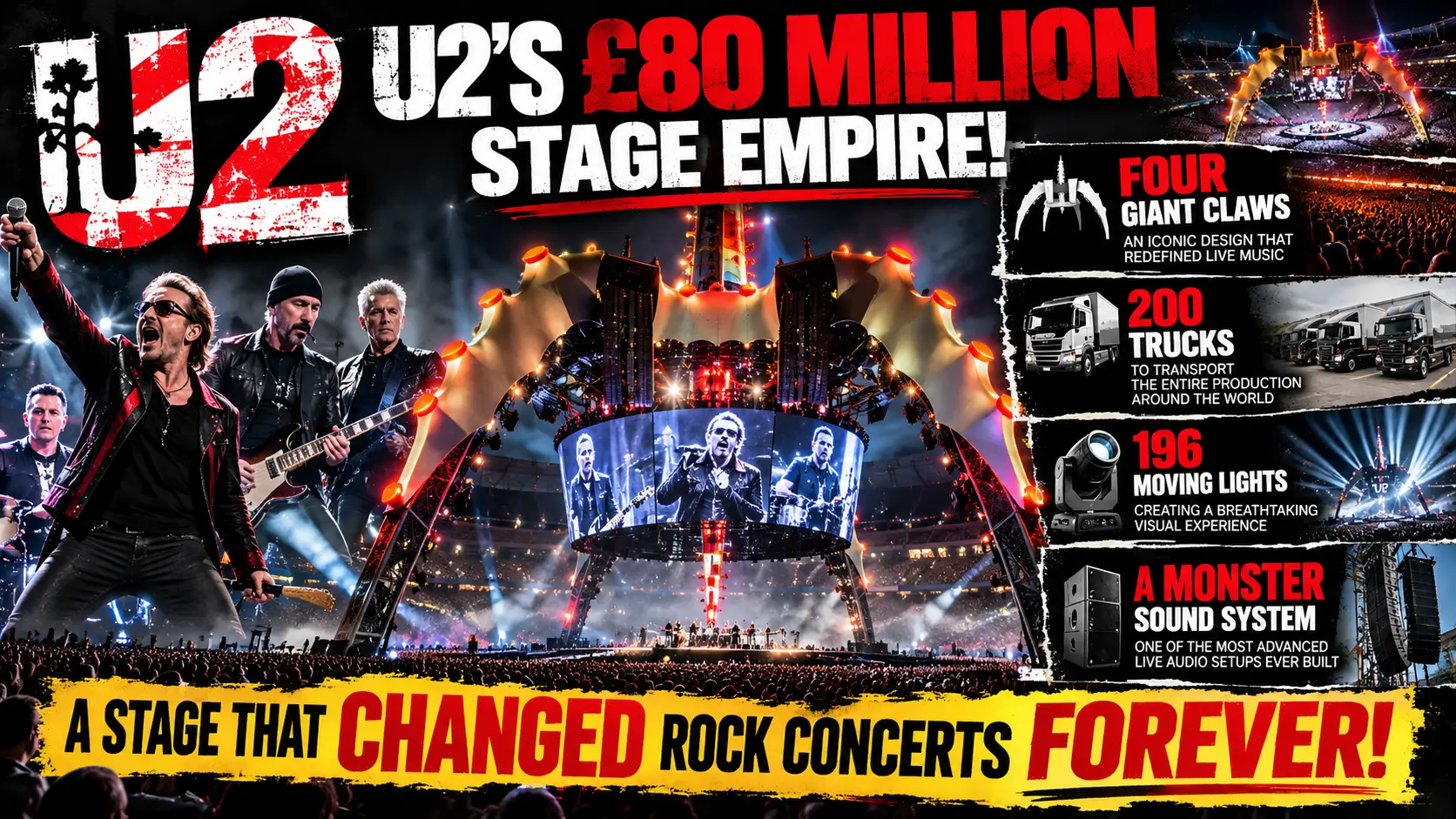
We’re talking stage structures costing a reported £15–£20 MILLION each, around 200 trucks, hundreds of crew members, 196 powerful moving lights, 156 strobe fixtures, enormous suspended speaker arrays and an extraordinary 72-subwoofer bass system.
And if that wasn’t enough, the entire tour went on to generate approximately £450 MILLION in ticket revenue.
Welcome to the extraordinary world of U2’s 360° Tour, where rock ‘n’ roll collided with engineering on a truly ridiculous scale! 🤘🔥
🎸 THIS WASN’T JUST A CONCERT – IT WAS AN ENGINEERING REVOLUTION!
Picture the scene.
It’s 2009.
You’re standing inside a packed football stadium, surrounded by tens of thousands of screaming U2 fans.
The lights begin to fade.
An enormous structure towers above the pitch, stretching into the sky like some mysterious alien spacecraft.
Four gigantic curved steel legs arch over the crowd.
Hundreds of powerful lighting fixtures illuminate the structure.
Huge speaker arrays hang above the stage, ready to unleash some of the biggest rock anthems ever written.
Then Bono, The Edge, Adam Clayton and Larry Mullen Jr. take their positions.
The opening notes ring out.
And suddenly, that giant alien-looking machine becomes one of the most spectacular concert stages ever created.
WELCOME TO THE U2 360° TOUR!
Running from 30 June 2009 until 30 July 2011, the tour became a milestone in live entertainment.
It travelled across Europe, North America, South America, Africa, Australia and New Zealand.
But what made this operation remarkable wasn’t simply the number of concerts or the enormous crowds.
It was everything behind the show.
The stages.
The lighting.
The sound.
The transport.
The crew.
And the staggering financial commitment required to make it all happen.
Because U2 didn’t build just one of these monsters.
They originally commissioned three identical structures so their enormous touring operation could keep moving between stadiums.
And by 2011, reports described four giant Claws.
Now that’s what we call doing things on a ridiculous scale!
🤯 U2’S 360° TOUR – THE MIND-BLOWING NUMBERS!
Let’s start with some of the extraordinary figures behind this touring production.
Touring operation
Reported figures
Original giant Claw structures
3
Claws reportedly in use by 2011
4
Estimated cost per Claw
£15m–£20m
Potential combined cost of 4 Claws
£60m–£80m
Tour ticket revenue
Approximately £450m
Concerts performed
110
Total attendance
7,272,046
Countries visited
30
Maximum stage antenna height
51 metres
Main steel structure weight
220 tonnes per Claw, excluding ballast
Trucks per steel structure
38
Wider touring operation
Around 200 trucks reported
Construction
Approximately 5 days
Dismantling
Approximately 2 days
PRG Bad Boy moving lights
196
Martin Atomic strobes
156 in the original 2009 rig
Giant roof searchlights
8
DWE PAR lighting fixtures
498 reported
Custom ripple lighting effects
5
Clair S4 subwoofers
72 around the outer performance ring
Stage-side subwoofers
24 Clair BT218
Lighting crew
14 reported in 2009
Daily running overhead reported in 2009
Around £470,000
The figures reflect historical production specifications and contemporary reports. Equipment counts changed during the tour, and the £60–£80 million total is calculated from reported construction estimates rather than a confirmed final invoice.
And if those numbers don’t make your jaw hit the floor, wait until you discover how the lighting and sound actually worked.
🏗️ THREE IDENTICAL GIANT STAGES – WHY ONE WAS NEVER GOING TO BE ENOUGH!
One of the biggest logistical challenges facing the production team was transporting the enormous Claw between stadiums.
The stage was simply too complicated to dismantle, transport and rebuild in time for every performance using a conventional touring schedule.
Each structure took several days to assemble.
So U2 came up with an ambitious solution.
BUILD THREE OF THEM!
Belgian staging specialists Stageco manufactured three identical steel systems.
Rather than moving as one enormous convoy, the structures could operate independently.
It’s a system known as leapfrogging.
🔥 STAGE ONE – THE CURRENT CONCERT
Imagine U2 are performing at Wembley Stadium.
Thousands of fans are screaming along to Where the Streets Have No Name.
The first Claw is carrying the lighting, video and sound equipment above the musicians.
🏗️ STAGE TWO – THE NEXT DESTINATION
Meanwhile, hundreds of miles away, another construction team is already assembling the second structure.
Cranes are positioning gigantic sections of steel.
Riggers are preparing the framework.
Engineers are checking the installation.
By the time U2 arrive, the next structure is already waiting for its travelling technical equipment.
🚛 STAGE THREE – MOVING AHEAD
The third structure is being dismantled, transported or prepared at another future destination.
This allows the operation to continue without waiting for one enormous stage to travel between every concert.
One stage performing. One stage preparing. One stage moving.
And by June 2011, The Guardian reported that U2 owned four separate Claw structures, each valued at between £15 million and £20 million.
That’s a potential combined construction cost of £60–£80 million.
Just imagine being the person responsible for keeping track of four giant metal spaceships!
👽 THE CLAW – AN ALIEN SPACESHIP BUILT FOR ROCK ‘N’ ROLL!
The Claw was designed by concert architect Mark Fisher and show designer Willie Williams, working with an extraordinary team of engineers and production specialists.
Its appearance was inspired partly by the futuristic Theme Building at Los Angeles International Airport.
The design featured four enormous curved legs supporting a central structure above the musicians.
The central grid stood approximately 28 metres high.
A huge antenna extended to approximately 51 metres.
The main steel structure weighed around 220 tonnes, excluding its additional ballast.
Each Claw required another 90 tonnes of steel ballast for stability.
And the structures were designed to carry around 170 tonnes of production equipment.
That included enormous speaker systems, lighting fixtures, video technology and supporting equipment.
The stage wasn’t simply a decorative backdrop.
It was a piece of temporary architecture capable of supporting an entire stadium concert.
And because U2 were performing in the round, the production had to work from almost every direction.
That created some extraordinary challenges.
Especially when it came to lighting.
💡 196 PRG BAD BOY MOVING LIGHTS – HOW U2 LIT UP ENTIRE STADIUMS!
Now we’re getting into one of the most technically fascinating parts of the whole operation.
THE LIGHTING RIG!
When audiences arrived at a U2 360° concert, they weren’t simply looking at a huge stage.
They were entering an entire visual environment.
The giant Claw could glow in different colours.
Beams of light could sweep across the stadium.
Huge strobes could illuminate thousands of fans.
And enormous searchlights could send powerful shafts of light high into the night sky.
The visual spectacle was developed by Willie Williams, with lighting director Ethan Weber and associate lighting designer Alex Murphy playing central roles in programming and operating the system.
Specialist production company PRG – Production Resource Group supplied the lighting equipment.
🔥 The main lighting equipment
The original 2009 technical specification included:
Lighting equipment
Quantity
PRG Bad Boy automated fixtures
196
Martin Atomic 3000 strobes
156
Atomic colour scrollers
156
Zap Technology BigLites
8
Novalight Nova-Flowers
7
Custom ripple-drum effects
5
DWE PAR scenic lamps
498 reported
Tamlite sodium fixtures
30 in the published original equipment list
Red bulkhead fixtures
38 in the published equipment list
Strong Gladiator followspots
10
Lycian M2 followspots
12
Different technical accounts and later touring specifications show some variation in individual fixture totals.
And here’s the extraordinary thing.
Every one of those lighting fixtures had a specific job.
The system wasn’t simply about throwing as much light as possible towards the stage.
It was about creating a carefully controlled visual environment across an entire stadium.
🎯 The PRG Bad Boy – the workhorse of the operation
The 196 PRG Bad Boy fixtures were among the most important components.
These powerful automated lights were designed for large-scale concert production.
They could produce intense beams capable of travelling substantial distances while maintaining useful brightness.
That was essential because the Claw was enormous.
Some lighting positions were around 80–100 feet from the stage.
Other fixtures positioned around the stadium could be approximately 400 feet away.
Ordinary stage lights would struggle to deliver the required intensity from those distances.
The Bad Boys could operate as powerful spotlights, produce broad washes of colour and generate textured lighting effects.
They allowed Williams and Weber to create dramatic looks without filling the entire stadium with thousands of unnecessary fixtures.
And that’s what made the design so clever.
It wasn’t simply about having the biggest lighting rig. It was about making every fixture count.
⚡ 156 MARTIN ATOMIC STROBES – WHEN THE ENTIRE STADIUM FLASHED!
Another major part of the lighting system involved 156 Martin Atomic 3000 strobe fixtures.
These powerful lights were fitted with colour-changing accessories.
Strobes create rapid flashes of light, producing an intense visual effect when synchronised with music.
During particularly dramatic moments, sections of the stage and stadium could be illuminated by sudden bursts of light.
The effect could make the entire structure appear to explode visually.
Combine that with the giant moving video screen and the atmosphere becomes extraordinary.
But there was more to the lighting system than strobes.
Inside the Claw’s towering central structure were hundreds of PAR lamps.
These traditional-style lighting fixtures helped illuminate the enormous industrial-looking framework.
Sodium lights provided distinctive warm tones.
Red bulkhead lights added atmosphere around the giant legs and central pylon.
Five custom ripple-drum fixtures created unusual rotating beams and textures.
And scenic LED fixtures illuminated parts of the Claw’s outer skin.
The result was a stage that could change appearance dramatically between songs.
One moment the structure looked almost like a giant machine.
The next, it became a glowing futuristic sculpture towering above the audience.
Not bad for a bunch of stage lights, eh, butt!
🔦 EIGHT GIANT SEARCHLIGHTS ON TOP OF THE CLAW!
Here’s one of the most extraordinary details.
The production included eight powerful Zap Technology BigLite searchlights positioned high on top of the main structure.
These weren’t ordinary lighting fixtures.
They were enormous, high-powered units designed to throw beams over extraordinary distances.
Installing them wasn’t a simple job.
According to the lighting crew, a crane reaching approximately 40–50 metres was required to lift the equipment into position.
Imagine trying to install eight gigantic searchlights at the top of a structure already towering above a football stadium.
Every fixture had to be lifted, secured, connected and tested.
And that’s before anyone could switch it on.
Once operational, the lights contributed to the gigantic visual appearance of the production.
Beams could extend into the night sky and transform the stadium into a huge illuminated landmark.
For fans approaching the venue, the spectacle often began long before they reached the turnstiles.
You could see that something enormous was happening.
The Claw wasn’t simply a stage. It was practically a lighthouse for rock ‘n’ roll!
🎛️ HOW DID U2 CONTROL HUNDREDS OF LIGHTING FIXTURES?
With such an enormous lighting system, somebody needed to control the whole thing.
And no, it wasn’t a bloke standing backstage with three dimmer switches!
The tour used MA Lighting grandMA consoles, professional control desks designed for complex concert productions.
The original system featured two full-size grandMA consoles, providing main and backup control functions, alongside smaller consoles for scenic lighting and related systems.
Lighting director Ethan Weber operated the main automated lighting.
Alex Murphy controlled other visual elements and coordinated followspot cues.
The equipment communicated through PRG’s Series 400 Power and Data Distribution System.
This specialist infrastructure distributed electrical power and digital control signals around the huge structure.
Fibre-optic connections linked different areas of the Claw.
Wireless DMX technology was used to communicate with lighting positions around the stadium.
And the entire system needed to respond accurately to programmed cues.
Because when a stadium show is synchronised to music, timing matters.
A light that changes colour two seconds late can ruin a carefully choreographed moment.
The lighting crew had to ensure all these different systems worked together.
👷 Fourteen lighting technicians – and hours of preparation
During the original 2009 tour, the lighting department included approximately 14 crew members.
The lighting installation alone initially required around 12–14 hours once the appropriate stage structures were ready.
Technicians had to climb the enormous Claw.
Equipment needed positioning in the legs, central structure and roof.
Additional fixtures were installed on lighting platforms around the upper levels of the stadium.
And every fixture had to be focused.
For a 360-degree production, even focusing the lights became complicated.
A conventional concert stage generally has a clearly defined front.
U2’s stage had an audience surrounding it.
That meant lighting had to work from numerous angles without losing the musicians in shadow.
And with Bono and The Edge constantly moving around the stage and bridges, the operators needed to follow the action.
It’s an astonishing amount of preparation.
Hundreds of lights, thousands of control decisions and one enormous stadium waiting for the show to begin!
🔊 THE SPEAKER SYSTEM – HOW U2 DELIVERED SOUND IN EVERY DIRECTION!
Now here’s where things become really interesting for anyone who loves concert sound.
THE PA SYSTEM!
A traditional stadium concert usually has huge speaker arrays positioned to project sound forwards into the audience.
But U2 had a completely different problem.
The band were performing beneath an enormous structure with fans positioned around them.
That meant the sound needed to travel in virtually every direction.
And simply installing a couple of gigantic speaker stacks wouldn’t do the job.
The production team worked with specialist audio company Clair Global, using a large system built around its Clair i5 and i5B loudspeakers.
The audio design involved longtime U2 front-of-house engineer Joe O’Herlihy, senior systems engineer Jo Ravitch, and Clair’s technical teams.
The result was a specially arranged sound system designed for a 360-degree stadium audience.
🔈 THE CLAIR i5 SPEAKER ARRAYS – HUGE SOUND FROM EVERY SIDE OF THE CLAW!
The main system was divided into multiple zones.
Rather than simply pointing every speaker towards one end of the stadium, the arrays were arranged around the Claw to provide coverage in different directions.
The original 2009 production specification identified the following principal components.
Speaker position
Equipment
Front arrays
Clair i5 and i5B systems, with 36 units of each type specified in the front configuration
Rear arrays
Clair i5 and i5B, with 24 of each specified in the rear configuration
Side arrays
Clair i5 and i5B, with 16 of each type at both sides
Main stage front-fill
24 Clair FF2 speakers
Main stage low-frequency system
24 Clair BT218 subwoofers
Outer performance ring
72 Clair S4 subwoofers
Supplementary delay systems
Clair iDL cabinets on dedicated towers at selected venues
This arrangement provided sound coverage around the stadium.
The i5 cabinets reproduced the main concert programme.
The i5B systems supported the low-frequency performance of the suspended arrays.
Additional loudspeakers closer to the stage helped serve audiences standing nearby.
And supplementary delay speakers could be added at venues requiring additional coverage.
The aim was to deliver a balanced sound experience to fans positioned at different distances and angles.
That’s particularly important in a stadium.
A fan standing just a few metres from Bono should hear a powerful, clear performance.
But somebody sitting high in the opposite stand should also hear the music properly.
And the sound shouldn’t become an unpleasant wall of overlapping echoes.
Achieving that requires careful speaker positioning, system processing and acoustic measurement.
This wasn’t just a massive PA system. It was a carefully engineered stadium-wide sound network.
💥 72 CLAIR S4 SUBWOOFERS – BASS THAT SHAKED THE STADIUM!
Right, bass lovers.
This is where things get particularly exciting!
The production used 72 Clair S4 subwoofers arranged around the outer performance ring.
And these weren’t simply stacked together in one enormous pile.
The subwoofers were configured in a cardioid arrangement.
Now, that might sound like something a doctor would discuss during a medical appointment, but it’s actually a very clever audio technique.
🔊 What is a cardioid subwoofer arrangement?
Traditional subwoofers radiate low-frequency sound in multiple directions.
That can create problems on a stage surrounded by enormous amounts of bass.
Musicians may experience excessive low-frequency energy.
Microphones can pick up unwanted sound.
And the overall mix can become difficult to control.
A cardioid subwoofer arrangement uses carefully configured speakers and signal processing to direct more bass towards the audience while reducing the amount travelling backwards towards the stage.
In U2’s case, this helped create a cleaner performance environment beneath the Claw.
The musicians could concentrate on performing without being overwhelmed by unnecessary bass energy.
Meanwhile, the audience still experienced the low-frequency impact of the music.
The system also incorporated 24 Clair BT218 subwoofers around the main stage area.
Together, the different subwoofer systems helped reproduce the weight of Adam Clayton’s bass guitar and Larry Mullen Jr.’s kick drum.
Just imagine the opening of Vertigo hitting through that system.
Or the bassline of With or Without You spreading across an entire stadium.
Proper chest-rattling rock ‘n’ roll!
🎚️ TWO DiGiCo SD7 MIXING CONSOLES – AND BACKUP SYSTEMS EVERYWHERE!
Of course, having hundreds of loudspeakers is only part of the challenge.
Somebody has to mix the music.
And that’s where U2’s legendary audio engineer Joe O’Herlihy comes in.
O’Herlihy had already spent decades working with the band.
But the 360° Tour presented an entirely new set of problems.
The production used two DiGiCo SD7 digital mixing consoles at front of house.
These operated as a redundant system.
In simple terms, there was a second mixing console available if the main system experienced a serious problem.
The consoles handled the different instruments and vocals while allowing engineers to manage the enormous PA system.
The stage monitoring department also used DiGiCo SD7 equipment alongside a Digidesign Profile console.
And the audio system incorporated further backup arrangements.
Digital audio connections were supported by analogue alternatives.
The idea was to ensure that a technical failure wouldn’t automatically bring the concert to a halt.
⚡ The amplifiers behind the monster
Powering the Clair speaker arrays required an enormous amplification system.
The 2009 equipment specification listed 154 Lab.gruppen PLM10000Q and PLM14000Q amplifiers.
Other production reports also identified Powersoft amplification within the system.
The amplifiers were distributed around the base of the giant Claw structure.
That allowed the engineers to supply power to the different speaker arrays without concentrating everything in one location.
Specialist Lake audio processing technology was used to manage equalisation and system control.
Engineers also used acoustic measurement software to fine-tune the system.
And because stadium acoustics can vary enormously, the audio team needed to make adjustments at different venues.
A stadium in Cardiff isn’t acoustically identical to one in Barcelona or Chicago.
The sound system had to be capable of adapting.
One tour. Dozens of stadiums. Hundreds of speakers. And a hell of a lot of technical expertise!
🎤 HOW DID THE BAND HEAR THEMSELVES?
There’s another important part of the audio system that most audiences never consider.
Stage monitoring.
When Bono sings in front of tens of thousands of people, he needs to hear his own voice and the other musicians accurately.
The same applies to The Edge, Adam Clayton and Larry Mullen Jr.
But performing beneath a giant structure surrounded by loudspeakers creates complicated monitoring conditions.
U2 used professional in-ear monitoring systems to provide personalised audio mixes.
The original technical specification included 60 Sennheiser G2 in-ear monitoring systems among the touring equipment.
Not all of those were necessarily being used simultaneously by the four band members.
The wider inventory supported the needs of the production and its personnel.
Dedicated monitor engineers managed the individual mixes.
The band could hear the instruments and vocals they needed without relying entirely on enormous stage monitor wedges.
This helped the musicians perform while moving around the stage.
And moving around was a major part of the show.
The 360° stage featured bridges connecting the main performance area to the outer ring.
That allowed Bono and other band members to move closer to the audience.
Their monitoring arrangements needed to remain reliable throughout.
Because there’s nothing worse than trying to sing Beautiful Day when you can’t hear what the bloody band is playing!
📺 THE INCREDIBLE TRANSFORMING LED SCREEN!
As if the lighting and sound weren’t impressive enough, The Claw also featured one of the most remarkable video displays ever used in a touring concert.
Suspended above the musicians was an enormous cylindrical screen.
But it wasn’t an ordinary fixed display.
The screen could physically expand downwards, transforming into a towering cone-like structure.
It incorporated 888 LED panels and approximately 500,000 pixels.
The system involved technology developed by Hoberman Associates, Innovative Designs and Barco, alongside the show’s creative and technical teams.
As the screen expanded, it dramatically changed the appearance of the stage.
Live camera footage, animated graphics and specially created visuals could surround the performance area.
And because the show was designed for a 360-degree audience, the screen allowed fans on different sides of the stadium to see the musicians.
That was essential.
Without the enormous display, fans seated far from the stage might struggle to follow the performance.
But with the screen positioned high above the musicians, the visual presentation became visible throughout much of the stadium.
The screen was also carefully integrated with the lighting design.
The moving fixtures, LED visuals and giant steel structure worked together to create one enormous theatrical environment.
This wasn’t simply a concert with a big television hanging above it.
It was a completely integrated multimedia production.
🚛 AROUND 200 TRUCKS – THE CONVOY THAT KEPT EVERYTHING MOVING!
Transporting three giant stages was already an enormous challenge.
But add hundreds of lighting fixtures, a massive sound system, dozens of audio equipment racks, instruments, video screens and all the supporting technology?
Now you’re talking about some serious transport.
Each steel Claw structure required approximately 38 trucks.
The broader touring operation was reported to involve around 200 trucks, although the exact number varied between accounts and tour legs.
These vehicles weren’t necessarily all travelling together.
Different stage structures and technical departments moved according to their own schedules.
Some trucks carried steel components.
Others transported lighting and sound equipment.
There were also vehicles carrying video technology, instruments, catering equipment and merchandise.
Every item needed packing carefully.
And because the stage required several days of construction, the equipment had to arrive in the correct order.
There’s little point delivering all the expensive lighting equipment if the steel structure it’s supposed to hang from hasn’t been assembled!
The process required detailed loading plans and extremely careful coordination.
Imagine being the logistics manager responsible for ensuring hundreds of equipment cases arrive at exactly the right stadium.
And then doing it all again a few days later.
That’s not a tour manager’s job. That’s a bloody superpower!
✈️ SIX BOEING 747 JETS REPORTED FOR AUSTRALIA!
One of the biggest challenges came when U2 needed to transport their enormous production between continents.
European road transport was one thing.
Moving the show to Australia was another matter entirely.
A contemporary Australian report from November 2010 described the touring operation arriving on six Boeing 747 aircraft.
That figure referred to the Australian leg of the tour rather than every international movement.
The exact freight arrangements varied between destinations, and this historical report doesn’t establish that six aircraft transported every Claw or all equipment on every journey.
Nevertheless, it offers a fascinating glimpse into the scale of international logistics involved.
Transporting lighting and sound equipment, stage components and specialist production materials overseas requires careful planning.
Equipment must be documented.
Cargo needs to be packed and secured.
Customs arrangements must be organised.
Freight schedules need coordinating.
And when the equipment arrives, local transport has to deliver everything to the correct venue.
Ocean freight was also an important consideration for transporting large equipment between continents.
Rammstein famously coordinated seven Boeing 747 freighters for a major 2022 international production movement, while U2’s Australian touring operation was reported to have involved six 747 aircraft in 2010.
Different tours, different transport requirements, but equally extraordinary examples of the logistics behind massive live music productions.
⏱️ FIVE DAYS TO BUILD – TWO DAYS TO DISMANTLE!
The scale of The Claw meant construction was a serious operation.
According to Stageco, each structure required approximately five days of preparation.
Four days were dedicated to constructing the steel framework.
Another day involved installing production equipment.
That included the lighting, sound and other technical systems.
After the performance, dismantling the structure took approximately two days.
And that’s exactly why the multiple-stage system was so important.
Without separate steel structures moving around the touring schedule, the production would have required much longer gaps between performances.
While one Claw was being used for a concert, another could already be prepared elsewhere.
It was a gigantic logistical ballet involving cranes, trucks and hundreds of skilled workers.
And after the concert?
Everything was dismantled and loaded for the next destination.
Five days to build. Two days to take apart. One unforgettable night of rock ‘n’ roll!
👷 HUNDREDS OF CREW MEMBERS – THE REAL HEROES BEHIND THE CLAW!
All this technology required an enormous workforce.
Contemporary accounts described more than 400 people working within the wider touring operation, including technical specialists and transport personnel.
Additional local crews were also needed at stadiums.
The production required riggers, steelwork specialists, lighting technicians, audio engineers, video operators, electricians, truck drivers, stage managers, instrument technicians, production managers and many other professionals.
And here’s something worth remembering.
The audience might see Bono and The Edge performing on stage for a couple of hours.
But the technicians have already spent days preparing the production.
The lighting crew have climbed the enormous structure to install fixtures.
The sound engineers have prepared and tested the speaker arrays.
The riggers have assembled the supporting equipment.
And the logistics teams have ensured everything arrived safely.
When the concert finishes, the crew start taking everything apart.
Many will be working while the audience is already fast asleep.
These are the people who turn an ambitious creative idea into a real live concert.
And at The Riff Report, we reckon they deserve a massive round of applause!
💷 £470,000 A DAY – THE COST OF KEEPING THE MONSTER ALIVE!
Now comes the part that would probably make most accountants reach for a stiff drink.
During 2009, U2’s manager Paul McGuinness discussed the extraordinary expense of running the production.
The daily overhead was reported at approximately £470,000.
That’s an enormous amount of money.
And the remarkable thing is that significant operating costs continued even when the band weren’t performing.
The trucks still needed paying for.
Crew members required wages.
Equipment needed maintaining.
Hotels and transport required organising.
And the giant stage structures had to keep moving.
The reported figure reflected a particular period of the tour and shouldn’t be treated as an identical cost for every day of the entire two-year operation.
But it demonstrates just how financially demanding the production was.
💸 The major expenses
The tour involved substantial spending on stage construction, lighting equipment, sound systems, video technology, transport, staffing, accommodation, logistics, insurance and other operating costs.
The lighting and audio systems alone represented serious technical investments.
And remember, there were multiple giant stage structures operating across the schedule.
Imagine spending nearly half a million pounds in a day before you’ve even played a note!
That’s the sort of number that makes a regular rock band’s tour budget look like loose change down the back of the sofa.
💰 £450 MILLION IN TICKET SALES – THE TOUR THAT BROKE RECORDS!
Despite the staggering investment, U2’s 360° Tour became a record-breaking success.
By the time the final concert took place on 30 July 2011, the tour had generated approximately £450 million in gross ticket revenue.
A total of 7,272,046 fans attended the 110 concerts.
The tour became the highest-grossing music tour in history at the time.
It surpassed the previous record established by The Rolling Stones’ A Bigger Bang Tour.
🎟️ The financial breakdown
Financial measure
Historical reported value
Total gross ticket revenue
Approximately £450m
Number of concerts
110
Average gross revenue per concert
Approximately £4.09m
Estimated cost of three Claws
£45m–£60m
Potential cost of four Claws
£60m–£80m
Daily overhead reported during 2009
Approximately £470,000
Of course, £450 million in ticket revenue doesn’t mean the band personally earned £450 million.
That is the gross revenue before the enormous costs associated with the operation.
Nevertheless, the commercial success was extraordinary.
U2 had invested in one of the most ambitious live productions ever attempted.
And millions of fans around the world paid to experience it.
🐉 WHEN THE GIANT CLAW LANDED IN CARDIFF!
Right, butt!
Here’s where things get particularly exciting for us at The Riff Report.
Because U2 didn’t simply take their enormous touring production around the world.
THEY BROUGHT THE CLAW TO WALES!
On Saturday 22 August 2009, U2 performed at the Millennium Stadium in Cardiff, now known as the Principality Stadium.
The concert attracted 73,354 fans, according to the stadium’s own records.
That represented a concert attendance record for the venue at the time.
The enormous Claw towered above the pitch.
Hundreds of lighting fixtures illuminated the stadium.
The huge speaker system delivered the band’s music to thousands of Welsh fans.
And the transforming video screen created a spectacular visual experience.
The concert was also particularly special for guitarist The Edge.
Although born in England, The Edge has strong Welsh family connections.
His parents were Welsh, and he appeared wearing a Wales shirt featuring the famous Welsh dragon.
Now that’s how you get the crowd on your side, butt! 🐉
The setlist included classics such as Beautiful Day, Sunday Bloody Sunday, Pride (In the Name of Love), Where the Streets Have No Name, One, With or Without You and Moment of Surrender.
For Cardiff, it was another demonstration of the city’s ability to host truly enormous international productions.
And for Welsh rock fans, it was a chance to experience a stage that had already become one of the most talked-about structures in live music history.
Seventy-three thousand fans, one giant alien spaceship and enough rock anthems to shake the foundations of Cardiff!
What a night!
🌍 THE WORLDWIDE TOURING OPERATION – AN INTERNATIONAL ENGINEERING PROJECT!
Taking The Claw around the world required extraordinary coordination.
The tour visited stadiums in Europe, North America, South America, Africa, Australia and New Zealand.
Different venues presented different problems.
Some had restricted access.
Others required specific staging arrangements.
The engineering teams had to consider ground conditions, structural loads, available space and local requirements.
Lighting positions also changed depending on the stadium.
Sound engineers had to adapt the PA system to different acoustic environments.
And international freight teams needed to make sure the equipment reached each destination on schedule.
This is one of the most fascinating things about the 360° Tour.
The production wasn’t simply enormous.
It was designed to be repeatable.
A concert in Cardiff needed to deliver the same extraordinary experience as one in Barcelona, Chicago or Sydney.
And achieving that required far more than simply owning expensive equipment.
It required careful planning, highly experienced professionals and a remarkably sophisticated touring system.
🎭 WHY DID U2 WANT A 360-DEGREE STAGE IN THE FIRST PLACE?
The idea behind the production wasn’t simply to build the biggest stage possible.
U2 wanted to create a different relationship between the band and the audience.
Traditional stadium stages are normally positioned at one end of the venue.
That means huge areas behind the stage often can’t be used for spectators.
But by positioning the musicians beneath the central Claw, U2 could accommodate fans around the performance area.
The design increased potential audience capacity.
It also allowed the band to interact with different sections of the crowd.
Two moving bridges connected the central stage with a surrounding circular performance ring.
Bono and the other musicians could move towards fans positioned farther away.
And because the sound and lighting systems were designed for the same 360-degree concept, the production could support that movement.
The speaker arrays were arranged around the Claw.
Lighting fixtures illuminated performers from several angles.
And the huge video screen helped audiences see what was happening.
Everything was designed around the same idea: bringing the band and the audience closer together inside an enormous stadium.
And it worked.
🏗️ WHAT HAPPENED TO THE GIANT CLAWS AFTER THE TOUR?
When the tour finally ended, U2 faced another unusual problem.
What do you do with several giant steel structures that cost millions of pounds to build?
You can’t exactly stick them in a storage cupboard.
And listing them on Facebook Marketplace might be a bit ambitious.
FOR SALE: ONE GIANT ALIEN SPACESHIP. SLIGHTLY USED. COLLECTION ONLY!
During 2011, reports emerged that U2 wanted to find permanent uses for the structures.
There were discussions about converting the Claws into entertainment venues or amphitheatres.
Tour director Craig Evans described the ambition to give them a second life.
After all, the structures were already designed to support enormous technical loads.
They were visually distinctive.
And they represented a substantial engineering investment.
However, the proposals shouldn’t be confused with confirmation that all the structures were successfully converted into permanent venues.
Nevertheless, the discussions revealed just how unusual the project had become.
These weren’t disposable stage decorations.
They were huge pieces of architecture.
And they deserved something better than being cut up for scrap.
🤘 U2 VS RAMMSTEIN – THE BATTLE OF THE GIANT STADIUM PRODUCTIONS!
There’s another fascinating comparison worth making.
Both U2 and Rammstein have created spectacular stadium tours involving huge stages, major transport operations and extensive technical crews.
But the designs were radically different.
🎸 U2 – 360° WORLD TOUR
Years: 2009–2011
Stage structures: Three identical systems originally, with a fourth reported later
Maximum height: Approximately 51 metres
Lighting: 196 PRG Bad Boy automated fixtures and 156 Atomic strobes in the original rig
Audio: Clair i5 and i5B arrays, plus extensive floor-based subwoofers
Transport: Around 200 trucks across the wider operation
Main concept: An enormous 360-degree performance environment
🔥 RAMMSTEIN – WORLD STADIUM TOUR
Years: 2019–2024
Stage structures: Two sets of major supporting steelwork during the 2019 touring operation
Main tower: Approximately 36 metres
Lighting: Extensive automated lighting integrated into the enormous industrial stage
Audio: Large stadium-scale sound reinforcement
Transport: Around 90 trucks reported for the original 2019 setup
Main concept: A gigantic industrial-metal spectacle featuring extraordinary pyrotechnics
So which one was more impressive?
Well, that’s probably a debate best settled over a few drinks after a gig!
U2 pushed the boundaries of stage architecture, audience capacity and 360-degree production.
Rammstein pushed the boundaries of industrial theatrical staging and spectacular fire effects.
Both required extraordinary technical teams.
And both transformed the expectations of stadium concerts.
The real winners were the fans lucky enough to witness these incredible productions!
🔥 THE RIFF REPORT VERDICT – WHEN ROCK ‘N’ ROLL BECAME A MULTI-MILLION-POUND ENGINEERING MONSTER!
So, what did it really take to bring U2’s groundbreaking 360° World Tour to life?
Three enormous identical stage structures originally manufactured for the tour.
A fourth Claw reported during its later stages.
Construction estimates ranging from £15 million to £20 million per structure.
A wider touring operation involving around 200 trucks.
Hundreds of skilled crew members.
Five days of construction for each major stage setup.
Two days of dismantling.
And an astonishing amount of technical equipment.
196 PRG Bad Boy moving lights.
156 Martin Atomic strobes in the original production.
Eight giant rooftop searchlights.
Hundreds of decorative lighting fixtures.
A massive Clair loudspeaker system providing stadium-wide coverage.
Seventy-two specially configured S4 subwoofers around the outer performance ring.
Twenty-four additional BT218 subwoofers.
Professional DiGiCo digital mixing consoles.
An enormous expanding video screen with approximately half a million pixels.
And all of that was supported by an intricate network of power distribution, digital control systems, specialist engineers and transport crews.
The result was a world tour that attracted more than seven million fans and generated around £450 million in ticket revenue.
But perhaps the most impressive achievement wasn’t the money.
It was making all that complicated technology disappear behind the performance.
The audience didn’t need to understand how the speaker arrays were positioned.
They didn’t need to know which lighting consoles controlled the moving lights.
And they certainly didn’t need to think about how many trucks were transporting the equipment.
They simply experienced the music.
The lights went down.
The opening notes rang out.
And one of the biggest stadium productions ever created came alive.
U2 DIDN’T JUST TAKE A STAGE AROUND THE WORLD. THEY BUILT AN ENTIRE MULTI-MILLION-POUND ROCK ‘N’ ROLL EMPIRE!
And with its incredible lighting system, revolutionary speaker arrangement and gigantic Claw structures, the 360° Tour remains one of the most extraordinary engineering achievements in live music history.
Keep the riffs loud, the stages enormous and those boots firmly at the barricade! 🤘🔥🐉
🎸 THE RIFF REPORT WANTS TO HEAR FROM YOU!
Did you experience U2’s legendary 360° World Tour?
Were you among the 73,354 fans who watched The Claw tower over Cardiff’s Millennium Stadium on 22 August 2009?
Did the enormous lighting rig blow your mind?
Could you feel the bass shaking the stadium?
Or was it the giant transforming video screen that really made the concert unforgettable?
And now that you know about the multiple stage structures, the hundreds of moving lights and the massive speaker system, does it make you appreciate the show even more?
Drop your memories in the comments and tell The Riff Report about your U2 experience!
And share this article with your fellow rock fans who might not realise just how much engineering, money and manpower went into creating one of the greatest stadium productions ever seen.
The Riff Report Blog – Music Journalism With Boots At The Barricade. 🤘🔥🐉
Celebrating the music, the musicians, the fans and the extraordinary people behind the world’s greatest live performances – from global stadium spectacles to the grassroots rock and metal scene here in Wales.
#U2 #U2360Tour #TheClaw #U2Live #ConcertLighting #LiveSound #RockHistory #TheRiffReport