Some songs gently introduce themselves.
Some take a few listens before the chorus finally gets its claws into you.
And then there is “Du Hast.”
A track that arrives like an industrial wrecking ball, kicks the speakers through the wall and sets fire to whatever remains.
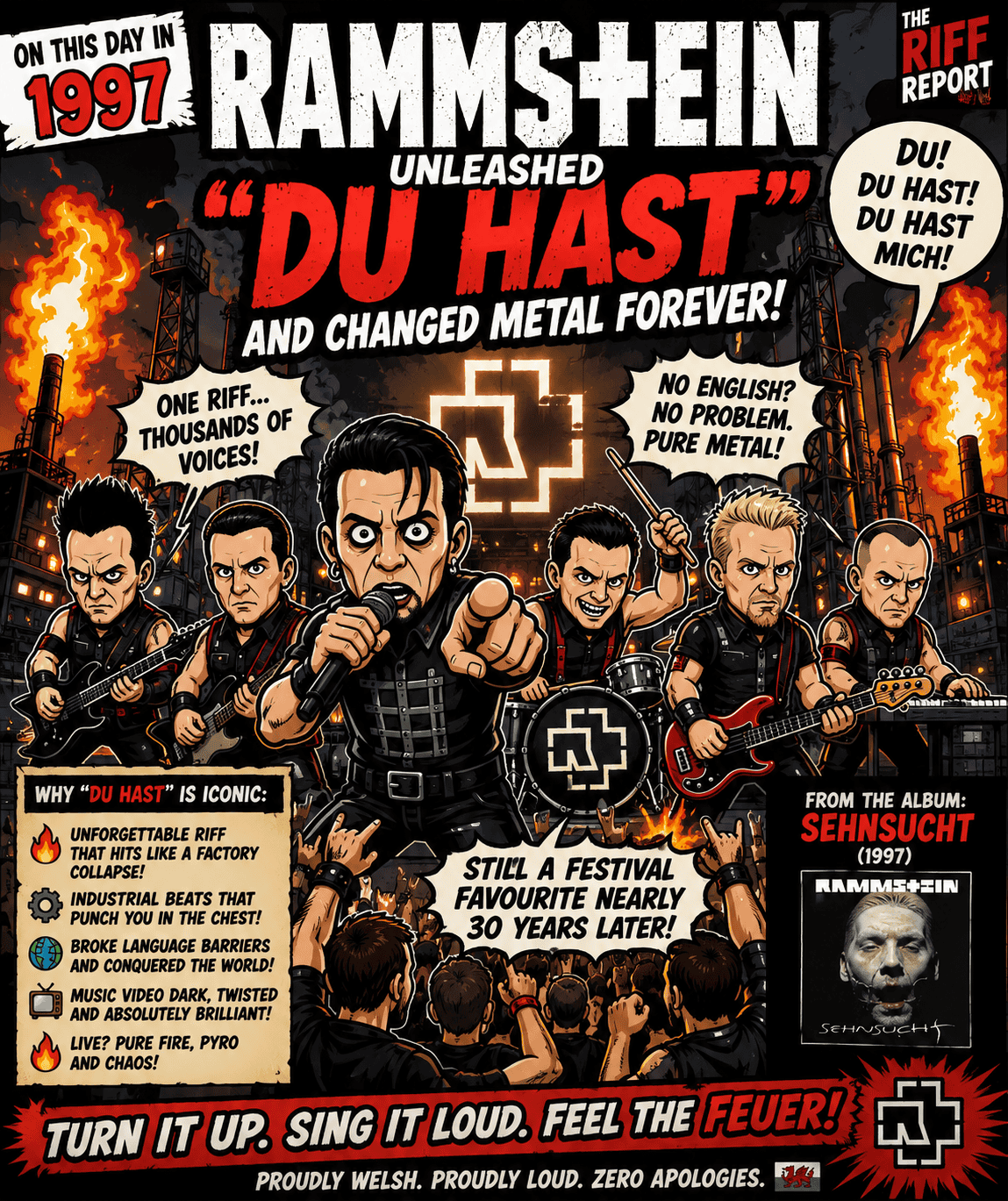
On this day in 1997, German metal titans Rammstein unleashed the song that would become their defining anthem, drag industrial metal into the international spotlight and teach millions of fans to confidently shout German lyrics they only partially understood.
Nearly three decades later, the opening pulse of “Du Hast” can still make an entire arena lose its collective mind.
That, butt, is the power of a proper metal classic. 🤘
🔥 THREE SECONDS IS ALL IT TAKES
You do not need to hear the chorus to recognise “Du Hast.”
You barely need the first riff.
The electronic sequence begins, the tension builds and then those enormous guitars come crashing in like heavy machinery starting up inside a haunted factory.
It is simple.
It is mechanical.
It is ridiculously effective.
Richard Kruspe and Paul Landers deliver a riff built for stadiums, sweaty rock clubs and festival campsites at two in the morning, while Oliver Riedel’s bass and Christoph Schneider’s thunderous drumming give the track its relentless industrial stomp.
Then Till Lindemann arrives.
Deep voice. Cold delivery. Maximum menace.
One word is enough.
“Du…”
And suddenly everybody in the room is involved.
🇩🇪 RAMMSTEIN REFUSED TO COMPROMISE
One of the most remarkable things about Rammstein’s international breakthrough was the band’s refusal to abandon their identity.
They did not suddenly switch entirely to English to make themselves more marketable.
They did not soften the guitars or remove the unsettling imagery.
They remained unmistakably German, unmistakably strange and completely unapologetic.
Rather than changing themselves for the international music industry, Rammstein made the international music industry come to them.
“Du Hast” proved that a song did not need an English-language chorus to become globally recognisable.
The riff translated everything.
The rhythm translated everything.
The fireballs certainly translated everything.
Metal had found another universal language—and it sounded like a German factory being demolished in perfect time.
🧠 WHAT DOES “DU HAST” MEAN?
The title contains a clever piece of German wordplay.
“Du hast” means “you have,” but it sounds like “du hasst,” which means “you hate.”
That double meaning gives the song a darker and more complicated edge.
The lyrics also twist the wording of traditional wedding vows, turning what should be a romantic declaration into something tense, confrontational and deeply unsettling.
This is not exactly the tune you would expect during the first dance at a traditional wedding reception.
Unless the happy couple arrives through a wall of flames while the best man fires a confetti cannon into the buffet.
In that case, crack on. 🔥
📺 A VIDEO THAT MATCHED THE MENACE
The music video for “Du Hast” helped cement Rammstein’s dark and cinematic identity.
Instead of delivering a straightforward performance clip, the band created something that felt like a disturbing European crime film.
There were masks, suspicious characters, violence, fire and enough tension to make viewers wonder whether anybody involved would leave the room alive.
It was unsettling, theatrical and impossible to ignore.
At a time when many rock videos were built around glamorous locations and carefully windswept hair, Rammstein appeared to have filmed theirs in the back room of Europe’s most dangerous nightclub.
And it worked beautifully.
💿 THE SONG THAT OPENED THE DOOR
“Du Hast” appeared on Rammstein’s second studio album, Sehnsucht, a record that took the dark industrial foundations of the band’s debut and turned everything up several notches.
The guitars became bigger.
The choruses became more immediate.
The production became sharper.
The sense that something was about to explode became considerably stronger.
The album also featured tracks including “Engel,” “Sehnsucht,” “Tier,” “Bestrafe Mich,” “Bück Dich” and “Klavier,” helping establish Rammstein as one of the most distinctive bands of the era.
But it was “Du Hast” that became the battering ram.
It smashed through the language barrier and introduced the band to listeners who may never previously have explored German metal.
One minute, fans were casually watching music television.
The next, they were attempting to pronounce Rammstein lyrics while investigating whether owning a flamethrower was legal.
🤘 INDUSTRIAL METAL GOES GLOBAL
Rammstein were not the first band to combine metal with electronic and industrial influences.
However, “Du Hast” helped bring that sound to an enormous new audience.
The song was heavy enough for metal fans, rhythmic enough for alternative club nights and catchy enough to become lodged permanently inside the human brain.
It also introduced many listeners to Neue Deutsche Härte, the German heavy-music movement that fused metal guitars, electronic sounds, precise rhythms and commanding vocals.
For fans outside Germany, Rammstein became the gateway.
They showed that heavy music could be theatrical without becoming silly, electronic without losing its power and cinematic without sacrificing the riffs.
Although, to be fair, things occasionally became very silly too.
That was part of the charm.
🎬 “DU HAST” ENTERS POPULAR CULTURE
The song soon escaped the boundaries of the traditional metal scene.
Its appearance on The Matrix soundtrack was a particularly perfect match.
The film’s leather-coated, industrial and futuristic atmosphere fitted Rammstein’s music like a suspiciously tight black glove.
From there, “Du Hast” continued appearing across films, television, games, sporting events, club nights and metal compilations.
Even people who could not name another Rammstein song often recognised it immediately.
They might not have known which album it came from.
They might not have understood the lyrics.
But when that opening sequence started, they knew things were about to get heavy.
🔥 LIVE, IT BECAME AN ABSOLUTE MONSTER
The studio recording of “Du Hast” is enormous.
The live version feels like a controlled military exercise conducted entirely with guitars, chanting and fire.
Rammstein have spent decades building one of the most spectacular live productions in music.
Their concerts are filled with towering flames, enormous structures, dark humour, theatrical violence and pyrotechnics capable of warming fans several streets away.
When “Du Hast” arrives in the set, thousands of voices immediately answer Till Lindemann’s vocal commands.
The riff shakes the venue.
The stage erupts.
Everybody starts shouting along with maximum confidence, regardless of whether their German pronunciation would survive five seconds inside a classroom.
Nobody cares.
There are flames shooting into the sky.
This is not the moment for a language test.
🏟️ FROM CLUBS TO STADIUMS
“Du Hast” played an enormous role in Rammstein’s transformation from an exciting German industrial band into a global stadium-filling phenomenon.
The band would eventually become capable of building their own touring environments, bringing gigantic stages into cities and turning football grounds into blazing metallic fortresses.
Yet despite the scale of everything that followed, “Du Hast” never became overshadowed.
It remained the song people waited for.
The song that united casual listeners and die-hard fans.
The song that could turn a packed stadium into one enormous shouting choir.
Plenty of bands spend their entire careers searching for one track with that level of impact.
Rammstein created theirs early—and then spent decades finding increasingly bonkers ways of setting it on fire.
⏳ WHY IT STILL SOUNDS MASSIVE
Many songs from the late 1990s are tied completely to the era in which they were created.
You hear them and are instantly transported back to baggy jeans, music television and arguments about who had scratched the family CD.
“Du Hast” still carries that nostalgia, but it does not feel trapped by it.
The production remains powerful.
The electronic pulse still sounds menacing.
The guitar riff still feels enormous.
The vocal performance remains unlike anything else in mainstream metal.
Most importantly, the song still works on younger listeners discovering Rammstein for the first time.
A teenager hearing it today can experience the same moment of confusion, excitement and mild fear that listeners experienced in 1997.
That is how a song becomes immortal.
🍺 A ROCK-CLUB GUARANTEE
There are certain songs a rock DJ can play when the dance floor needs rescuing.
“Du Hast” is one of them.
The moment that introduction begins, pints are raised, horns appear in the air and somebody near the back suddenly believes they are fluent in German.
It works in clubs.
It works at festivals.
It works at house parties.
It probably works in Greggs, although setting off pyrotechnics near the sausage rolls may be frowned upon.
From generations of metal fans to curious newcomers, the reaction remains the same.
The riff hits.
The heads begin moving.
The shouting starts.
Job done.
🖤 MORE THAN A NOSTALGIA TRACK
It would be easy to treat “Du Hast” as a brilliant relic from the golden age of late-1990s alternative metal.
But its continued popularity goes far beyond nostalgia.
New fans keep finding it.
New guitarists keep learning the riff.
New audiences keep witnessing the live spectacle.
The song has become part of heavy-metal culture itself—a track passed from one generation of fans to the next like an extremely loud and mildly dangerous family heirloom.
That lasting influence is what separates a successful single from a genuine landmark.
“Du Hast” was not merely popular.
It changed expectations.
It showed how far a non-English-language metal song could travel, helped push industrial sounds into the mainstream and gave Rammstein the platform from which they would build one of the biggest live reputations on Earth.
🎸 THE RIFF REPORT VERDICT
Rammstein did not simply release another metal song in 1997.
They released a global warning siren.
“Du Hast” broke through language barriers, introduced millions of listeners to German industrial metal and helped transform six musicians from Berlin into one of the most recognisable bands on the planet.
Nearly three decades later, nothing about it feels small.
The riff still crushes.
The chorus still demands an answer.
The live performance still threatens to remove your eyebrows.
And the opening seconds can still turn any rock club, festival field or unsuspecting family barbecue into a temporary Rammstein concert.
So turn it up loud, warn the neighbours and prepare your finest attempt at German pronunciation.
“Du…”
You know exactly what happens next. 🤘🔥
💬 WHAT IS YOUR FIRST MEMORY OF “DU HAST”?
Did you discover it through music television, The Matrix, a rock club, a festival campsite or one of Rammstein’s spectacular live shows?
Let us know and join the noise with The Riff Report Blog.
Proudly Welsh. Proudly Loud. Zero Apologies. 🐉🤘🔥