
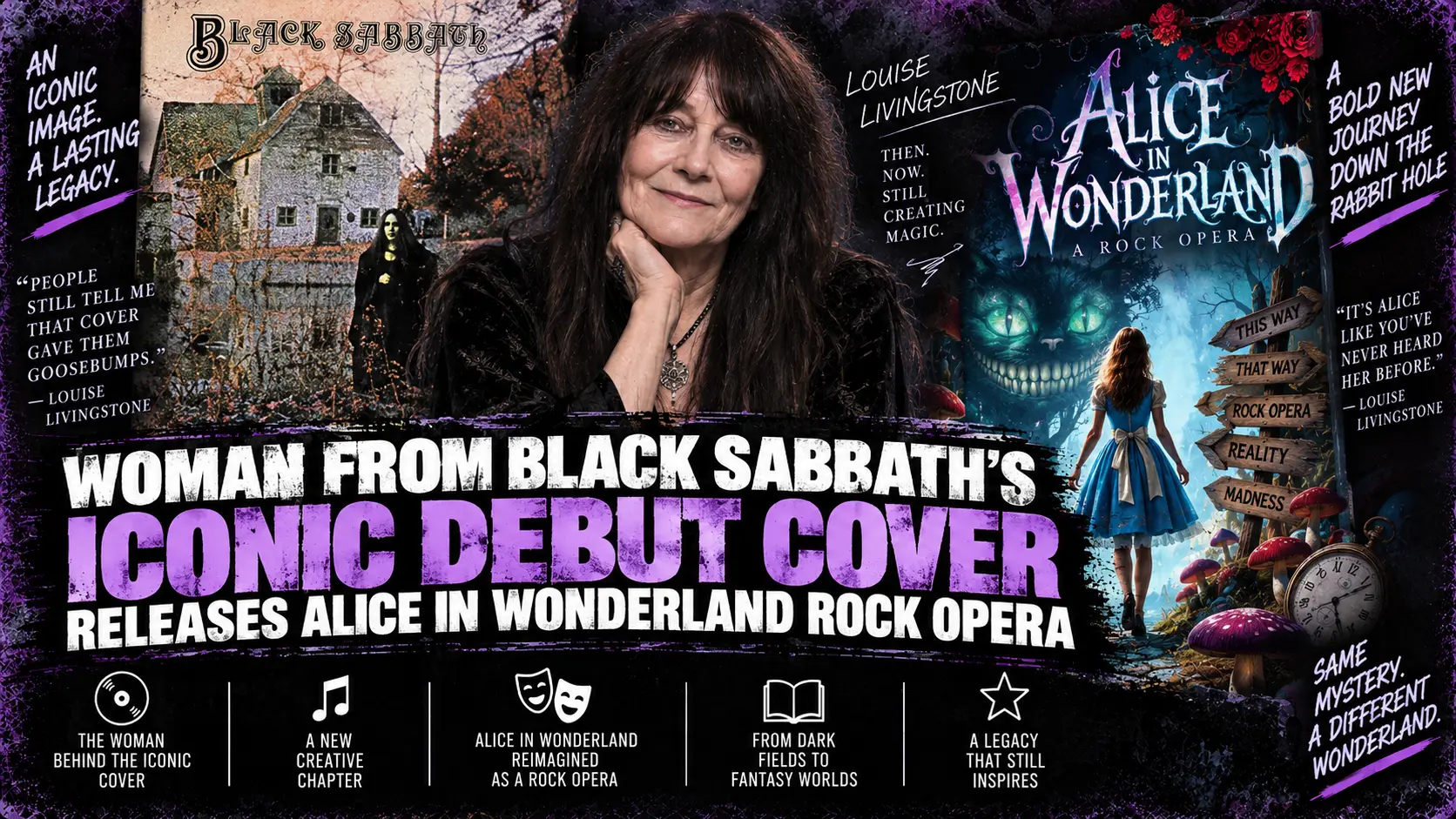
Louisa Livingstone — the mysterious woman immortalised on the cover of Black Sabbath’s legendary 1970 debut album — has returned with a psychedelic rock opera inspired by Alice In Wonderland, artificial intelligence and the increasingly bizarre world of 2026.
Now there’s a sentence we didn’t expect to be writing today.
The ghostly figure staring out from one of the most famous album covers in heavy metal history has gone from mysterious rock folklore to creating a wonderfully strange musical universe of her own.
Louisa Livingstone, who appeared on the sleeve of Black Sabbath’s self-titled debut album, has released a five-track project titled Alice under her musical name Indreba.
And rather fittingly for someone permanently associated with one of rock’s eeriest images, this isn’t exactly straightforward pop music.
It’s being presented as a psychedelic rock opera inspired by Lewis Carroll’s Alice In Wonderland stories, with Alice returning to navigate the peculiar landscape of the modern internet and artificial intelligence.
Because apparently Wonderland wasn’t weird enough already.
🖤 The Woman Who Haunted Heavy Metal
Even if you didn’t know Louisa Livingstone’s name, there’s a very good chance you know her face.
Or, more accurately, her deeply unsettling silhouette.
When Black Sabbath released their self-titled debut album in 1970, the record arrived wrapped in artwork every bit as sinister as the music inside.
Standing outside Mapledurham Watermill in Oxfordshire was a mysterious woman dressed in black, staring towards the camera through an eerie landscape.
No name.
No explanation.
Just this spectral figure who looked like she knew something you definitely didn’t want to know.
Combined with the opening thunderstorm, tolling bell and Tony Iommi’s doom-laden riff on Black Sabbath, the artwork helped create one of the most important introductions in heavy metal history.
For decades, fans wondered who the mysterious woman actually was.
👻 The Mystery Was Finally Solved
It wasn’t until 2020, around 50 years after the album appeared, that Livingstone’s identity became widely known.
She had been only 18 years old when photographer Keith Macmillan captured the image that would eventually become one of the defining pieces of artwork in rock history.
Imagine turning up for a modelling job as a teenager and accidentally becoming the face of heavy metal darkness for the next half-century.
Not bad for the CV.
The photograph became inseparable from Black Sabbath’s debut and helped establish an ominous visual identity around a band whose music was already rewriting the rules of rock.
And remarkably, Livingstone had another creative life developing away from that famous photograph.
🎶 Meet Indreba
Livingstone creates music under the name Indreba, derived from Incredible Dream Band.
Earlier in 2026 she leaned directly into her place in Sabbath history with two songs connected to that legendary album cover.
Witch Woman referenced the supernatural image that fans had associated with her for decades, while The Woman By The Mill looked back towards the location where the photograph was taken.
For anyone fascinated by the mythology surrounding Black Sabbath’s first album, those songs were already a wonderfully unusual continuation of the story.
But now she’s taken things somewhere considerably more ambitious.
Down the rabbit hole, you might say.
🐇 Welcome To ‘Alice’
Livingstone’s latest project, Alice, consists of five interconnected tracks designed to be experienced as one continuous story.
Drawing inspiration from Lewis Carroll’s Alice books, the rock opera imagines Alice stepping into the world of 2026.
And frankly, after spending five minutes online in 2026, the Mad Hatter probably looks remarkably well-adjusted.
The project explores ideas surrounding the internet, technology, consciousness and artificial intelligence, all wrapped inside a psychedelic musical journey.
Rather than simply borrowing Alice In Wonderland imagery because it looks cool on a poster, Livingstone has built the project around Alice as a character trying to understand a modern world every bit as surreal as Wonderland itself.
Which actually feels rather appropriate.
🤖 Alice Meets Artificial Intelligence
Artificial intelligence plays an important role in the ideas behind the record.
Livingstone has spoken about changing her own attitude towards AI, moving from scepticism towards viewing it as another creative tool.
And that relationship between creativity and technology sits neatly inside the Alice concept.
The internet can already feel like falling down a rabbit hole.
One minute you’re checking the weather.
Forty minutes later you’re watching somebody restore a Victorian toaster while an algorithm desperately attempts to sell you tactical trousers.
Absolute Wonderland behaviour.
By placing Alice inside the digital age, the project taps into questions about technology, reality and consciousness without losing the bizarre theatrical spirit associated with Carroll’s original stories.
🧠 A Proper Psychedelic Trip
Livingstone has described the five tracks as forming a sequential story filled with musical changes, with the lyrics playing a major role throughout the experience.
That makes Alice less like a conventional collection of individual singles and more like the kind of album where you’re encouraged to sit down and experience the whole thing.
Remember doing that?
Headphones on.
Phone somewhere else.
Album from start to finish.
Radical stuff.
The rock-opera format naturally gives Livingstone plenty of room for theatricality, psychedelic textures and unexpected shifts as Alice explores her newly imagined Wonderland.
🔥 From Sabbath To Wonderland
There’s also something wonderfully circular about Livingstone’s story.
More than half a century ago, she became part of an album that helped change the course of rock music.
Black Sabbath’s debut wasn’t simply another heavy record.
Alongside its follow-up Paranoid, it helped provide the foundations upon which generations of doom, metal and heavy rock would be built.
Tony Iommi’s riffs sounded darker.
Ozzy Osbourne’s vocals sounded haunted.
Geezer Butler’s lyrics explored horror, war, fear and the supernatural.
Bill Ward sounded like he was trying to demolish the studio from behind his drum kit.
And then there was that cover.
Livingstone standing in black outside the watermill somehow looked exactly like the music sounded.
Cold.
Strange.
Unsettling.
Heavy.
🎸 One Of Rock’s Greatest Album Covers
Album artwork has changed enormously since 1970.
These days, plenty of people first encounter an album cover as a tiny square on a phone screen.
Back then, artwork was part of the ceremony.
You bought the record.
You held it.
Studied it.
Read everything.
And occasionally stared at it while wondering whether the creepy woman on the front was actually going to climb out and curse your family.
The Black Sabbath sleeve belongs firmly in that latter category.
Its atmosphere became almost as legendary as the album itself.
More than 50 years later, people are still talking about it.
And now the woman standing at the centre of that image is creating musical mythology of her own.
That’s genuinely brilliant.
🖤 From Mysterious Model To Musician
For years, Livingstone existed within the Black Sabbath story almost entirely as an unknown figure.
Fans created theories.
Rumours circulated.
The image took on a mythology independent of the real person standing in it.
Discovering that the woman behind the photograph had her own musical and creative interests made the story considerably more fascinating.
And with Alice, she’s no longer simply revisiting her connection to Sabbath.
She’s building something completely separate.
That might be the best part of the whole thing.
🤘 THE RIFF REPORT VERDICT
Heavy metal history is full of wonderfully strange stories.
But the mysterious woman from Black Sabbath’s debut album cover resurfacing decades later to create a psychedelic Alice In Wonderland rock opera about the internet and artificial intelligence?
That’s elite-level weird.
And we mean that entirely as a compliment.
Louisa Livingstone became part of heavy metal history before the genre had even properly worked out what it was.
One photograph.
One freezing morning beside an Oxfordshire watermill.
One album that changed everything.
More than five decades later, she’s still creating.
Only now she’s swapped Sabbath’s misty mill for Wonderland.
Follow the white rabbit, crank the speakers and mind the witch by the watermill. Things are getting wonderfully strange again. 🖤🐇🤘