
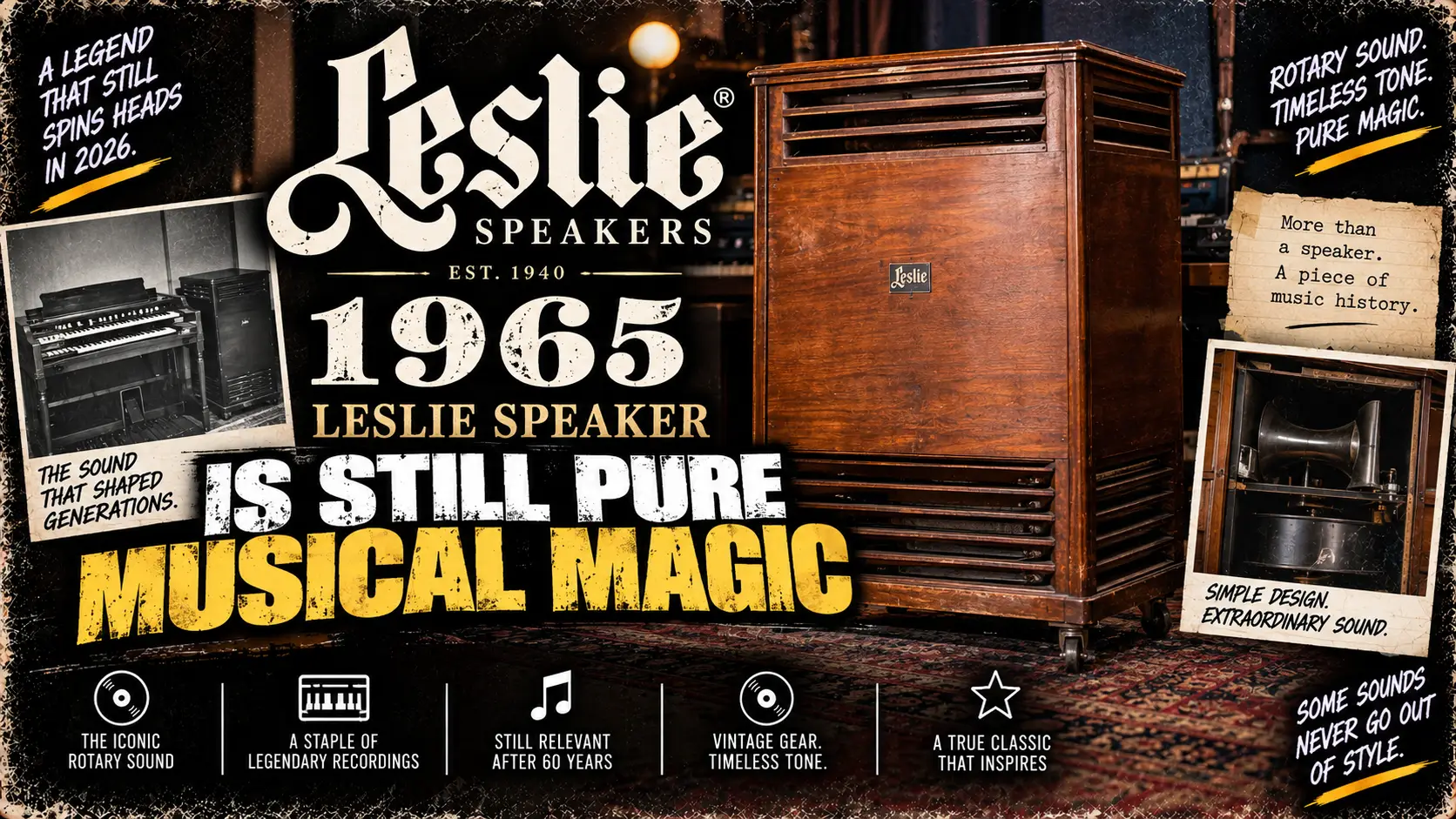
A vintage Leslie speaker dating back to 1965 has been grabbing attention online — and one look inside the cabinet is enough to remind you just how brilliantly bonkers old-school music technology could be.
There’s vintage gear.
And then there’s proper vintage gear.
The sort of kit that doesn’t need a touchscreen, Bluetooth connection or six firmware updates before it’ll make a noise.
A beautifully preserved Leslie speaker from 1965 has been doing the rounds online, with footage showing the rotating mechanism inside the cabinet in full motion.
And honestly?
It’s hypnotic.
Not just because of the sound, but because of the engineering behind it.
🔄 A Speaker That Physically Moves The Sound
The Leslie speaker’s magic comes from movement.
Rather than simply firing sound straight at you from a fixed speaker, traditional Leslie cabinets use rotating components to create that unmistakable swirling effect.
Inside the cabinet, sound is directed through moving parts that rotate at different speeds.
That physical movement changes the way the sound reaches your ears.
The result is a rich, pulsing, three-dimensional effect that seems to swirl around the room.
It’s warm.
It’s weird.
It’s instantly recognisable.
And once you’ve heard a proper Leslie in action, you understand why musicians have spent decades trying to recreate it.
🎶 Why Does It Sound So Good?
The rotating parts create subtle changes in pitch, volume and tone as they move.
That’s what gives the Leslie its famous wobble and shimmer.
At slower speeds, the effect feels dreamy and atmospheric.
At faster speeds, it becomes more dramatic, almost like the sound itself is spinning around your head.
It’s one of those sounds that feels alive.
And that’s the key.
Modern effects can imitate it brilliantly, but the original Leslie effect comes from actual physical movement inside a wooden cabinet.
No digital trickery.
Just motors, speakers and clever acoustics.
🎹 The Hammond Organ Connection
Leslie speakers became closely associated with Hammond organs, and together they created one of the most iconic keyboard sounds in music history.
That combination became a huge part of gospel, soul, blues, jazz, psychedelia, progressive rock and classic rock.
And once rock musicians discovered what happened when you cranked a Hammond through a Leslie, things got very loud very quickly.
The sound could be smooth and soulful one minute…
…then absolutely monstrous the next.
For bands that wanted atmosphere, drama and a massive wall of sound, the Leslie was a gift from the gear gods.
🔥 Rock Music Fell In Love With The Leslie
The Leslie sound became a familiar part of rock music throughout the late ’60s and ’70s.
Keyboard players used it to give Hammond organs that huge, rolling texture that could fill an entire room.
But musicians being musicians, it didn’t stop there.
Guitars were sent through Leslie-style effects.
Vocals were experimented with.
Studios started using rotating speaker sounds in all sorts of wonderfully strange ways.
Because if rock history has taught us anything, it’s that the answer to:
“Should we run this through that weird spinning speaker?”
is nearly always:
“Absolutely.”
🛠️ The Engineering Is Glorious
What makes the old Leslie design so satisfying is how mechanical it is.
You can physically see the system working.
Motors spin the internal components.
Sound is thrown around the cabinet.
The effect changes depending on the speed.
It’s like watching a machine breathe.
And there’s something wonderfully refreshing about that.
No menu diving.
No presets.
No app.
Just a box full of moving parts creating one of the most famous sounds in music.
Beautiful.
🕰️ Built In 1965 And Still Going Strong
This particular Leslie reportedly dates from 1965.
That means it has survived around six decades of changing music technology.
Think about everything that has happened since.
Multitrack recording exploded.
Synthesizers took over.
Digital recording arrived.
Pedals got smarter.
Plugins became ridiculously powerful.
Amp modelling became frighteningly convincing.
And yet people are still obsessed with the sound of a spinning speaker cabinet built in the mid-1960s.
That says a lot.
Some sounds simply don’t get old.
🎛️ Modern Gear Can Copy It — But The Original Is Special
To be fair, modern Leslie simulators are excellent.
Effects pedals can get remarkably close.
Digital organs can recreate the movement.
Studio plugins can dial in all sorts of rotary-speaker tones.
For most musicians, that’s far more practical than dragging a massive wooden cabinet around.
But there’s still something different about the real thing.
The tiny mechanical variations.
The way the sound interacts with the room.
The physical movement.
That slight unpredictability.
All of it gives the original Leslie a character that feels difficult to fully bottle.
🤘 Why Rock Fans Should Care
You don’t need to be a keyboard player to appreciate this thing.
The Leslie speaker helped shape the sound of countless classic records.
That swirling effect is woven into decades of rock, soul, blues and progressive music.
And once you know what you’re listening for, you start spotting it everywhere.
That’s the dangerous bit.
You watch one video of a vintage Leslie.
Then another.
Then suddenly you’re browsing old Hammond organs at 2am and trying to work out whether your living room technically needs a sofa.
It does not.
The Leslie wins.
🖤 Old Gear Has Soul
There’s a reason vintage music gear still fascinates people.
It isn’t always about whether it sounds objectively “better”.
It’s about personality.
Old gear has quirks.
Noise.
Imperfections.
Mechanical movement.
Things that modern equipment often tries very hard to remove.
And sometimes those imperfections are exactly what make music feel human.
The Leslie speaker is a perfect example.
Its sound is built around movement.
It wobbles.
It breathes.
It shifts.
It never feels completely static.
And that’s why it still sounds so bloody good.
🤘 THE RIFF REPORT VERDICT
A working 1965 Leslie speaker is more than just an old cabinet.
It’s a piece of music history.
It represents a time when engineers solved problems with motors, wood, rotating horns and pure mechanical ingenuity.
And nearly 60 years later, the result still sounds magical.
Modern technology can copy it.
Musicians can simulate it.
Plugins can model it.
But the original Leslie just sits there, spinning away and reminding everyone who did it first.
Vintage gear doesn’t get much cooler than this.
Turn it up.
Let it spin.
And enjoy the sound of 1965 still showing the modern world how it’s done. 🎹🔥🤘