The Forgotten Festival of Rock’s Golden Era Gets Its Second Verse 🎸🔥
Mention the great British rock festivals of the late 1960s and the usual names come thundering out of the speakers.
Woodstock.
The Isle of Wight.
Hyde Park.
Bath.
Perhaps even the early foundations of what would eventually become Reading Festival.
But tucked away in the Sussex countryside sits another location with an extraordinary rock ’n’ roll history — one that deserves to be shouted about far louder.
Plumpton Racecourse.
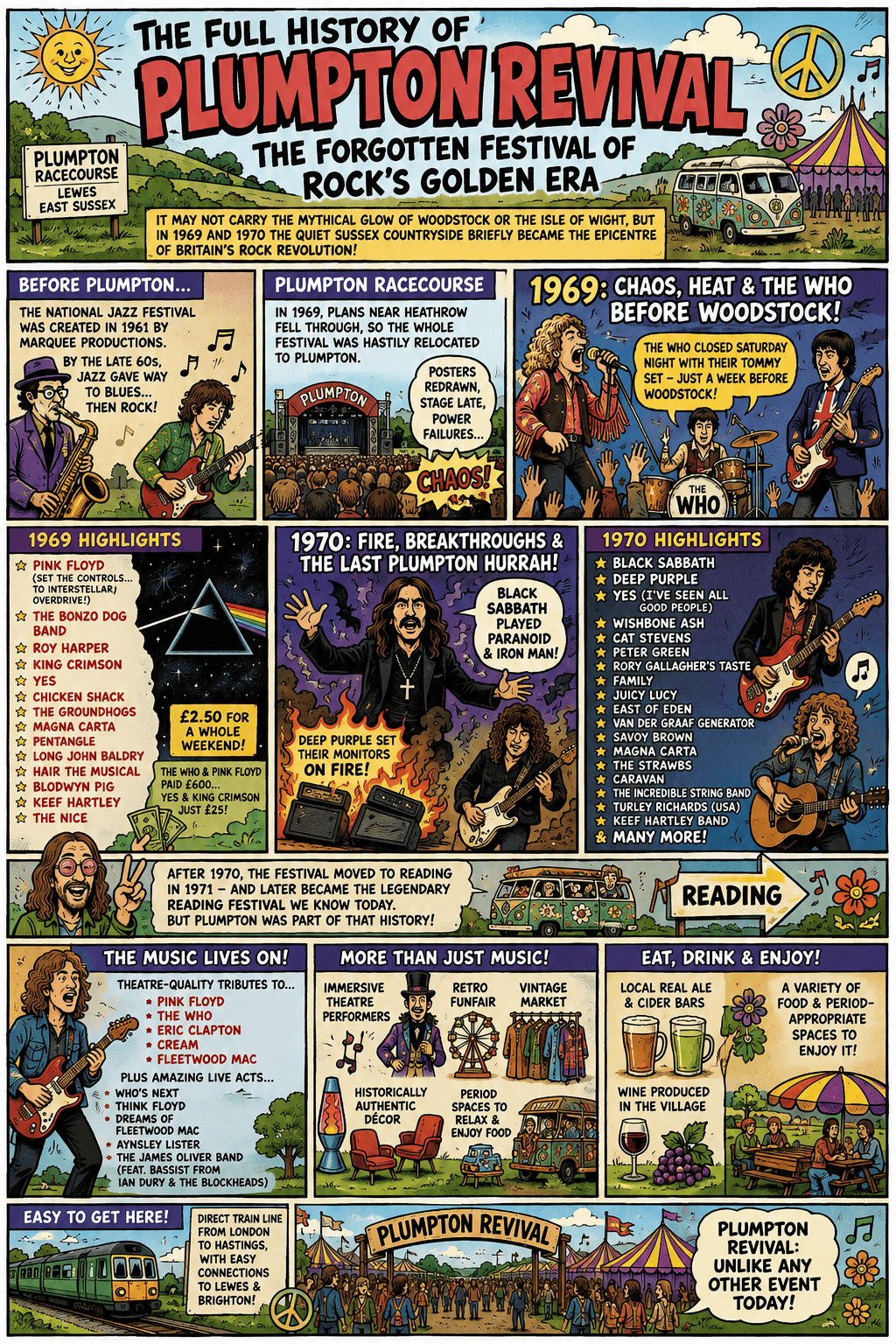
For two glorious, chaotic and hugely important summers in 1969 and 1970, this peaceful corner of East Sussex became the temporary centre of Britain’s rapidly changing music scene.
Pink Floyd played there.
The Who played there just days before Woodstock.
King Crimson and Yes appeared while they were still carving out their reputations.
Black Sabbath performed on the brink of changing heavy music forever.
Deep Purple arrived armed with In Rock and reportedly managed to set their stage monitors ablaze.
Peter Green, Cat Stevens, Rory Gallagher’s Taste, Pentangle, Family, Caravan, The Groundhogs, Wishbone Ash and countless others all passed through Plumpton before many of them became household names.
It may not carry the mythical glow of Woodstock or the Isle of Wight, but for two unforgettable weekends, Plumpton Racecourse hosted a staggering snapshot of rock music transforming in real time.
Now, more than half a century later, Plumpton Revival is preparing to bring that spirit back to the racecourse.
This is not simply another retro music weekend.
This is unfinished business.
This is the forgotten festival of Britain’s golden rock era finally getting its second verse.
🎷 BEFORE PLUMPTON: THE BIRTH OF A BRITISH FESTIVAL INSTITUTION
The story begins long before the first amplifier crackled into life at Plumpton.
The National Jazz Festival was created in 1961 by Marquee Club founder Harold Pendleton and Marquee Productions.
Originally staged at Richmond Athletic Ground, the event began as a celebration of British and international jazz. However, popular music was changing rapidly throughout the decade.
Blues was creeping into the programme.
Rhythm and blues followed.
Electric guitars became louder.
Young bands inspired by American blues musicians began developing a distinctly British sound, filling clubs with distortion, experimentation and enough hair to block a venue fire exit.
By the middle of the decade, the festival had become the National Jazz and Blues Festival, reflecting the changing tastes of its audience.
Then rock music exploded.
Cream, Fleetwood Mac, The Yardbirds, Jeff Beck and other electric pioneers began pulling the festival away from its traditional jazz roots. The music was becoming heavier, stranger and increasingly difficult to contain beneath the original title.
By 1969, the event had evolved into the National Jazz, Blues & Pop Festival.
The word “pop” may sound slightly polite considering the volume of noise that was about to descend upon Sussex, but the festival was now sitting directly in the path of Britain’s rock revolution.
And then the organisers needed somewhere new to hold it.
Enter Plumpton.
🌄 PLUMPTON RACECOURSE BECOMES ROCK ’N’ ROLL COUNTRY
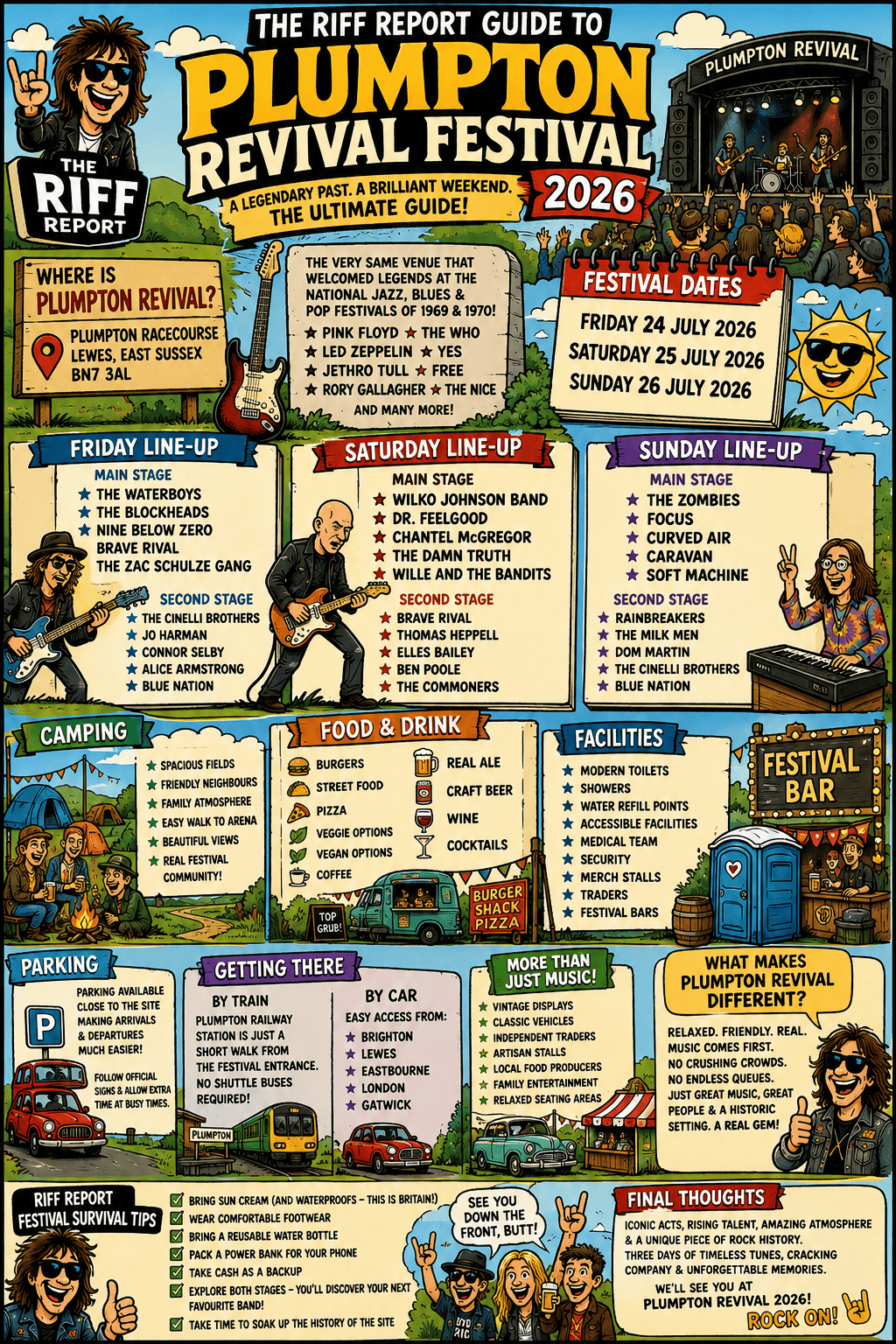
Plumpton Racecourse sits close to Lewes, surrounded by the rolling countryside of East Sussex.
It is hardly the first location you might imagine when picturing one of Britain’s most important early rock gatherings.
That is part of its magic.
The familiar sounds of racing, village life and the Sussex countryside were suddenly replaced by amplifiers, generators, packed tents, psychedelic clothing and thousands of young music fans.
Plans to hold the 1969 festival near Heathrow had fallen through, forcing organisers to relocate the entire event to Plumpton at relatively short notice.
Festival posters had to be altered.
Stages and equipment had to be transported.
Infrastructure had to be assembled rapidly.
Thousands of fans were already heading towards the festival.
What could possibly go wrong?
Quite a lot, as it turned out.
But this was 1969.
Chaos was practically part of the ticket price.
☀️ 1969: CHAOS, HEAT AND THE WHO BEFORE WOODSTOCK
The Ninth National Jazz, Blues & Pop Festival took place at Plumpton Racecourse from Friday 8 August to Sunday 10 August 1969.
It arrived during one of the most significant years in modern music history.
The Beatles were completing Abbey Road.
Led Zeppelin had released their debut album.
The Rolling Stones were rebuilding following the death of Brian Jones.
David Bowie released “Space Oddity”.
Woodstock was just days away.
And in a field in Sussex, some of the greatest bands of their generation were assembling for a weekend that history has somehow allowed to slip beneath the radar.
⚡ FRIDAY NIGHT: POWER CUTS AND PINK FLOYD AFTER MIDNIGHT
The opening evening did not exactly run like a professionally organised stadium production.
The stage was reportedly late being prepared, technical problems caused lengthy delays and power failures repeatedly disrupted the music.
Soft Machine’s performance was cut short.
Equipment struggled.
The schedule began slipping faster than a festival-goer wearing trainers in a muddy campsite.
Pink Floyd were supposed to headline Friday evening, but by the time the band finally appeared, Friday had effectively become Saturday.
Much of the audience had already settled down beneath the hot, airless night sky.
Those who remained awake were rewarded with something extraordinary.
Pink Floyd opened with “Set the Controls for the Heart of the Sun”, creating an eerie, hypnotic atmosphere across the racecourse.
Their performance reportedly included experimental sound effects, sprawling instrumental passages and the sort of psychedelic exploration that had already established them as one of Britain’s most adventurous groups.
The set concluded with an extended version of “Interstellar Overdrive”.
Imagine lying half-awake in a Sussex field during the early hours of the morning while Pink Floyd unleashed waves of cosmic noise through the darkness.
No smartphones.
No giant LED screens.
No carefully scheduled social-media reveal.
Just a band, a crowd and a sound that seemed to arrive from another planet.
That is proper festival magic, butt.
🎪 SATURDAY AFTERNOON: HUMOUR, FOLK AND GLORIOUS WEIRDNESS
Saturday afternoon brought a wonderfully strange mixture of acoustic music, jazz influences, emerging rock and British eccentricity.
The Bonzo Dog Doo-Dah Band delivered their unique combination of comedy, surrealism and musical chaos.
Roy Harper brought his unconventional acoustic songwriting and unpredictable stage presence.
The Strawbs appeared during the period when British folk music was beginning to merge with progressive and psychedelic influences.
Peter Hammill, who would become best known as the frontman of Van Der Graaf Generator, was also among the afternoon performers.
This was a festival before rigid genre boundaries had fully taken control.
Folk musicians could share a bill with psychedelic experimentalists.
Jazz players could appear beside blues-rock bands.
Comedy performers could wander into a programme containing some of the heaviest groups in Britain.
Nobody seemed concerned about whether it fitted neatly into an algorithm.
They simply plugged in and played.
Lush.
🔥 SATURDAY NIGHT: THE FUTURE OF ROCK ARRIVES
As evening fell, Plumpton’s 1969 festival shifted into another gear.
The Saturday night programme included a remarkable collection of musicians who would help shape progressive rock, hard rock and British blues throughout the following decade.
King Crimson appeared during the same year that they released their monumental debut album, In the Court of the Crimson King.
Yes were still at the beginning of their journey, long before enormous stage productions and sprawling progressive-rock epics turned them into international stars.
The bill also featured Chicken Shack, The Groundhogs, Aynsley Dunbar, Fat Mattress, The Idle Race and others.
Looking back, the line-up reads like somebody found a cheat code for British rock history.
Yet some of these future giants were reportedly paid astonishingly small fees.
While headline artists such as Pink Floyd and The Who were said to have received around £600, emerging bands including Yes and King Crimson reportedly earned approximately £25.
Twenty-five quid!
You would struggle to buy a festival burger, two pints and a suspiciously expensive portion of loaded chips for that today.
But in 1969, these bands were still building their names.
The legends had not yet become legends.
Plumpton caught them at the precise moment before history fully understood what it was watching.
🎸 THE WHO: TOMMY COMES TO SUSSEX
Saturday night was brought to a thunderous close by The Who.
The band arrived with Tommy, the ambitious rock opera that had been released earlier that year and transformed them from explosive mod heroes into one of the most important rock bands on the planet.
Their Plumpton appearance carried an additional layer of historical significance.
Just one week later, The Who would perform at Woodstock.
The set they brought to Sussex was driven by the same Tommy-era energy that would soon be captured in one of the most famous festival performances of all time.
But Plumpton offered something different.
There was no enormous American crowd stretching endlessly towards the horizon.
No mythology had yet been written around the moment.
This was The Who raw, loud and relatively close to home.
Pete Townshend’s guitar crashed across the racecourse.
Keith Moon attacked the drums like they had personally insulted him.
John Entwistle held everything together with impossible calm.
Roger Daltrey commanded the stage as Tommy came roaring to life.
The audience at Plumpton witnessed a world-class rock band preparing to step directly into history.
Not bad for a Saturday night in Sussex.
🌿 SUNDAY: FOLK, BLUES, THEATRE AND PROGRESSIVE FIREWORKS
After Saturday’s heavy artillery, Sunday’s programme offered a more pastoral and eclectic atmosphere.
Magna Carta delivered folk harmonies.
Pentangle blended folk, jazz, blues and traditional music with breathtaking musicianship.
Long John Baldry represented Britain’s deeply rooted blues scene, while experimental composer and performer Ron Geesin added another streak of glorious unpredictability.
The London cast of Hair, featuring performers including Marsha Hunt and Paul Nicholas, brought the counterculture directly onto the festival stage.
This was more than entertainment.
Hair had become a theatrical symbol of the era’s changing attitudes towards war, authority, identity, sexuality and youth culture.
Its appearance at Plumpton connected the festival to the wider social upheaval taking place beyond the racecourse gates.
But the guitars were far from finished.
Blodwyn Pig, featuring former Jethro Tull guitarist Mick Abrahams, delivered muscular British blues-rock.
Keef Hartley Band, who would also appear at Woodstock, added another direct connection between Plumpton and the legendary American gathering.
Family brought their distinctive, emotionally charged progressive rock.
Then came The Nice, led by keyboard firebrand Keith Emerson.
The band reportedly previewed material from its forthcoming album, including an extended reinterpretation of Bob Dylan’s “She Belongs to Me”.
It was bold, dramatic and unmistakably progressive — a glimpse of the ambitious musical direction that would soon dominate British rock.
After three days of heat, electrical problems, delayed performances and unforgettable music, Plumpton’s first chapter was complete.
For the princely sum of approximately £2.50, audiences had witnessed an extraordinary weekend of artists who would define the next decade.
And they had absolutely no idea what was coming the following year.
🔥 1970: HEAVIER, LOUDER AND READY TO EXPLODE
The Tenth National Jazz, Blues & Pop Festival returned to Plumpton in August 1970.
It would be the final edition held at the racecourse.
But what a farewell it delivered.
By the summer of 1970, British rock had become considerably heavier.
Led Zeppelin were conquering venues around the world.
Deep Purple had released In Rock.
Black Sabbath had issued their terrifying self-titled debut album and were preparing to release the record that would make them immortal.
Progressive rock was expanding.
Folk musicians were embracing electricity.
The blues boom was mutating into hard rock.
Everything was getting louder.
Plumpton’s 1970 line-up captured this musical transformation at precisely the right moment.
⚔️ BLACK SABBATH: HEAVY METAL BEFORE THE WORLD KNEW WHAT HIT IT
Among the most historically important performances of the weekend came from four musicians from Birmingham.
Ozzy Osbourne.
Tony Iommi.
Geezer Butler.
Bill Ward.
Together, they were Black Sabbath.
Their debut album had been released earlier in 1970, introducing listeners to ominous riffs, unsettling lyrics and a crushingly heavy atmosphere unlike almost anything heard before.
But the band’s true global breakthrough was still approaching.
At Plumpton, Black Sabbath reportedly performed songs including “Paranoid” and “Iron Man” shortly before those tracks became cornerstones of heavy metal.
Imagine hearing the opening riff of “Iron Man” before decades of air guitar, denim jackets, arena tours and metal history had attached themselves to it.
Imagine hearing “Paranoid” while it was still simply a new song from a young Birmingham band.
The audience was not watching a comfortable heritage act performing familiar classics.
They were witnessing the birth of heavy metal in real time.
There are probably people who attended that weekend, watched Sabbath play and casually wandered off afterwards to buy a drink.
Only later would they understand that they had just stood in front of one of the most influential bands ever formed.
That is enough to make any metal fan need a quiet lie down.
💜 DEEP PURPLE: IN ROCK, ON FIRE
If Black Sabbath brought the darkness, Deep Purple brought the flames.
The band had recently released Deep Purple in Rock, the album that established the classic Mark II line-up as one of the most powerful forces in hard rock.
Ian Gillan’s voice could seemingly peel paint from buildings.
Ritchie Blackmore delivered riffs with danger and precision.
Jon Lord’s distorted Hammond organ sounded heavier than many guitarists.
Roger Glover and Ian Paice formed a rhythm section capable of driving the entire racecourse into the ground.
Their Plumpton performance reportedly featured material such as “Speed King”, “Into the Fire”, “Child in Time”, “Hush” and “Mandrake Root”.
Then there was the fire.
Deep Purple reportedly set their stage monitors ablaze, ensuring their appearance would be remembered for more than the music alone.
Because apparently releasing one of the greatest hard-rock albums ever made and playing at ear-melting volume was not dramatic enough.
Days after the festival, “Black Night” entered the British charts and became one of the band’s defining singles.
Once again, Plumpton caught a legendary group just as the door to superstardom was being kicked from its hinges.
🎤 CAT STEVENS: A SONGWRITER FINDS HIS VOICE
The festival was not entirely built around distortion and burning equipment.
Cat Stevens appeared during a crucial period of artistic reinvention.
Having moved away from his earlier pop-star image, Stevens was developing the thoughtful, intimate singer-songwriter sound that would define albums such as Mona Bone Jakon and Tea for the Tillerman.
Songs including “Lady D’Arbanville” and “Father and Son” showed an artist finding a deeper and more personal voice.
Surrounded by heavy rock, blues and progressive experimentation, Cat Stevens offered Plumpton something quieter but no less powerful.
It demonstrated once again that the festival was never restricted to one sound.
Plumpton celebrated an entire musical culture in motion.
🎸 PETER GREEN: BLUES GENIUS AFTER FLEETWOOD MAC
Another particularly poignant appearance came from Peter Green.
Only weeks earlier, Green had dramatically left Fleetwood Mac, the band he had helped create and guide through some of the greatest British blues recordings of the era.
His playing remained beautifully expressive, emotional and instantly recognisable.
For Plumpton’s audience, the performance offered an opportunity to see one of Britain’s finest guitarists at an uncertain and pivotal moment in his life.
Long before Fleetwood Mac became global stadium royalty with a very different line-up and sound, Peter Green had already established the band as a blues powerhouse.
His presence at Plumpton connected the festival directly to one of the most fascinating stories in British rock history.
🥁 RORY GALLAGHER, YES, WISHBONE ASH AND A RIDICULOUSLY DEEP BILL
The strength of Plumpton 1970 was not limited to its biggest names.
The bill was absolutely stacked.
Taste, fronted by the phenomenal Rory Gallagher, brought fierce blues-rock energy and astonishing guitar work.
Yes, now carrying material from Time and a Word, continued their evolution towards the progressive-rock giants they would soon become.
Their Plumpton appearance reportedly included “I’ve Seen All Good People”, another song that would go on to become a defining part of their career.
Wishbone Ash were preparing their debut album and developing the twin-guitar approach that would later influence generations of rock and metal bands.
The festival also welcomed:
- Family
- Juicy Lucy
- East of Eden
- Van Der Graaf Generator
- The Groundhogs
- Savoy Brown
- Caravan
- The Strawbs
- Magna Carta
- The Incredible String Band
- Keef Hartley Band
- Fat Mattress
- Colosseum
- Audience
- Rare Bird
- Fotheringay
That is not a festival line-up.
That is half of your dad’s record collection wandering around a racecourse.
Prog, folk, blues and hard rock all collided across the weekend.
Some bands were already respected.
Others were months away from major breakthroughs.
Several would go on to influence countless musicians who were not even born when the festival took place.
🇺🇸 A RARE INTERNATIONAL VISITOR
Although the festival remained largely British in character, the Sunday programme included American singer-songwriter Turley Richards.
Richards, a blind musician known partly for his interpretations of Bob Dylan songs, brought a rare international element to the weekend.
His appearance added another shade to Plumpton’s broad musical palette, sitting alongside the folk textures of Magna Carta, Caravan, The Strawbs and The Incredible String Band.
The variety was enormous.
You could experience crushing heavy rock, progressive experimentation, intimate songwriting, traditional folk and electric blues without leaving the racecourse.
Modern festival schedulers would need six stages, three apps and a colour-coded spreadsheet to organise it.
Plumpton simply got on with the job.
🏝️ OVERSHADOWED BY THE ISLE OF WIGHT
Part of the reason Plumpton’s 1970 gathering became overlooked was timing.
Later that same month, the enormous Isle of Wight Festival attracted hundreds of thousands of people and a line-up featuring Jimi Hendrix, The Who, The Doors, Joni Mitchell, Miles Davis and Leonard Cohen.
It became one of the defining events of the era.
Some music fans reportedly saved their money and energy for the Isle of Wight, leaving Plumpton as the more intimate choice.
But smaller did not mean less important.
Those who travelled to Sussex received something the larger festival could not necessarily provide: proximity.
Plumpton offered the chance to see future giants before history had placed them behind enormous barriers, security lanes and stadium-sized production.
Black Sabbath were still ascending.
Deep Purple were breaking through.
Wishbone Ash were preparing their first album.
Peter Green had only recently left Fleetwood Mac.
Yes were still developing their identity.
It was personal, unpredictable and unmistakably British.
No mythology.
No corporate village.
No thirty-minute queue to upload a video because the phone signal had collapsed.
Just extraordinary music in a Sussex field.
🚚 THE FESTIVAL MOVES ON — AND READING IS BORN
The 1970 festival proved to be Plumpton’s final chapter in the original story.
The National Jazz, Blues & Pop Festival moved to Reading in 1971.
Over time, it evolved into the festival known today as Reading Festival, later joined by its sister event in Leeds.
Reading and Leeds would become one of Britain’s largest and longest-running music festival institutions.
Its stages have hosted Nirvana, Metallica, Iron Maiden, Rage Against the Machine, Foo Fighters, Guns N’ Roses, Green Day and countless other international stars.
But before Reading became Reading, there was Plumpton.
The racecourse hosted the ninth and tenth festivals in that historic lineage.
That makes Plumpton more than an interesting footnote.
It is an essential part of the Reading Festival family tree.
For two years, Sussex helped carry one of Britain’s most important festivals through the exact period when jazz and blues were transforming into progressive rock, hard rock and heavy metal.
Then the amplifiers disappeared.
The crowds went home.
Plumpton Racecourse returned to racing.
And one of Britain’s greatest festival stories slowly faded from mainstream memory.
Until now.
🎶 PLUMPTON REVIVAL: IT IS TIME FOR THE SECOND VERSE
More than fifty years after The Who, Pink Floyd, Black Sabbath and Deep Purple shook the Sussex countryside, music is returning to Plumpton Racecourse.
Plumpton Revival aims to recapture not only the sounds of the original festivals but also the spirit of the period that produced them.
This is crucial.
The late 1960s were not simply about flared trousers, psychedelic posters and suspiciously large sideburns.
It was a period of enormous cultural change.
Young people challenged established authority.
Music became a vehicle for protest, identity and social experimentation.
Traditional boundaries between genres began collapsing.
Artists treated albums as complete works rather than collections of singles.
Concerts became communal experiences.
Festivals became temporary societies where new ideas, fashions and attitudes could flourish.
Plumpton Revival is aiming to celebrate that atmosphere across two days of live music, theatre, heritage, food, drink and vintage entertainment.
It is not attempting to rebuild 1969 piece by piece.
Nobody needs the original power failures recreated for historical accuracy, thank you very much.
Instead, the event will channel the creative freedom, community and musical adventure that made those weekends so significant.
🎸 THE MUSIC RETURNS TO PLUMPTON
Plumpton Revival will feature theatre-quality tribute performances celebrating artists connected to the original festival era.
The programme pays homage to legendary names including:
- Pink Floyd
- The Who
- Eric Clapton
- Cream
- Fleetwood Mac
The event will also include acts that may not have appeared at the original Plumpton festivals but embody the same musical artistry, atmosphere and adventurous spirit.
Among the featured performers are Who’s Next, bringing the explosive sound and energy of The Who back to the racecourse.
Think Floyd will recreate the atmospheric, ambitious music of Pink Floyd, reconnecting Plumpton with that remarkable late-night performance from 1969.
Dreams of Fleetwood Mac will celebrate the songs and changing eras of one of Britain’s most enduring bands.
The event will also welcome respected contemporary rock and blues musicians currently touring the live circuit.
Aynsley Lister brings world-class guitar playing, powerful songwriting and modern British blues-rock to the Revival.
The James Oliver Band will deliver another burst of high-energy musicianship, touring with a bassist connected to Ian Dury and the Blockheads.
This combination is important.
Plumpton Revival is not simply looking backwards.
It celebrates the music of the past while giving today’s touring artists a stage on which to continue that tradition.
Heritage and living music will stand side by side.
Exactly as they should.
🎭 MORE THAN A COLLECTION OF TRIBUTE BANDS
The Revival is being designed as an immersive experience rather than a straightforward sequence of concerts.
Theatrical performers in historically inspired costumes will move throughout the event, helping transport guests into the atmosphere of the late 1960s and early 1970s.
Historically authentic decoration will transform areas of the racecourse.
A retro funfair will bring another burst of period character.
A vintage market will give visitors the opportunity to browse clothing, collectables, crafts and other suitably groovy treasures.
Expect colour.
Expect characters.
Expect the occasional outfit capable of making Austin Powers look underdressed.
The goal is to create a world visitors can step into, not merely a stage they can stand in front of.
That makes Plumpton Revival unlike the average tribute festival.
It is part concert, part theatrical production, part historical celebration and part enormous reunion for music fans who believe the spirit of the era still has plenty to say.
🍺 LOCAL ALE, CIDER AND WINE FROM THE VILLAGE
A proper festival needs proper refreshments.
Plumpton Revival plans to feature bars serving local real ale and cider, giving the weekend another strong connection to the surrounding community.
Wine produced within the village will also be available.
That is about as local as festival drinking gets unless somebody sets up a brewery behind the drum riser.
A varied selection of food will be offered throughout the event, with period-inspired spaces where guests can sit, eat and soak up the atmosphere.
The focus on local produce helps ensure the Revival remains connected to Plumpton rather than simply being an event placed temporarily inside it.
This is the village’s history.
This is the racecourse’s story.
Local businesses, producers and residents deserve to share in its return.
🚂 A FESTIVAL WITH A VERY HANDY TRAIN CONNECTION
Plumpton Revival is also unusually accessible for a countryside event.
Plumpton sits on a direct railway line connecting London and Hastings, with convenient local connections to Lewes and Brighton.
That means visitors can experience the atmosphere of a rural festival without necessarily embarking on an expedition involving three motorways, an overloaded car and a sat-nav repeatedly shouting “recalculating”.
For fans travelling from London, the South Coast or elsewhere in Sussex, the railway offers a practical route towards one of Britain’s most historically important music locations.
Just remember that enormous inflatable guitars may not be popular during rush hour.
❤️ WHY PLUMPTON REVIVAL MATTERS
There are countless tribute events across Britain.
Plumpton Revival is different because it is happening on the ground where the original history took place.
When Pink Floyd’s music fills the air, it will be heard at the same racecourse where the real band performed in 1969.
When the songs of The Who thunder from the stage, they will echo through the location that hosted the group just days before Woodstock.
When blues guitar rings out, it will do so on ground once visited by Peter Green, Rory Gallagher, Savoy Brown, Keef Hartley and The Groundhogs.
When heavier riffs arrive, they will follow the path carved by Black Sabbath and Deep Purple in 1970.
That connection cannot be manufactured.
It cannot be transported to another venue.
It belongs to Plumpton.
The Revival offers an opportunity to reconnect the racecourse with a chapter of its history that deserves far greater recognition.
It also gives younger music fans the chance to discover that Britain’s festival culture did not begin with enormous sponsorship banners and downloadable apps.
It began in fields, racecourses and parks.
It grew through jazz clubs, blues bands, experimental artists and independent promoters willing to take enormous risks.
Sometimes the electricity failed.
Sometimes the schedule collapsed.
Sometimes the stage caught fire.
But the music survived.
🤘 THE RIFF REPORT VERDICT
Plumpton’s original festivals deserve to stand alongside Britain’s most celebrated musical gatherings.
They captured two extraordinary summers when everything was changing.
In 1969, Pink Floyd explored the outer reaches of psychedelic sound while The Who prepared to conquer Woodstock.
King Crimson and Yes hinted at the progressive revolution to come.
In 1970, Black Sabbath brought the sound of heavy metal to the Sussex countryside before much of the world even understood what heavy metal was.
Deep Purple arrived with In Rock, massive riffs and apparently flammable stage equipment.
Cat Stevens found his voice.
Peter Green carried the blues through a moment of personal and musical transition.
Rory Gallagher, Wishbone Ash, Caravan, Family, The Groundhogs and dozens more filled a line-up that now seems almost impossibly strong.
Then the festival departed for Reading, leaving Plumpton’s role in rock history to become a half-remembered tale shared by collectors, veteran festival-goers and dedicated music historians.
Plumpton Revival is changing that.
It is bringing the story home.
It is celebrating the music without treating it like a museum exhibit.
It is pairing iconic songs with contemporary blues and rock talent.
It is adding theatre, vintage culture, local food, real ale, cider, village-produced wine and a retro funfair.
Most importantly, it is inviting a new audience to stand on the same ground where Britain’s rock revolution once came roaring through the Sussex countryside.
This is not merely nostalgia.
This is history plugging the amplifiers back in.
The first verse was played in 1969.
The volume increased in 1970.
Now, after more than half a century of silence, it is finally time for The Second Verse.
Plumpton is ready to rock again.
And this time, mun, we are making sure nobody forgets it. 🤘🔥🎸
Proudly independent. Proudly loud. See you at the Revival.