
So, you’ve just been handed a chunky plastic wristband at the gate, the band walks on, the lights drop… and BOOM! your arm is suddenly glowing purple, pulsing to the drum beat like you’ve just been drafted into some sci-fi mosh pit army.
And you’re thinking:
“Alright… who’s hacking my wrist?”
Well c’mon butt, let’s pull this thing apart (figuratively – don’t actually rip it open mid-gig unless you fancy explaining to security why your battery rolled into the pit).
🛠 THE GUTS OF THE BEAST
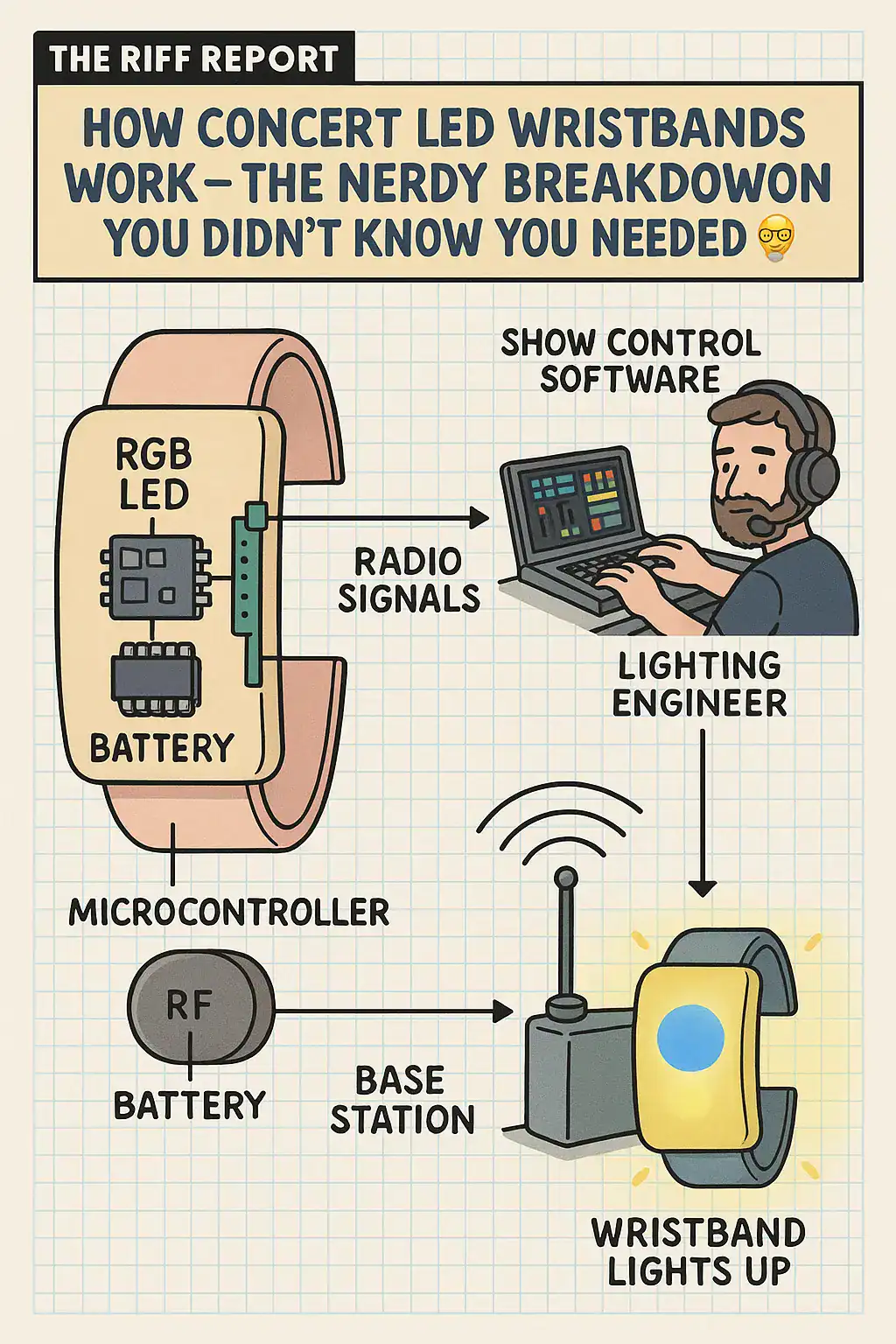
Inside these so-called “magic” bands is a little rave robot living rent-free on your wrist.
Here’s what’s inside:
- 💡 RGB LEDs – Super-bright little diodes that can turn any colour under the sun (and a few you’ve never seen sober).
- 🧠 Microcontroller – The brain. Listens for commands and tells the LEDs what to do, when to flash, when to fade, and when to blind your mate in the next row.
- 🔋 Battery – Usually a coin cell (CR2032) with just enough juice to last the gig, but not quite enough to power your TV remote afterwards.
- 📡 RF Receiver – This is the key. It’s constantly listening for signals from the mothership (aka the lighting engineer’s booth).
📡 HOW THEY CONTROL YOU (AND EVERYONE ELSE)
Forget Bluetooth, forget Wi-Fi — these babies use good old radio frequency broadcasting, usually around 433 MHz or 900 MHz.
The process:
- Lighting engineer programs all the lighting cues in advance – think of it like Guitar Hero but for lasers.
- Base station in the venue sends out radio signals across the crowd.
- Your wristband’s RF receiver catches the message: “Flash red now… blink twice… fade to blue… now pretend you’re in Blade Runner.”
- Everyone’s wristbands follow the command instantly – because the signal hits them all at once.
- For extra magic, the system can split the venue into zones, so the pit can pulse one colour while the nosebleeds shimmer another.
Result? One massive, synchronised light show that would make Daft Punk jealous.
🧠 BONUS NERDY FACTS
- Some high-end wristbands have two-way communication, so the lighting desk can tell if your band’s dead and send a techie sprinting over with a replacement (probably tripping over three folding chairs en route).
- They can store multiple pre-programmed sequences, so the engineer can change the vibe from “mellow sea of white” to “techno apocalypse” in under a second.
- The microcontroller chip is often simpler than the one in your microwave – yet it’s out here pulling off stadium-wide wizardry.
🎶 WHY BANDS LOVE THEM
Apart from the obvious “makes the place look lush” factor:
- It makes every punter feel part of the show rather than just a bystander.
- Epic aerial shots – drones LOVE them.
- Perfect for dramatic slow songs and crowd singalongs (aka the moment your mate films vertically and uploads to Insta).
- They make encore drops feel like a sensory nuke.
♻ THE NOT-SO-ROCK ’N’ ROLL BIT – WASTE
Here’s the minger in the mosh pit – most LED wristbands are single-use. Millions get handed out every year, and far too many end up in landfill.
Some festivals collect and reuse them (Coldplay are big on this), and newer models are rechargeable silicone versions. Until then, if you’re taking one home – either turn it into a nerdy ornament or gut it for the LEDs (your future Halloween costume will thank you).
🧪 TL;DR – THE RIFF REPORT SCIENCE BIT
How it works:
- Microcontroller in your wristband listens to RF signals from the lighting desk.
- RF tells your LEDs what to do – instant, stadium-wide synchronisation.
- You look cool. The band looks cooler. The Insta likes roll in.
So next time your wrist lights up in sync with 50,000 other people, remember – it’s not magic. It’s science. Loud, sweaty, beautifully nerdy science. 🤘💡