
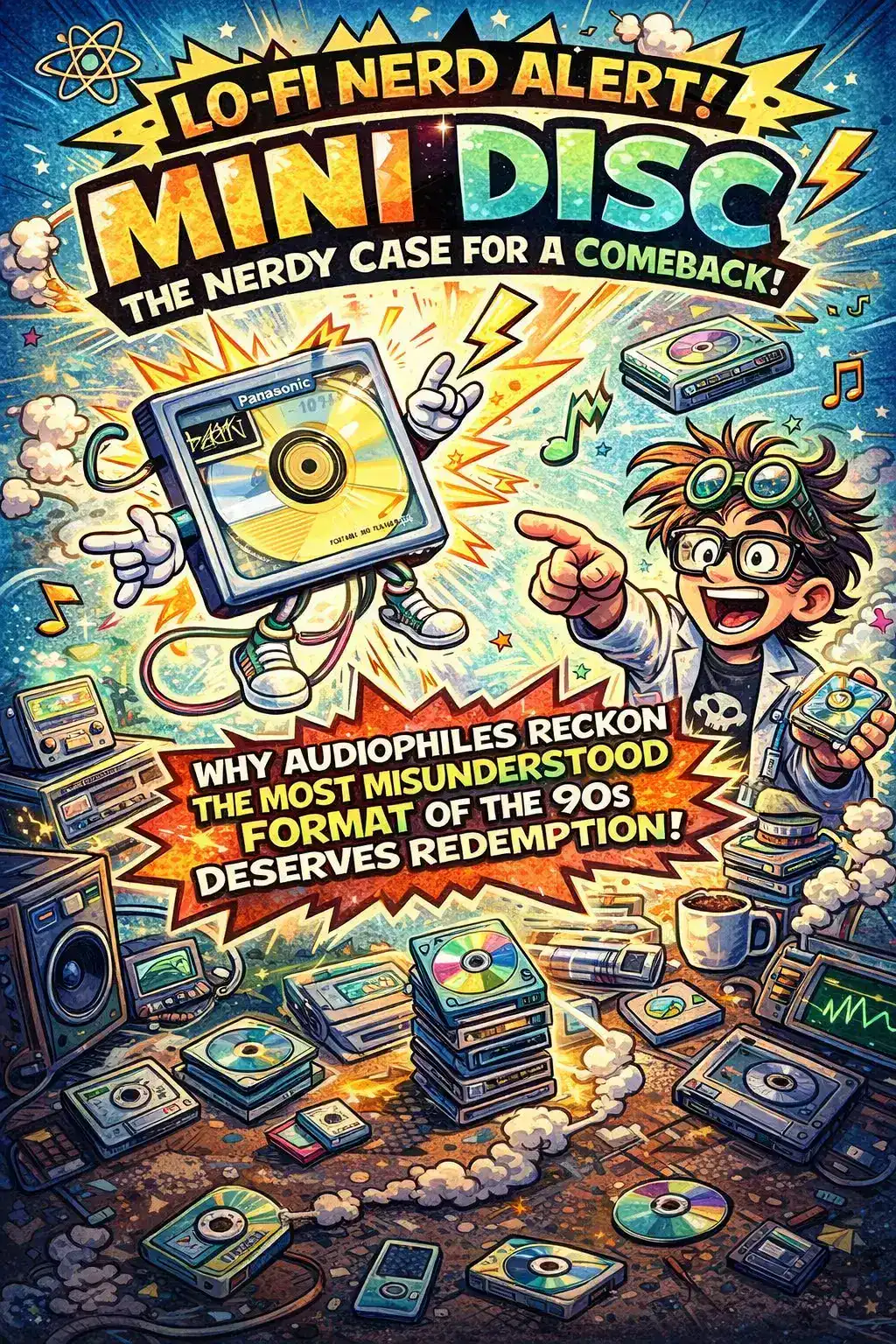
Why audiophiles reckon the most misunderstood format of the 90s deserves redemption
MiniDisc isn’t just nostalgia with a battery compartment. It’s one of the most over-engineered, misunderstood, and prematurely buried music formats ever unleashed on humanity.
And now — thanks to a fresh wave of audiophile nerdery — it’s being hailed as the #1 physical format that should make a comeback. Not because it’s trendy. Not because it looks cool (although… it does).
But because the tech was secretly brilliant.
Let’s crack this thing open and have a proper poke inside 🧠🔍
🧪 WHAT MINI DISC ACTUALLY WAS (NOT WHAT PEOPLE THINK IT WAS)
MiniDisc wasn’t “a tiny CD”. That’s like calling a synth “a noisy piano”.
It was:
- Magneto-optical storage (yes, lasers and magnets, because Sony)
- Fully random access (no rewinding like a cassette, you animals)
- Shock-resistant buffering long before solid-state players were normal
- Re-recordable without degrading like tape
- Designed for editing at the track level on the device itself
You could split tracks, rename them, reorder them, delete mistakes — on the player. In the 90s. While everyone else was still praying their CD didn’t skip on the bus.
MiniDisc wasn’t simple.
It was elegant nerd chaos.
🔊 ATRAC: THE CODEC EVERYONE MISUNDERSTOOD
Here’s where the audiophile debates get spicy 🌶️
MiniDisc used ATRAC (Adaptive Transform Acoustic Coding), Sony’s proprietary compression format. And yes — early versions were lossy.
But:
- ATRAC was psychoacoustically tuned for human hearing
- It prioritised musical masking rather than raw data reduction
- Later versions (ATRAC Type-R, Type-S) were vastly improved
- NetMD and Hi-MD pushed bitrates higher and higher
Hi-MD eventually supported:
- Linear PCM (uncompressed)
- Higher-capacity discs
- USB transfers
- Computer-based workflows
By the time MiniDisc reached its final form…
MP3 culture had already eaten the world.
Classic case of tech arriving early, getting misunderstood, and being abandoned just as it matured.
💾 WHY NERDS ARE TALKING ABOUT MINI DISC NOW
This recent audiophile vote isn’t about fashion. It’s about format logic.
MiniDisc sits in a weird sweet spot:
- Physical, but not fragile
- Digital, but not disposable
- Portable, but intentional
- Editable, but album-friendly
With modern tech, the theoretical upgrade path is wild:
- Solid-state assisted buffers
- Lossless or near-lossless codecs
- Massive capacity micro-discs
- USB-C, Bluetooth, modern DACs
In other words:
MiniDisc 2.0 wouldn’t compete with vinyl.
It would compete with streaming.
And that’s the point.
🧠 THE ANTI-ALGORITHM APPEAL
Here’s the philosophical bit (sorry).
Streaming optimises for:
- Passive listening
- Background noise
- Endless choice paralysis
MiniDisc optimised for:
- Curation
- Attention
- Ownership
- Albums as intentional objects
Making a MiniDisc was an act of decision-making.
You chose the tracks. You named them. You committed.
From a nerd perspective, that’s human-centred design, not algorithmic optimisation.
And people are tired of invisible music.
🎸 RIFF REPORT NERD VERDICT
MiniDisc didn’t die because it was bad.
It died because it was too clever for a market that wanted simple.
Now we live in a world where:
- Vinyl is booming
- Cassettes are inexplicably back
- Digital ownership feels fake
- People miss doing things with music
Suddenly, MiniDisc doesn’t look obsolete.
It looks unfinished.
If it returns, it won’t be mainstream.
But it could become the thinking person’s physical format.
And honestly?
That feels very rock ’n’ roll in its own strange, nerdy way 🤘🤓