
Somewhere between the barrier and the bar, you’ll hear it:
“Yeah, but it’s only crop, mate…”
Usually said by someone who missed the chorus while fiddling with ISO.
So let’s settle it properly.
This is crop vs full frame, explained with sensor physics, focal lengths, and festival grime. Nerdy? Absolutely. Dry? Not on our watch 🤘🔥
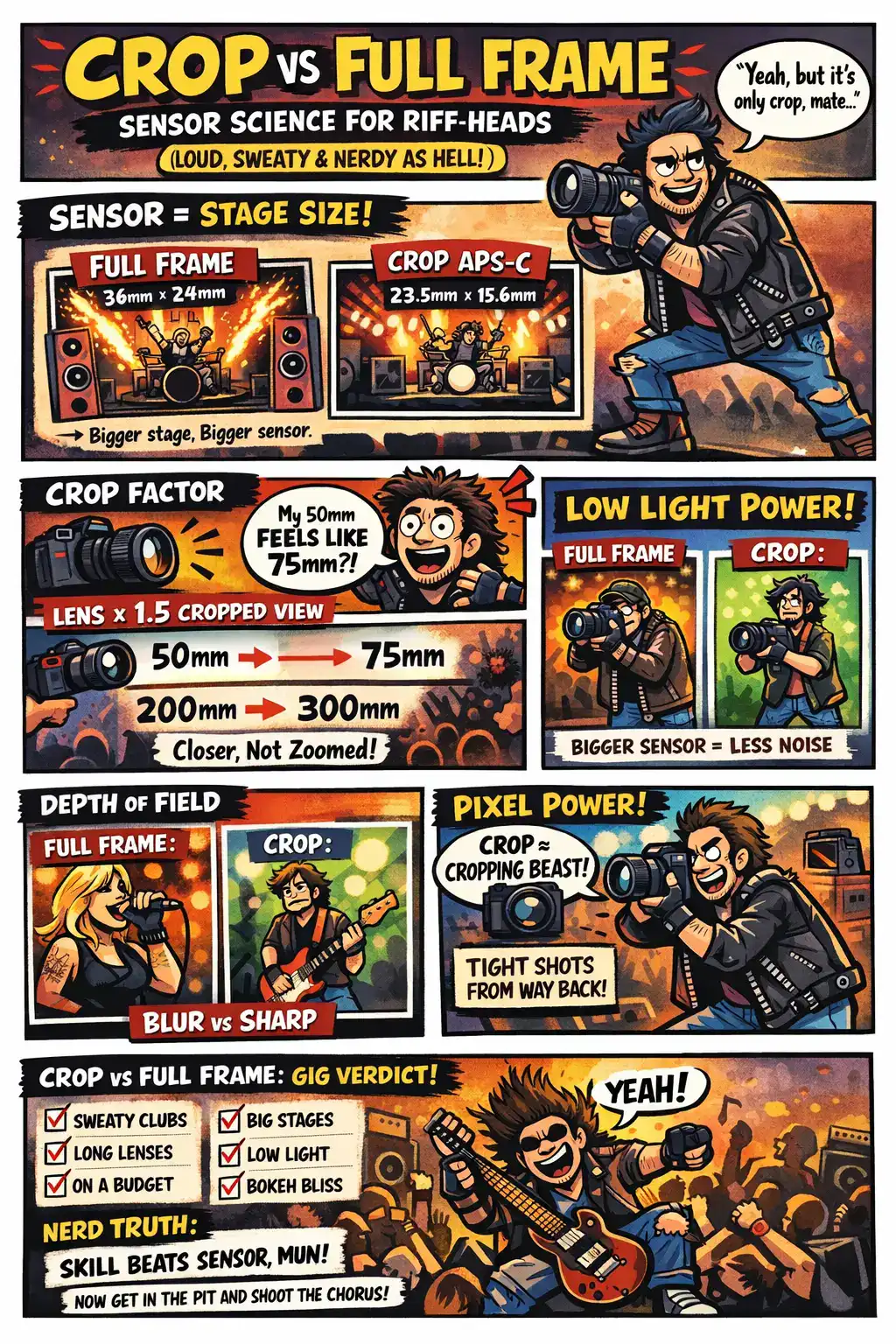
🔊 THE STAGE SIZE THEORY: SENSOR = STAGE
Think of your camera sensor like a stage.
- Full frame is the main stage. Wide. Loud. Full rig.
- Crop (APS-C) is the club stage. Tighter. Sweatier. Still chaos.
Same band. Same song.
Different amount of the madness captured.
The cold hard specs
- Full Frame: 36mm × 24mm
- APS-C: roughly 23.5mm × 15.6mm
Your lens throws out a big circular image like a wall of sound.
Crop sensors just grab the middle and say, “that’ll do nicely, mun.”
🎸 CROP FACTOR: WHEN YOUR LENS STARTS LYING TO YOU
This is where arguments start in the pit.
Most APS-C cameras have a 1.5x crop factor
(Canon APS-C is closer to 1.6x)
The riff maths
Lens focal length × crop factor = effective field of view
So:
- 35mm feels like ~52mm
- 50mm feels like ~75mm
- 200mm feels like ~300mm
Important truth bomb:
- The lens does not zoom
- Perspective does not change
- You’re just closer in the mix
It’s like stepping from the back of the crowd straight to the side of the stage.
🌒 LOW LIGHT & NOISE: WHY FULL FRAME OWNS DARK ROOMS
Small venues. Red lights. Smoke machines committing crimes against visibility.
This is where full frame flexes.
Bigger sensor = bigger pixels (usually)
Bigger pixels = more light collected
Result:
- Cleaner high ISO
- Better shadow detail
- Less crunchy noise when the lights die
Crop cameras still rip.
They just hit the noise wall earlier when the venue lighting is powered by vibes alone.
🎨 DEPTH OF FIELD: BOKEH, BUT MAKE IT METAL
Ever notice how full frame shots melt backgrounds like a slow doom riff?
That’s physics, not sorcery.
To get the same framing:
- Crop sensors need shorter lenses or more distance
- Both increase depth of field
End result:
- Full frame = blurrier backgrounds
- Crop = more stuff in focus
Neither is “better”.
One’s cinematic. One’s raw. Pick your flavour.
🔭 PIXEL DENSITY: WHY CROP CAMERAS ARE FESTIVAL SNIPERS
Here’s the nerd bit that actually slaps.
Crop sensors pack more pixels into less space.
That means:
- Higher pixel density
- Better for heavy cropping
- Absolute weapons for distant stages
Festival fields?
Crop cameras punch above their weight like a support band stealing the show.
🤘 CROP VS FULL FRAME: THE RIFF REPORT GIG VERDICT
| You’re shooting… | Sensor that slaps |
|---|---|
| Sweatbox venues | Crop |
| Big festival stages | Full frame |
| Long lenses on a budget | Crop |
| Filthy low light | Full frame |
| Aggressive cropping | Crop |
| Maximum bokeh drama | Full frame |
🧠 THE REAL HEADLINER TRUTH
Crop vs full frame isn’t about status.
It’s about tools, physics, and how you shoot.
A crop camera in the right hands will absolutely embarrass a full frame in the wrong ones.
The best camera?
- The one you know
- The one you trust
- The one that survives beer, elbows, and bad decisions
🥁 RIFF REPORT FINAL RIFF
- Crop = tight, punchy, pit-approved
- Full frame = wide, cinematic, low-light monster
- Skill beats sensor. Always.
Now stop arguing, get in the pit, and shoot the chorus 🤘📸🔥