
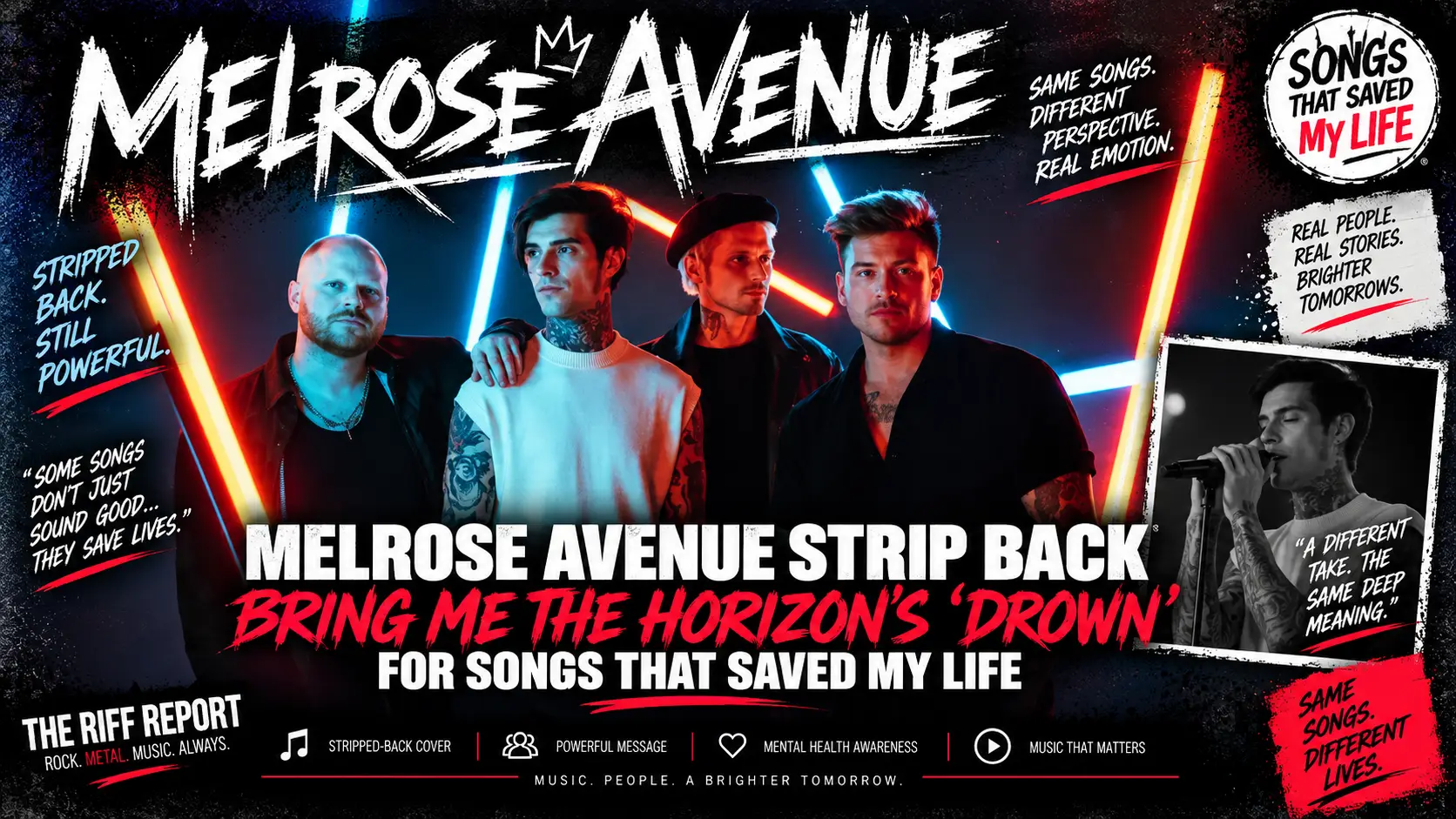
Melrose Avenue have taken on one of Bring Me The Horizon’s most emotionally charged songs, releasing a stripped-back cover of “Drown” as part of the Songs That Saved My Life project.
Some songs hit hard because of the riff.
Some because of the breakdown.
And some don’t need either.
“Drown” has always belonged firmly in that final category.
Originally released by Bring Me The Horizon in 2014, the track became one of the most important songs in the Sheffield band’s evolution, showing a considerably more melodic and vulnerable side of a group previously associated with outright heaviness.
Now Melrose Avenue have given the song a fresh interpretation, stripping away much of the original’s huge production and allowing the emotion at its centre to breathe.
And honestly?
“Drown” is exactly the sort of song that can survive that treatment.
🖤 ‘Drown’ Has Always Been Bigger Than Its Production
When Bring Me The Horizon first released “Drown”, it represented a pretty dramatic moment.
This was a band whose early reputation had been built around deathcore aggression suddenly leaning into soaring melodies, emotional vulnerability and a chorus big enough to fill arenas.
Naturally, people had opinions.
Metal fans having opinions?
Impossible, we know.
But “Drown” endured.
The song later became part of That’s The Spirit and has grown into one of Bring Me The Horizon’s defining emotional anthems.
Its strength was never simply the production surrounding it.
It was the song underneath.
Strip everything back and those lyrics still land.
Hard.
🎶 Melrose Avenue Take A Different Approach
Rather than attempting to reproduce Bring Me The Horizon’s original version note for note, Melrose Avenue have approached “Drown” from a more intimate direction.
That makes sense.
A great cover shouldn’t simply make you reach for the original instead.
It should find another angle.
Another emotion.
Another way into the song.
By reducing the scale and focusing on the vocal and melody, the stripped-back version places more attention on the vulnerability behind the track.
Suddenly there’s nowhere for the words to hide.
And with a song like “Drown”, that matters.
🎤 Sometimes Quiet Hits Harder
Heavy music fans understand something people outside the scene occasionally miss:
Heavy doesn’t always mean loud.
A blastbeat can be heavy.
A breakdown can be heavy.
But sometimes one voice and a sparse arrangement can hit considerably harder than an entire wall of amplifiers.
That contrast has always been part of Bring Me The Horizon’s appeal as they’ve evolved.
They’re capable of producing something utterly savage and then following it with a song built around vulnerability.
Melrose Avenue’s interpretation leans completely into the latter.
❤️ The Meaning Behind Songs That Saved My Life
The Songs That Saved My Life project has always centred on music’s ability to help people through difficult periods.
Artists revisit songs that meant something important to them, bringing attention to the emotional connection people build with music beyond simple entertainment.
And anyone involved in the rock, metal and alternative communities knows exactly how powerful that connection can become.
There are songs you like.
Then there are songs you need.
Tracks that become attached to a particular year.
A particular person.
A horrible night.
A brilliant memory.
A period where simply getting through tomorrow felt like enough.
Those songs become something more than music.
🤘 Rock And Metal Have Always Been Safe Spaces For Difficult Emotions
Despite all the screaming, distortion and enormous festival pits, heavy music has always given people somewhere to put feelings that don’t fit neatly anywhere else.
Anger.
Isolation.
Fear.
Grief.
Depression.
Anxiety.
Sometimes the music articulates something listeners couldn’t put into words themselves.
That’s one reason songs like “Drown” resonate so strongly.
It doesn’t pretend everything is fine.
It recognises what struggling feels like.
And when thousands of people scream those words together at a Bring Me The Horizon concert?
Suddenly something incredibly personal becomes communal.
That’s powerful.
🔥 Bring Me The Horizon Changed Dramatically With ‘Drown’
Looking back now, “Drown” also feels like a crucial signpost in Bring Me The Horizon’s musical journey.
The band had already been evolving for years, moving away from the raw deathcore of their earliest work into increasingly expansive metalcore and electronic experimentation.
But “Drown” made the next stage impossible to ignore.
Bigger melodies.
Cleaner vocals.
Huge alternative-rock production.
A willingness to move outside whatever boundaries fans expected them to remain inside.
That approach eventually became central to Bring Me The Horizon.
Today, predicting exactly what genre their next song will belong to is basically a fool’s errand.
Pop?
Metal?
Electronic?
Hardcore?
Hyperpop?
Yes.
🎸 Covers Can Introduce Songs To Completely New Audiences
That’s another beauty of projects like this.
Someone who follows Melrose Avenue but doesn’t necessarily spend their evenings digging through Bring Me The Horizon’s catalogue might hear “Drown” through this version first.
Then curiosity takes over.
One song becomes another.
Another becomes an album.
Suddenly they’re six records deep wondering why Oli Sykes is screaming at them.
Job done.
Cover songs have always helped music travel between generations and scenes.
Metallica did it with Diamond Head and Budgie.
Johnny Cash famously transformed songs by completely different artists.
And punk bands have been cheerfully demolishing pop songs for decades.
A good song survives reinvention.
“Drown” absolutely does.
🖤 A Song Worth Revisiting
More than a decade after its original release, “Drown” still connects because the emotion behind it hasn’t dated.
Production styles change.
Scenes change.
Bands change.
People don’t suddenly stop feeling lost.
Or overwhelmed.
Or desperate for somebody else to understand what they’re going through.
That’s why certain songs endure.
Not because they were fashionable.
Because they were honest.
🤘 THE RIFF REPORT VERDICT
Melrose Avenue’s stripped-back version of “Drown” understands something important about the Bring Me The Horizon original.
Underneath the enormous chorus and polished production was always a deeply vulnerable song.
Take away some of the weight.
Slow things down.
Give the vocal room.
And the emotional core becomes even harder to ignore.
That makes the track a particularly fitting contribution to Songs That Saved My Life.
Because music doesn’t always need to solve anything.
Sometimes it simply needs to sit beside you while things are difficult.
And sometimes hearing somebody else put those feelings into words is enough to remind you that you’re not the only person experiencing them.
That’s why songs matter.
That’s why projects like this matter.
And that’s why, more than a decade later, “Drown” still refuses to disappear beneath the surface.
Turn it down for once. Listen properly. This one deserves the space. 🖤🎶🤘