
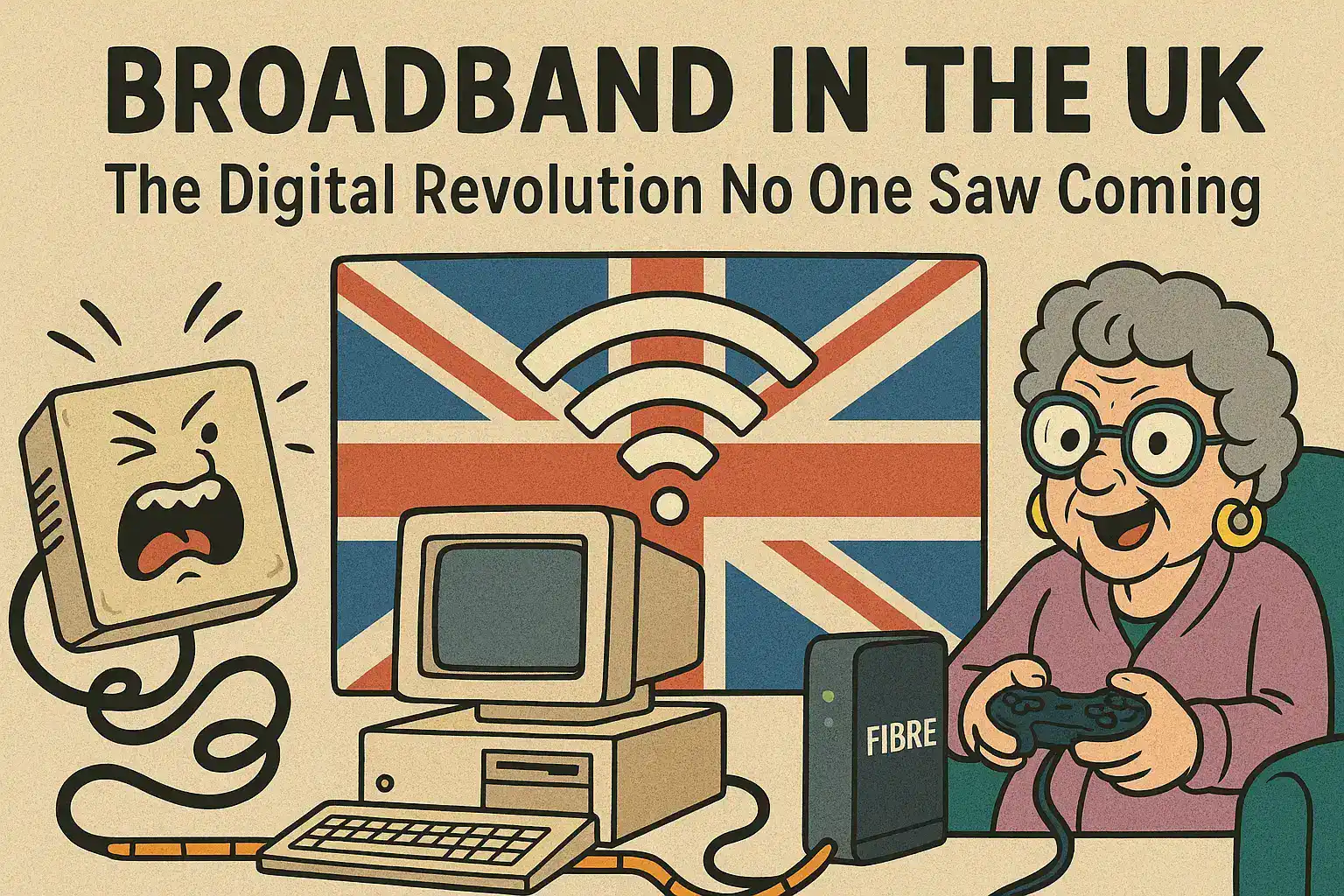
🕰️ The Prehistoric Days (Before Broadband)
Back before memes, 4K Netflix, and rage-quitting in Warzone, we had dial-up. Your modem screeched like a dying robot every time you connected, and downloading a single song took longer than boiling a kettle for the entire street.
Dial-up:
- Speed: Up to 56 kbps
- Connection: Over your landline (which meant NO calls while online)
- Providers: AOL, Freeserve, Demon Internet, CompuServe
- Typical Cost: Pay-per-minute access or monthly subscriptions (e.g. £15–£20/month)
- Bonus Features: Loud screeching modem tones, timeouts, and 3-hour download times for a 5MB file 🎧
The UK in the ’90s was hungry for faster internet. Enter: broadband.
🚀 What Exactly Is Broadband?
Broadband simply means “high-speed internet that’s always on” – unlike dial-up, which had to connect every time you used it.
It came in several juicy flavours:
- ADSL (Asymmetric Digital Subscriber Line): Used your existing copper phone line but didn’t block phone calls.
- Cable Broadband: Delivered via coaxial cables (originally used for TV), offering faster and more stable speeds.
- Fibre Broadband: The ultimate upgrade – fibre-optic cables that used light to transmit data very fast.
📅 The Timeline of UK Broadband – With All the Milestones
🔹 1998–1999: Testing the Waters
- BT begins testing ADSL in select UK areas.
- Broadband is being trialled at 512kbps – still revolutionary at the time.
- Early adopters include universities and big businesses.
🔹 2000: The Birth of UK Broadband
- BT Openworld launches the first commercial ADSL service.
- Home users in limited areas can get 512kbps down / 256kbps up.
- Cost? Around £39.99/month with a 12-month contract and a hefty setup fee.
🔹 2002–2004: The Broadband Boom
- NTL and Telewest (later to become Virgin Media) offer cable broadband.
- Speeds increase to 1Mbps and 2Mbps.
- ISP competition heats up — price wars begin.
- BBC launches BBC iPlayer trials in 2003 – broadband makes it viable.
🔹 2006: Broadband Becomes the Norm
- More homes have broadband than dial-up for the first time.
- Average speed in UK now ~4Mbps.
- YouTube and Facebook start to dominate thanks to faster home connections.
🔹 2009–2012: Fibre Enters the Chat
- BT Infinity launches FTTC (Fibre To The Cabinet).
- Speeds jump to 40–76 Mbps.
- Virgin Media begins offering 100 Mbps via cable.
- “Superfast broadband” officially defined as 24Mbps+.
🔹 2016–2020: Ultrafast Dreams
- Government targets 95% of UK to have access to superfast broadband.
- Full Fibre (FTTP) starts rolling out with speeds up to 1 Gbps.
- Streaming, cloud gaming, and 4K content now actually work reliably.
🔹 2020–2025: Gigabit Britain (Almost)
- ISPs like BT, Virgin Media, Hyperoptic, Community Fibre, and G.Network push full fibre across the UK.
- Government Gigabit Broadband Voucher Scheme helps rural homes.
- Average UK home speed (as of 2024): over 80 Mbps download.
📡 Technical Deep Dive: Broadband Types Explained
| Type | Year Introduced | Max Speeds | Tech Used | Good For… |
|---|---|---|---|---|
| Dial-Up | 1990s | 56 kbps | Analog telephone lines | Pain and suffering 💀 |
| ADSL | 2000 | 8 Mbps / 512 kbps | Copper phone line (DSL tech) | Basic browsing, email |
| ADSL2+ | 2005 | 24 Mbps / 1 Mbps | Enhanced copper DSL | Light streaming, downloads |
| Cable | 2002 | 20–100 Mbps | Coaxial TV cables | Stable connections, families |
| FTTC | 2009 | 76 Mbps / 20 Mbps | Fibre to cabinet, copper to home | Streaming, gaming, WFH |
| FTTP (Full Fibre) | 2015+ | 1–10 Gbps+ | Pure fibre to the home | EVERYTHING 🔥 |
| 5G Broadband | 2020s | Up to 1 Gbps (in theory) | Mobile masts & home routers | Rural & backup connections |
💷 The Cost of Connecting – Then vs Now
🕰️ Then (2000s):
- Setup Fee: £50–£150 (modem install, engineer visit)
- Monthly: £30–£40 for 512kbps!
- Download Limits: Often capped at 1–5GB/month
- Contracts: 12 to 18 months, no freebies!
💫 Now:
- Monthly: £25–£60 depending on speed (Fibre starts ~£30)
- Speeds: 50Mbps to 1Gbps
- Unlimited downloads are standard
- Bundled deals: Broadband + TV + Phone + Mobile
- Free routers, next-day installs, cashback offers
🧠 Fun Nerd Facts for the Broadband Brainiacs
- The first UK town with 100% FTTP coverage? B4RN (Broadband for the Rural North) – a community project in Lancashire! 🐑
- Virgin Media’s DOCSIS 3.1 upgrade now allows 1.1 Gbps via coax cables.
- The average UK household in 2024 uses 350GB of data a month – that’s a lot of TikToks.
- ADSL modems were often chunky beige boxes with blinking green lights. Some had fans louder than an Xbox 360.
🇬🇧 Broadband and the Digital Divide
Not all regions had equal access:
- Urban vs Rural: Big cities got fast fibre first. Rural areas got stuck on ADSL for years.
- Government Interventions: “Broadband Delivery UK” (BDUK) and voucher schemes helped rural and disadvantaged communities.
- Mobile Broadband/5G: Became a workaround for some areas without fixed-line fibre.
The Welsh Valleys, highlands of Scotland, and coastal Cornwall saw community-led projects and satellite internet long before fibre arrived. “Only in Wales, mun…”
🔮 What’s Next? The Future of UK Broadband
- 10Gbps full fibre already exists in some London test areas.
- Satellite internet (like Starlink) will help remote areas.
- Wi-Fi 7 and mesh networks are making homes smarter and faster.
- The UK government wants nationwide gigabit-capable broadband by 2030.
And soon, even your fridge will have a faster connection than your first PC did in 2001. Madness.
🎸 Broadband Changed Everything – And We’re Still Downloading
Broadband didn’t just make things faster – it unlocked a whole new way of living. From booting up Limewire in 2003 to streaming your 6-hour Dungeons & Dragons session in glorious HD today — broadband made it all possible.
No more dropped phone calls, no more buffering halfway through a YouTube rant, and no more paying £39.99/month just to check your Hotmail inbox once a day.