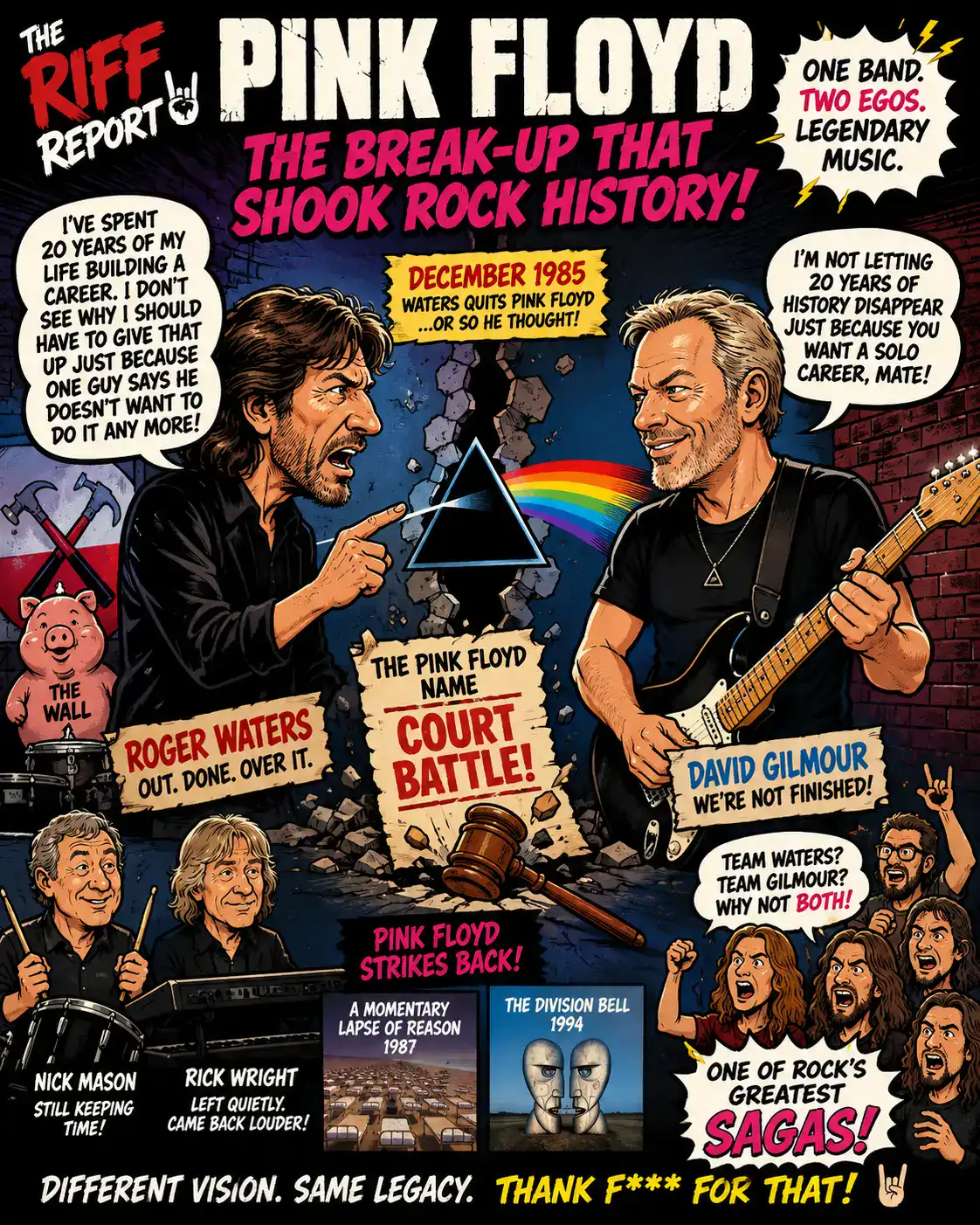
“I’ve spent 20 years of my life building a career. I don’t see why I should have to give that up just because one guy says he doesn’t want to do it anymore.”
Those words from David Gilmour perfectly sum up one of the most explosive fallouts in rock history.
When people talk about legendary band break-ups, names like Oasis, Guns N’ Roses and Fleetwood Mac usually spring to mind. But few were as bitter, as complicated, or as fiercely fought as the battle that almost destroyed Pink Floyd.
🌑 The Beginning of the End
In December 1985, Roger Waters officially informed Pink Floyd’s record labels—EMI in London and CBS in New York—that he was leaving the band.
To those close to the group, it wasn’t exactly a shock.
Pink Floyd had been largely inactive since The Final Cut arrived in 1983. Although released under the Pink Floyd name, many fans viewed the album as a Roger Waters solo project in everything but name. Waters had become the dominant creative force during the late 1970s, while the contributions of the other members had gradually diminished.
After leaving, Waters wasted no time forging his own path, releasing The Pros and Cons of Hitch Hiking in 1984 before taking his ambitious theatrical stage show across Europe and America.
Many believed that was the end of Pink Floyd.
David Gilmour had other ideas.
⚡ David Gilmour Wasn’t Ready to Walk Away
While Waters was carving out his solo career, David Gilmour had also released a solo album and toured, although the reception wasn’t as successful. Some dates were even cancelled because of disappointing ticket sales.
Nick Mason and Rick Wright also released solo material during the same period, although only the most dedicated Floyd fans were paying attention. In fact, many casual listeners didn’t even realise Rick Wright had quietly left the band during the making of The Wall in 1979.
Despite everything, Gilmour believed Pink Floyd still had life left in it.
His attitude was simple:
Why should decades of work disappear because one member wanted to move on?
⚖️ The Legal War Begins
What followed wasn’t just an argument—it became one of rock music’s most famous legal battles.
Roger Waters argued that Pink Floyd had effectively finished and should be retired.
David Gilmour and Nick Mason completely disagreed.
The dispute over ownership of the Pink Floyd name dragged through the courts before eventually being settled, allowing Gilmour and Mason to continue using the band’s name. Rick Wright would later return, completing much of the classic line-up once again.
That decision changed rock history.
🎶 Pink Floyd Lives On
Rather than quietly fading away, Pink Floyd returned in spectacular fashion.
A Momentary Lapse of Reason arrived in 1987, followed by massive world tours that filled stadiums across the globe.
Then came The Division Bell in 1994, proving that Pink Floyd remained one of the biggest bands on the planet.
Whether fans preferred the Waters era or the Gilmour era, one thing became crystal clear—Pink Floyd wasn’t finished after all.
🤔 A Debate That Still Divides Fans
Nearly four decades later, the debate continues.
Some fans believe Roger Waters was the visionary genius responsible for Pink Floyd’s greatest artistic moments.
Others argue David Gilmour’s breathtaking guitar work, unmistakable voice and melodic brilliance were just as essential to the band’s success.
The reality is probably somewhere in the middle.
Without Waters’ concepts, Pink Floyd wouldn’t have become one of the most important progressive rock bands ever.
Without Gilmour’s musicianship and determination, the band may never have survived beyond 1985.
Both helped shape one of the greatest catalogues in music history.
🎸 The Riff Report Says…
Sometimes bands don’t just break up—they explode.
The Pink Floyd split wasn’t simply about egos. It was about identity, legacy and who had the right to carry one of rock’s most iconic names into the future.
Love him or loathe him, Roger Waters changed progressive rock forever.
Love him or loathe him, David Gilmour refused to let one of the world’s greatest bands disappear.
And decades later, fans are still arguing about who was right.
Maybe that’s exactly why the story remains one of the greatest sagas in rock history.
🤘 What do you think, butt?
Was Roger Waters the heart and soul of Pink Floyd?
Or did David Gilmour prove the band could thrive without him?
Drop your thoughts in the comments and let’s get the debate started! 🎸🔥