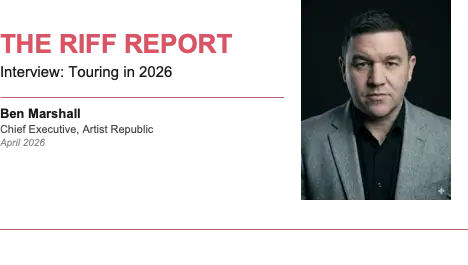
🙌🔥 MASSIVE THANK YOU TO BEN 🔥🙌
Before we dive headfirst into the madness of touring in 2026, we’ve gotta give a proper Riff Report shoutout to Ben from Artist Republic 🤘
Taking time out of the chaos of the music industry to chat with us isn’t something we take lightly — especially when the scene is moving faster than a double-kick drum blast at full tilt 🥁💨
Ben’s insight into the realities of modern touring — the highs, the headaches, and everything in between — is absolute gold for anyone trying to understand what’s really going on behind the curtain 🎭
So from all of us here at The Riff Report…
🍻 Cheers, Ben — you legend!
For the honesty, the knowledge, and for keeping it real in a world that’s anything but simple right now.
Now… let’s get into it 😈🎸
TOURING IN 2026 – WHAT’S GONE WRONG?
1. Let’s start blunt — touring used to be the lifeblood of bands. What’s actually gone wrong in recent years?
The economics of touring have inverted. What used to be a revenue stream is now a cost centre for most working bands, and the industry keeps treating that as a temporary problem when it is structural. The combination of post-COVID venue attrition, production cost inflation, and an audience that was retrained during lockdown to consume music passively rather than attending live shows has created conditions that a good summer of bookings is not going to fix. We have also seen a collapse of the middle ground. The premium end of live music, arena shows, large-scale productions, is doing well. The grassroots end persists because passion keeps it alive. The regional touring circuit that used to develop artists and sustain mid-tier venues has quietly hollowed out, and not enough people in positions of influence are treating that as the crisis it is.
2. We keep hearing that costs have spiralled out of control — what are the biggest expenses hitting bands hardest right now?
The visible conversation is about fuel, which is real but only part of it. The less visible problem is accommodation. When a five-piece band cannot afford to stay overnight within 150 miles of a venue, someone drives home at 2am exhausted. That is a safety issue before it is a financial one. Beyond accommodation, there has been a significant transfer of production responsibility from venues to artists. The expectation that a touring band will bring professional-grade sound and lighting, and absorb that cost entirely, is one that crept in and has now become normalised. PA hire, backline, technical riders: these are costs that used to be absorbed or shared and now sit almost entirely with the performer. Add to that insurance and the self-employed National Insurance burden, and you are looking at a cost structure that makes many shows economically inviable before a single ticket is sold.
3. Fuel, accommodation, merch cuts, venue costs… is there one area that has become the biggest killer?
If I had to identify one, it is accommodation, because of how it compounds everything else. Fuel you can plan around, to a degree. Merch cuts are infuriating but finite. Accommodation inflation has outpaced virtually every other cost in touring because it sits within a general hospitality sector that has had its own pressures. A band touring the UK cannot avoid it unless they are playing within driving distance of home every night, which fundamentally limits where you can build a following. The practical consequence is that regional touring has become geographically contracted. Bands play closer to home, support from fewer markets, and the national profile that used to be built gradually on the road is now either built digitally first or not at all.
SMALL BANDS FEELING THE PAIN
4. For emerging and grassroots bands, touring is becoming borderline impossible — how bad has it actually got from what you’re seeing?
The function and wedding band sector that Artist Republic works in directly has held up relatively well, because clients are paying a set fee for a specific experience at a private event and the economics are cleaner. The emerging original music scene is a different story. What I am seeing, and what the musicians I work with are reporting, is a return to the pay-to-play era, dressed up in the language of ‘community’ and ‘exposure’. Bands are being asked to sell tickets on behalf of venues in exchange for stage time. The artist bears the promotional risk and the financial shortfall. That is not a stepping stone; it is a trap, and a lot of talented people are caught in it. Through work4musicians.com, we operate a strict policy of listing only paid roles. We do not publish expenses-only or unpaid opportunities, because treating musicians as professionals starts with paying them like professionals. The fact that this distinguishes us at all tells you something about how normalised exploitation has become.
5. Are we now at a point where some bands are actively losing money just to stay visible?
Yes, and this is not a fringe case. Losing money on a show was always a risk of touring, particularly for emerging acts. What has changed is the scale and the frequency. Bands that once accepted a modest shortfall on one tour date now find that most dates on a run carry a deficit, and the cumulative loss is not sustainable for people who have mortgages, families, and day jobs they cannot simply walk away from. The calculation has changed for session musicians specifically, who are the most economically exposed group in this conversation. When a band tightens its touring budget, the first thing that goes is the additional player. Session musicians who once supplemented their income with touring work are finding that work contract, and the alternatives, studio sessions, function work, teaching, are increasingly competitive precisely because everyone else is doing the same calculation.
6. Have you seen artists pulling out of tours or scaling back plans because they simply can’t afford it anymore?
Yes. In our touring productions through The Live Music Co., we have had to become significantly more deliberate about routing and what we ask musicians to commit to. We build costs in at the planning stage now in a way that five years ago would have felt overly cautious. We route to minimise overnight stays, we are explicit about what fees cover and what they do not, and we do not ask musicians to absorb costs that are properly our responsibility as the production company. Not every operation has the structure or the will to do that, and the result is that artists and musicians are making withdrawal decisions based on what they can actually afford rather than what they would want to do artistically.
THE IMPACT ON THE SCENE
7. If smaller bands can’t tour, what does that mean for the wider music ecosystem — venues, promoters, fans?
The ecosystem is interconnected, and that interdependence works in both directions. When bands stop accepting the economic terms that grassroots venues offer, venues lose programming. When venues lose programming, promoters lose the ability to build nights around emerging acts. When that disappears, fans lose the discovery mechanism that live music uniquely provides. You cannot replicate being in a room where a band you have never heard of stops you cold. Streaming algorithms can surface music, but they cannot reproduce that experience, and that experience is how the next generation of significant artists builds a committed audience. Removing it does not just hurt today’s bands. It degrades the pipeline for the next decade.
8. Are we at risk of losing the next generation of great live bands before they even get started?
This is the question that concerns me most, and it runs deeper than the economics. I was in Nashville recently and watched an Irish country singer perform to a room of around forty people in a bar. He had an enormous Instagram following, built largely off the back of a single cover that went viral. Great voice, genuinely talented. But the Nashville session players and touring musicians in the same city, some of the finest live performers on the planet, had a fraction of his online reach and were playing to similar rooms. The selection mechanism has shifted. The industry now disproportionately rewards content creation ability over live musicianship, and those are not the same skill. The consequence is that a musician who cannot or will not build a social media presence is functionally invisible, regardless of what they can do on a stage. Combine that with the financial barrier to touring and you have a pipeline that is being filtered at the wrong point. We are selecting for virality rather than for the kind of sustained, disciplined live talent that used to define a serious musical career. The musicians who get lost in that filter are often the ones the industry will most want in ten years.
9. How does this shift affect diversity in music — are only better-funded acts able to survive on the road now?
The cost barrier functions as a filter, and it is not a neutral one. Artists without parental financial support, without access to industry connections, or without the ability to absorb losses for extended periods are being priced out before they get started. That was always partially true in music, but the threshold has risen to the point where it actively excludes people who have the talent but not the resources. The artists who are making it through the current environment are disproportionately those with financial cushions, and that is not a coincidence. It is a structural bias embedded in the economics, and it will show in the diversity of voices we hear in five to ten years if it is not addressed.
VENUES, MERCH AND THE REALITY ON THE GROUND
10. There’s been a lot of talk about venues taking a cut of merch sales — how big of an issue is that in reality? It is significant, and it is largely invisible to the public. The conversation tends to focus on the headline percentage, and splits that give the venue 70 or 80 per cent are genuinely difficult for artists to accept. But the deeper issue is what the merch cut represents on a night where the band is already operating at a loss. Merchandise is often the margin that makes a show viable. When a venue takes a substantial cut of that, they are not just taking a share of additional income; they are taking a share of the financial lifeline that makes the tour possible at all. For some acts, the decision becomes binary: either you sell merch and absorb the cut, or you do not sell merch and your tour is definitively uneconomic.
11. Are grassroots venues part of the problem, or are they struggling just as much as the bands?
Most grassroots venues are not the villains of this story; they are casualties of the same pressures. Their costs have risen, their margins were never healthy, and they are applying pressure to artists partly because they are under pressure themselves. Business rates, licensing costs, staffing, energy: all of these have increased and most small venues are operating without significant reserves. The merch cut issue is real, but in most cases it is a symptom of a broken chain rather than venue greed. Where I would be more critical is of the larger venues, those with genuine resources, that have adopted the practices of the grassroots sector not out of necessity but because the market has allowed it. That is a different conversation.
12. From your perspective, where is the biggest disconnect happening between artists, venues, and the wider industry?
Between the language the industry uses and what it actually does economically. There is significant rhetoric about supporting artists, about grassroots music mattering, about the importance of the live sector. Then artists are asked to perform for expenses, for a percentage of a door that generates £90, for the promise of future opportunities that rarely materialise. The language and the reality are two entirely different things, and the people generating the rhetoric are often not the ones absorbing the cost. The disconnect is between those who benefit from a thriving live music ecosystem without having to pay the cost of creating it, and the musicians who create it and are left to carry the financial risk alone.
THE BUSINESS SIDE OF MUSIC
13. Do you think bands are being forced to think more like businesses now just to survive?
Yes, and this is both necessary and a genuine problem. The artists who survive the current environment are the ones who treat their touring as a business operation: they know their cost per show, their minimum viable fee, their break-even point before load-in. That financial literacy is valuable and I actively encourage it among the musicians I work with. But the musicians who make the most extraordinary, risk-taking music are not always the ones with spreadsheet discipline, and when you force artists to choose between commercial viability and artistic ambition, you lose something important. The industry benefits enormously from artistic risk-taking. It should not be asking artists to fund that risk entirely from their own pockets while the infrastructure around them absorbs the reward.
14. Has the traditional model of ‘tour to grow your fanbase’ completely broken down? The model has not broken down but it has been fundamentally renegotiated, and the renegotiation has created a tension that the industry has not yet resolved. Touring now follows online audience building rather than generating it. You build an audience digitally, demonstrate that demand exists, then you tour to convert that audience into a live experience. But here is the thing that struck me recently: the conversion does not always follow. I was in Nashville a few weeks ago and watched an Irish country singer perform to around forty people in a bar. He had built a huge Instagram following, largely from a viral cover, and he was a genuinely talented performer. But the room was almost empty. Meanwhile, the Nashville musicians who might surpass him technically were drawing similar crowds despite, in most cases, having a fraction of his online reach. A following and a fanbase are not the same thing, and touring cannot bridge that gap if the connection is built on a single piece of viral content rather than on a genuine relationship with an audience. The sequence has reversed but it has not simplified. Artists who are better performers than content creators are being sidelined, and artists who have built online audiences are discovering that digital reach does not automatically put people in a room. The result is a lot of confusion about what touring is actually for and who it serves.
15. Are there smarter ways bands can approach touring in the current climate?
Regional clustering is underused: playing two or three dates in the same area in the same week reduces the per-show accommodation and transport cost significantly. Direct-to-audience booking through social media, cutting out the promoter margin where the fanbase is established enough to support it, is viable for some acts. And hybrid models, combining private event work with public shows to cross-subsidise the touring economics, are increasingly important. The wedding and function sector that Artist Republic focuses on is precisely this model. The musicians who work in it are professional touring performers who have found a way to remain economically active while the original music touring circuit becomes harder. It is not a compromise; it is pragmatic professionalism. Many of them maintain serious original projects alongside the function work because the function work pays reliably.
WHAT NEEDS TO CHANGE?
16. If you could fix three things tomorrow to make touring viable again, what would they be?
First, a mandatory minimum fee standard for public performances, not a voluntary code, but an industry-wide floor below which it is not acceptable to ask a professional musician to work. Second, a structured National Insurance relief for self-employed musicians that reduces the employment cost friction stopping bands from growing their lineups and paying session musicians fairly. Third, a properly funded grassroots venue support mechanism, not emergency grants when venues are already failing, but sustained infrastructure investment that treats live music venues as the cultural infrastructure they are. If those three things were in place tomorrow, the economic calculus of touring would change materially within a year.
17. What role should labels, promoters, and platforms like Artist Republic play in supporting artists?
Labels need to stop treating touring as purely a promotional vehicle for recorded income that flows back to them while the artist absorbs the touring cost. If you benefit from an artist’s live presence, you share the risk of building it. Promoters need to move beyond guaranteed-against-ticket-sales models that place all financial risk on the performer and none on the promoter. And platforms like ours have a specific responsibility to ensure that the work we put in front of musicians is paid at a rate that reflects their professionalism. At work4musicians.com, we do not list unpaid or expenses-only roles. That is not a policy position we arrived at reluctantly; it is an ethical baseline. Every paid opportunity we publish carries transparent fee information so musicians can make informed decisions. The fact that this remains unusual in the wider market tells you how far the industry still has to travel.
18. Do you think government or industry-wide support is needed to protect grassroots touring? Yes, and I would go further than most conversations on this subject tend to. The UK live music industry generates substantial economic output: tourism, hospitality, international cultural export, and tax revenue. The government has been willing to recognise that in broad terms when it suits, particularly around Brexit and touring rights. What has not followed is the structural policy support that matches that rhetorical recognition. Treating the touring costs of self-employed musicians as fully deductible business expenses without restriction would be a start. Extending the Music Venue Trust’s work with dedicated public investment would be another. The case for this is not sentimental. It is economic. The return on protected grassroots infrastructure is measurable, and the cost of letting it collapse will be paid for years after the venues have closed.
THE FUTURE OF LIVE MUSIC
19. Looking ahead — are you optimistic or worried about the future of live music for smaller bands?
Both, and I think anyone who answers this with only one of those is not paying close enough attention. I am worried about the immediate pipeline, the bands that will not form, the session musicians who will leave the profession, the venues that will close in the next two years before any structural support arrives. The damage being done right now is real and some of it will be permanent. But I am not pessimistic about the long term, because the human desire to be in a room with other people experiencing something together is not going anywhere. Live music addresses a need that recorded music, however sophisticated, cannot. The format will adapt and the appetite will not disappear. What concerns me is how much talent and infrastructure we lose in the gap between where we are now and where the sustainable model emerges.
20. What does a sustainable touring model actually look like in 2026 and beyond?
Smaller, smarter, and more financially transparent. Fewer dates, each properly paid. Audiences paying more per ticket for a genuinely curated experience rather than a volume of cheap shows where the economics do not work for anyone. Artists understanding their own numbers well enough to decline unprofitable engagements without guilt or fear of missing out. And a more honest distribution of financial risk between venues, promoters, and artists, where the person taking the most risk is not automatically the least resourced person in the room. The function and private events sector points to what this can look like in practice: clear fees, professional expectations on both sides, and musicians who are treated as contractors rather than as a favour being done. That model is not perfect but it is economically coherent, and the wider touring sector could learn from it.
FINAL RIFF REPORT QUESTION
21. If nothing changes… what does the UK live music scene look like in five years’ time?
It fragments into two tiers with nothing in between. At the top, stadium and arena productions with the spectacle and the budget to match. At the bottom, hyper-local pub and club acts playing for the room and the love of it. The middle ground, the regional touring circuit that develops serious artists, gives session musicians a career, keeps mid-tier venues viable, and connects music to communities across the country, disappears. That middle ground is where virtually every significant British band of the last fifty years came from. It is where musicians learn to be musicians, where audiences learn what live music can do to a room, and where the industry finds the acts it will be exploiting profitably for the following decade. Losing it is not a small cultural adjustment. It is the removal of the mechanism by which the entire ecosystem renews itself, and the consequences of that will be felt long after the last venue has locked its doors.
🌐 Artist Republic – Social Media Links
- Website: https://www.artistrepublic.co.uk
- Instagram: https://www.instagram.com/artistrepublicuk
- Facebook: https://www.facebook.com/artistrepublicuk
- Twitter / X: https://twitter.com/artistrepuk
- LinkedIn: https://www.linkedin.com/company/artist-republic
- YouTube: https://www.youtube.com/@artistrepublicuk
🎧 What They’re All About
Artist Republic are absolute legends in the indie scene — helping bands get heard, sorted, and surviving the madness of modern music 🎸💸
From distribution to industry insight, they’re right in the trenches with emerging artists trying to make it without selling their souls (or their van for petrol money 😅)