
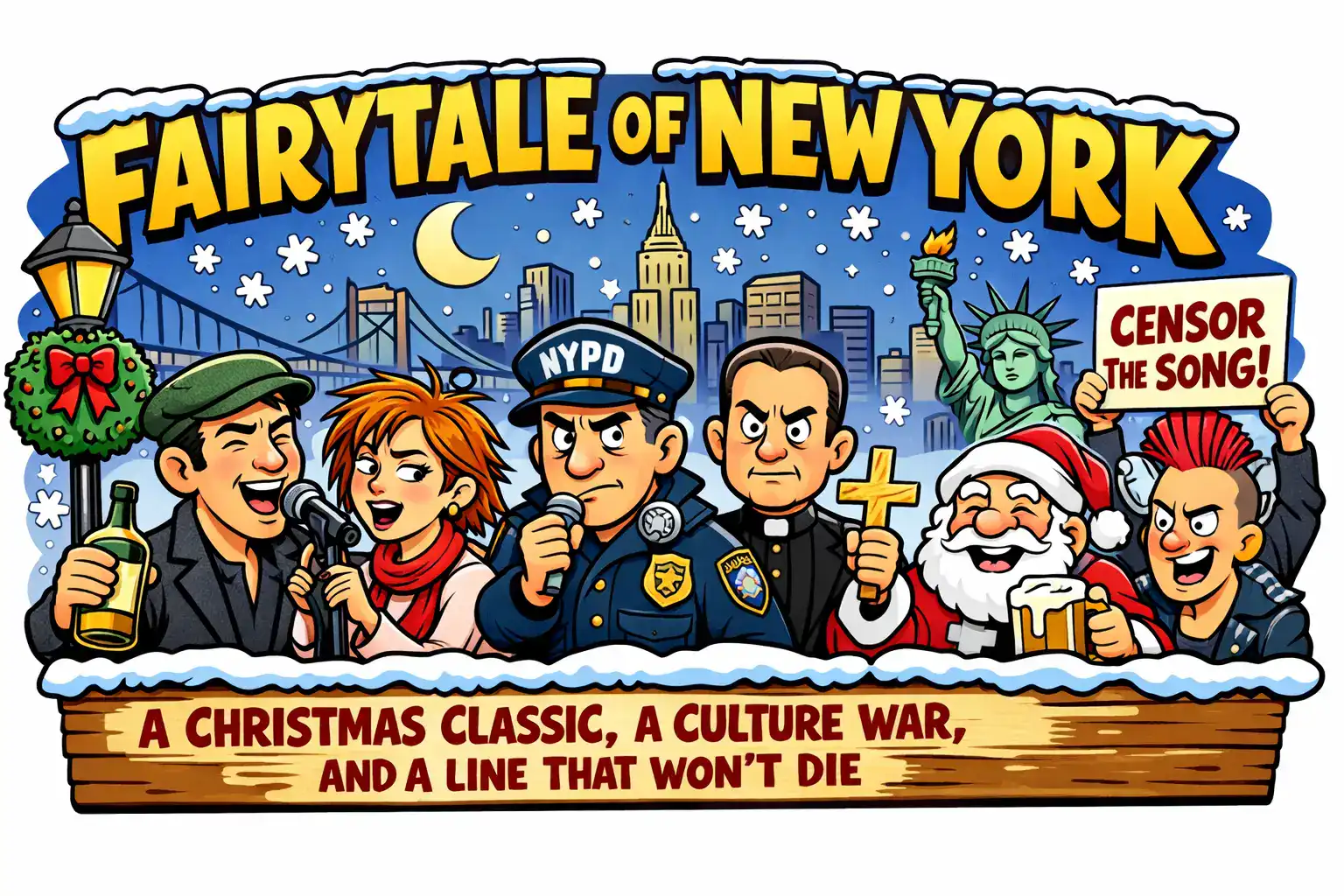
In 1987, English-Irish punk-folk rabble-rousers The Pogues did something quietly revolutionary. They took Christmas music, dragged it out of the cosy living room, sat it on a pub step at 2am, and forced it to admit that not everyone is having a magical time.
The result was Fairytale of New York. A song so beloved it’s now unavoidable every December, yet so volatile it restarts the same argument every single year like an annual festive tradition nobody formally agreed to.
At the time, the Christmas charts were drowning in glossy cheer. You had Wham! sobbing into jumpers on ski slopes with Last Christmas, and Chris Rea gently trundling home through traffic in Driving Home for Christmas. Polite, warm, radio-safe stuff.
Then The Pogues kicked the door off its hinges.
No snow globes. No miracles. Just broken dreams, immigration, addiction, ageing, love that survives mostly out of stubbornness, and Christmas as it actually feels for a lot of people. Messy. Loud. Hungover. Real.
And then there’s that lyric.
🚨 THE LINE THAT SHATTERS THE FESTIVE BUBBLE
There’s a moment in Fairytale of New York that pulls many queer listeners clean out of the song like a needle skipping the record.
On the original recording, Kirsty MacColl delivers:
“You scumbag, you maggot
You cheap lousy f****t
Happy Christmas, your arse
I pray God it’s our last”
For some, it’s defended as character, context, or gritty realism.
For others, it lands with the thud of a word that’s been used as a weapon far too often to feel abstract or harmless.
Both reactions are real. And crucially, this discomfort is not new.
📺 THIS ISN’T A 2020s PROBLEM
One of the laziest arguments rolled out every December is that objections to the lyric are a modern invention. A symptom of “cancel culture”. A sign people are “too sensitive now”.
History says otherwise.
As far back as the early 1990s, the song’s creators and broadcasters were already showing visible unease. In 1992, during a performance on Top of the Pops, MacColl herself altered the lyric to:
“You’re cheap and you’re haggard”
No social media outrage. No petitions. No trending hashtags. Just a conscious choice.
Around the same time, the BBC and other stations routinely censored words like “f****t” and “slut” when airing the song. This wasn’t progressive Twitter pressure. It was a recognition, even then, that broadcasting misogynistic and homophobic slurs in a Christmas hit might not sit comfortably with a family audience.
So let’s be clear:
the debate didn’t suddenly appear. It’s been there all along.
📰 THE ANNUAL COLUMNIST FREAK-OUT
Despite this, every December brings the same predictable backlash. Opinion columns pile up in the right-wing press, written mostly by people who’ve never had that word thrown at them in anger, defending the lyric as sacred, untouchable, and under attack.
We’re told free speech is dying.
We’re told tradition is under threat.
We’re told rock music is being neutered.
And yet, nobody is banning the song. Nobody is erasing Shane MacGowan from history. Nobody is breaking into your house and confiscating your Pogues vinyl.
What is happening is a conversation. One that’s been going on quietly for decades, now simply louder because more people feel able to speak.
That isn’t censorship. That’s society doing what it’s always done: reassessing itself.
🖤 A CLASSIC CAN STILL BE COMPLICATED
Fairytale of New York remains a staggering piece of songwriting. It’s bleak, funny, tragic, tender, and brutally honest. It tells a truth most Christmas songs refuse to touch: that December doesn’t magically fix your life.
But loving a song doesn’t require blind loyalty.
You can sing every word and still acknowledge that one line hurts.
You can admire its realism while accepting language evolves.
You can hold nostalgia in one hand and empathy in the other.
Rock music has never been about freezing culture in amber. It’s about friction, discomfort, and growth. Pretending otherwise is revisionism with a pint in hand.
🎄🔥 SO WHERE DOES THAT LEAVE US?
Fairytale of New York endures because it refuses to lie.
The debate endures because people refuse to be silent.
If Christmas is about anything beyond novelty jumpers and reheated leftovers, it’s about recognising other people’s humanity. Even when it’s awkward. Especially when it challenges tradition.
So play the song.
Argue about it in the pub.
Shout the chorus at the radio.
Just don’t pretend this conversation is new, or that it’s coming from nowhere.
It’s been there since the first time that piano intro cracked through the speakers.
And it’s not going away, mun. 🤘🎄