
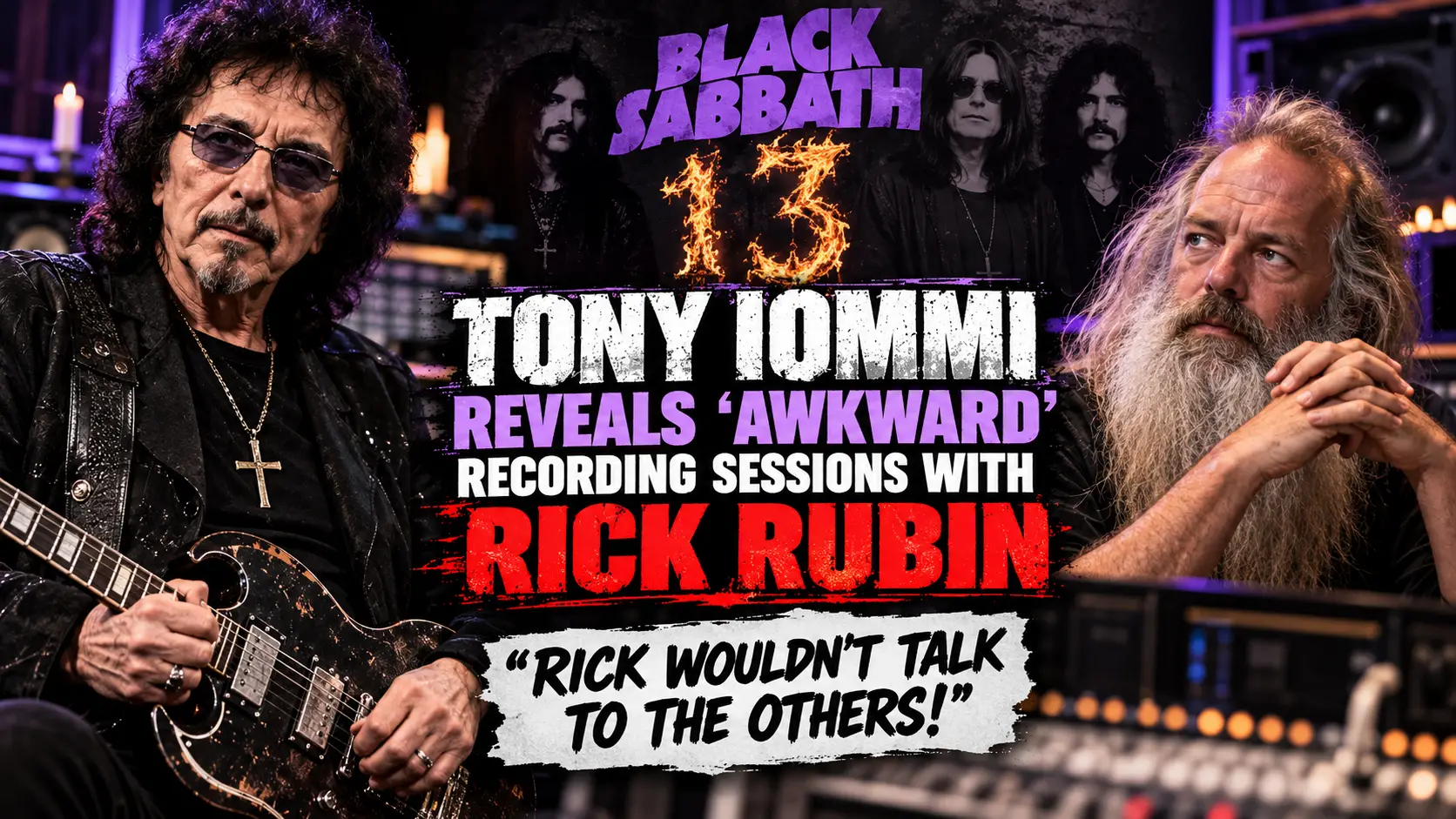
BLACK SABBATH legend TONY IOMMI has lifted the lid on the uncomfortable recording sessions behind the band’s final studio album, 13, revealing that legendary producer RICK RUBIN would communicate almost exclusively with him rather than fellow bandmates OZZY OSBOURNE and GEEZER BUTLER. The guitarist has recalled bizarre situations, unexpected songwriting demands and the frustration of being forced to act as the middleman during the creation of the 2013 record.
When you bring together three of heavy metal’s founding fathers and one of the world’s most celebrated record producers, you’d expect the results to be extraordinary.
And musically, BLACK SABBATH’s 2013 comeback album 13 certainly delivered.
The record reunited Tony Iommi, Ozzy Osbourne and Geezer Butler for their first studio album together in 35 years, storming to Number One in both Britain and America.
But according to Iommi, the atmosphere behind the scenes was considerably less harmonious than fans might have imagined.
Speaking during a new interview with Planet Rock’s Ian Danter, the legendary guitarist has revealed that working with producer Rick Rubin was a surprisingly uncomfortable experience.
Rather than communicating with the entire band, Rubin apparently preferred to deliver instructions through Iommi.
That left the guitarist responsible for passing information to his bandmates, sometimes with very little notice.
And one particularly extraordinary incident involving a last-minute request for a song inspired by Planet Caravan perfectly illustrates just how strange things became.
🎸 “Rick Wouldn’t Talk To The Others” – Tony Iommi Reveals Studio Tensions
Iommi made the revelations while discussing the recording process for his new solo album, From The Dark, released on Friday 23 October 2026.
The guitarist explained that working with longtime collaborator Mike Exeter on his latest record had been a much smoother experience than recording BLACK SABBATH’s final studio album.
Looking back on the 13 sessions, Iommi claimed that communication between Rick Rubin and the other musicians was unusually limited.
According to the guitarist, Rubin would discuss musical ideas and production decisions with him rather than addressing Geezer Butler or Ozzy Osbourne directly.
Iommi would then be expected to relay those instructions.
It created a situation where the musicians were sometimes unaware of what was happening until recording sessions were already underway.
The guitarist admitted that he still doesn’t understand why Rubin approached the sessions in that particular way.
For musicians who had been working together since the late 1960s, the arrangement was certainly unusual.
BLACK SABBATH had spent decades developing their musical identity through collaboration, experimentation and a shared understanding of how their songs should sound.
Having their creative discussions channelled through one member was hardly an ideal arrangement.
And as Iommi revealed, the situation occasionally became downright bizarre.
💀 Rick Rubin Demanded A New Song Over The Weekend!
One particularly memorable incident occurred while BLACK SABBATH were recording in Los Angeles.
Iommi recalled receiving a telephone call from Rubin on a Friday.
The producer wanted him to write a new composition inspired by ‘Planet Caravan’, the atmospheric track from BLACK SABBATH’s landmark 1970 album Paranoid.
There was just one problem.
Rubin wanted the song ready to record on Monday.
That gave Iommi only the weekend to develop something suitable.
Despite being surprised by the request, the guitarist went away and began working on an idea.
By Monday, he had prepared material that Rubin was apparently keen to record.
But there was another complication.
Nobody had told the other members of BLACK SABBATH about the song!
When the musicians arrived at the studio, Rubin announced that they would be recording Iommi’s new composition.
Geezer Butler was understandably confused.
The bassist had not heard the material, had not been involved in developing it and did not even know which key it was in.
Nevertheless, the producer apparently expected the band to begin recording.
Iommi remembered the situation as deeply awkward.
Although the musicians eventually managed to put the song down, the incident left a lasting impression on the guitarist.
For a band responsible for some of heavy metal’s most influential recordings, it was a remarkably unconventional way of working.
🎶 Why Did Rubin Want Another ‘Planet Caravan’?
The request becomes particularly interesting when you consider the original song.
Released in September 1970, Planet Caravan appeared on BLACK SABBATH’s second studio album, Paranoid.
Unlike the crushing riffs of War Pigs, Iron Man and the album’s title track, Planet Caravan explored a much more atmospheric musical direction.
The composition featured gentle guitar arrangements, unusual percussion and Ozzy Osbourne’s heavily processed vocals.
Its dreamy, psychedelic atmosphere demonstrated that BLACK SABBATH were capable of considerably more than simply delivering heavy guitar riffs.
The song also reflected the band’s willingness to experiment during their early years.
For Rick Rubin, Planet Caravan represented the sort of creative freedom he wanted the musicians to revisit.
His approach to 13 was heavily influenced by a desire to recreate the atmosphere of BLACK SABBATH’s earliest recordings.
Rather than attempting to produce a modern heavy metal album, he wanted the group to reconnect with the musical instincts that had shaped their groundbreaking debut.
It was an interesting idea in principle.
But according to the musicians themselves, the execution was not always particularly enjoyable.
⚡ GEEZER BUTLER Had Already Criticised Rick Rubin’s Production Methods
Tony Iommi is not the first BLACK SABBATH member to express frustration about recording 13.
In April 2022, bassist Geezer Butler discussed his experiences during an interview with Eddie Trunk.
Butler described working with Rubin as a strange experience, revealing that the producer had encouraged the band to forget their status as heavy metal legends.
Instead, Rubin wanted them to imagine they were recording the follow-up to their original 1970 debut album.
The producer apparently played the musicians their earliest recordings and encouraged them to rediscover the sound and atmosphere of that period.
Butler was unconvinced.
After all, BLACK SABBATH had spent more than four decades developing their songwriting, musicianship and creative approach.
Asking them to behave as though none of that musical evolution had happened was always going to be challenging.
The bassist also expressed frustration with Rubin’s production style.
He recalled receiving instructions without detailed explanations about why particular musical changes were necessary.
Rather than discussing the reasoning behind decisions, Rubin would sometimes simply approve or reject ideas.
For musicians accustomed to developing songs collaboratively, that approach could become frustrating.
🎤 Ozzy Osbourne Wasn’t Happy With The Recording Process Either
The late Ozzy Osbourne also expressed reservations about his experience recording 13.
During a 2022 interview, the BLACK SABBATH frontman admitted that he did not feel particularly enthusiastic about the finished album.
Although he remained friends with Rick Rubin, Ozzy suggested that the recording process had not provided the creative satisfaction he had hoped for.
The singer felt that the musicians had surrendered too much control over their own music.
He also expressed disappointment that original drummer Bill Ward had not participated in the recording.
For Ozzy, the absence of Ward meant that the album did not completely represent the BLACK SABBATH lineup responsible for creating the band’s earliest recordings.
Despite those reservations, 13 became an enormous commercial success.
The contrast between the album’s reception and the musicians’ memories of recording it is fascinating.
Sometimes a successful album doesn’t necessarily mean everyone enjoyed making it.
🥁 Why Didn’t Bill Ward Play On ‘13’?
One of the most significant controversies surrounding BLACK SABBATH’s reunion involved original drummer Bill Ward.
When the band announced their reunion in 2011, the intention was to bring together the four founding members:
- Ozzy Osbourne – Lead vocals
- Tony Iommi – Guitar
- Geezer Butler – Bass guitar
- Bill Ward – Drums
However, disagreements surrounding Ward’s proposed contract prevented him from participating in the album.
The drummer described the agreement he had been offered as unacceptable and ultimately withdrew from the project.
BLACK SABBATH subsequently recruited Brad Wilk, best known for his work with RAGE AGAINST THE MACHINE and AUDIOSLAVE, to record the drum parts.
Wilk brought considerable experience and technical ability to the sessions.
However, for some fans, the absence of Ward remained a significant disappointment.
After all, his distinctive drumming had been an essential part of BLACK SABBATH’s original sound.
For the accompanying tour, the band used Ozzy’s longtime touring drummer Tommy Clufetos.
Ward would eventually reunite with his original bandmates for their final performance at Birmingham’s Villa Park in July 2025.
💿 BLACK SABBATH’s ‘13’ Became A Worldwide Number One Album
Despite the difficult recording sessions, 13 became one of BLACK SABBATH’s most commercially successful albums.
Released on 10 June 2013, the record marked the return of Ozzy Osbourne to the band’s studio lineup for the first time since 1978’s Never Say Die!.
The album debuted at Number One on the UK Albums Chart.
It was BLACK SABBATH’s first British chart-topping album since Paranoid in 1970.
The record also reached Number One on the American Billboard 200, giving the band their first chart-topping album in the United States.
For a group that had helped establish heavy metal more than four decades earlier, the achievement was extraordinary.
🎸 BLACK SABBATH – ‘13’ Official Tracklist
- End Of The Beginning
- God Is Dead?
- Loner
- Zeitgeist
- Age Of Reason
- Live Forever
- Damaged Soul
- Dear Father
The album deliberately revisited the darker, slower and more atmospheric arrangements associated with BLACK SABBATH’s earliest recordings.
Songs such as End Of The Beginning and God Is Dead? featured enormous guitar riffs, ominous atmospheres and the unmistakable combination of Iommi’s guitar and Ozzy’s vocals.
Meanwhile, Zeitgeist explored a softer, psychedelic direction reminiscent of Planet Caravan.
The record was widely recognised as a return to the band’s musical roots.
And while the musicians may have had reservations about the production process, the finished album clearly connected with audiences.
🏆 ‘God Is Dead?’ Wins BLACK SABBATH A Grammy Award
One of the album’s biggest achievements came through the song God Is Dead?.
The track won Best Metal Performance at the 56th Annual Grammy Awards in January 2014.
It represented another important milestone for a band whose influence on the development of heavy metal was already firmly established.
The song combined heavy, slow-moving guitar arrangements with darker lyrical themes and an extended running time.
Its structure reflected the ambitious songwriting that had helped distinguish BLACK SABBATH during the early 1970s.
For Tony Iommi, the track also demonstrated that his distinctive guitar style remained enormously influential.
More than four decades after creating some of the first heavy metal riffs, he was still producing music capable of earning international recognition.
🎸 Rick Rubin – One Of Rock’s Most Successful Producers
Despite the criticism surrounding 13, Rick Rubin remains one of the most influential producers in modern music.
His career spans hip-hop, rock, heavy metal, country and alternative music.
During the 1980s, Rubin helped establish Def Jam Recordings and played an important role in the development of American hip-hop.
He subsequently worked with numerous major rock and metal artists.
His production credits include recordings by:
- SLAYER
- METALLICA
- RED HOT CHILI PEPPERS
- SYSTEM OF A DOWN
- AUDIOSLAVE
- AC/DC
- DANZIG
- JOHNNY CASH
- TOM PETTY
- THE CULT
Rubin is known for encouraging musicians to strip away unnecessary elements and concentrate on the fundamental strengths of their songwriting.
That philosophy has contributed to several enormously successful albums.
However, his production methods have occasionally divided opinion among the musicians who work with him.
Some artists appreciate his emphasis on simplicity and creative instinct.
Others have found his approach difficult, particularly when he challenges established working methods.
For BLACK SABBATH, the desire to recreate the atmosphere of their earliest recordings appears to have produced both successful music and considerable frustration.
Importantly, Iommi’s comments reflect his experience of the sessions. Rubin has not provided a new public response to the guitarist’s latest remarks.
🔥 Tony Iommi Says Recording His New Solo Album Was Much Easier
The revelations come as Tony Iommi celebrates the release of his latest solo album, From The Dark.
Released on Friday 23 October 2026 through BMG, the record marks his first solo studio album in more than two decades.
The project follows Fused, his 2005 collaboration with Glenn Hughes.
For the new record, Iommi worked with producer and engineer Mike Exeter, who has a long history of collaborating with the guitarist.
According to Iommi, the experience was considerably more relaxed than recording BLACK SABBATH’s 13.
Rather than working under sudden deadlines or receiving unexpected requests, the musicians were able to develop ideas at a more natural pace.
The guitarist explained that he appreciates having time to experiment with arrangements and consider how each composition develops.
That collaborative approach appears to have made the recording process more enjoyable.
And after the unusual experiences surrounding 13, that must have been something of a relief!
💿 ‘From The Dark’ – A New Chapter For Heavy Metal’s Founding Guitarist
Tony Iommi’s new album features a collection of musicians from across the rock and metal world.
Among the contributors are:
- Tony Iommi – Guitar
- Jørn Lande – Vocals
- Becky Baldwin – Bass guitar
- Karl Brazil – Drums
- Brian May – Guest guitar appearance
The involvement of QUEEN guitarist Brian May is particularly exciting.
The two musicians have maintained a friendship for decades, sharing a mutual respect for each other’s achievements.
Their collaboration on the track Death Wake brings together two of Britain’s most influential rock guitarists.
The album also features previously released singles World Alone and Stormwatcher.
For BLACK SABBATH fans, the record provides another opportunity to hear the unmistakable guitar sound that helped create heavy metal.
And with Iommi continuing to record new music at 78 years old, his enthusiasm for heavy riffs clearly hasn’t disappeared.
🖤 Would BLACK SABBATH Ever Have Recorded Another Album?
Tony Iommi has also recently discussed the possibility of BLACK SABBATH recording another studio album after 13.
Producer Andrew Watt, who worked with Ozzy Osbourne on his later solo recordings, had expressed interest in bringing the original lineup back into the studio.
The proposed project would have featured Ozzy, Tony, Geezer and Bill Ward.
However, Iommi was reluctant to commit to another reunion album.
His experience recording 13 had demonstrated how complicated the process could become when working with an outside producer.
He also questioned whether another album would be creatively worthwhile.
Watt has offered a different recollection of the discussions, suggesting that the musicians had shown interest before practical difficulties prevented the project from progressing.
Ultimately, the proposed recording never happened.
And following Ozzy Osbourne’s death on 22 July 2025, the possibility of another album featuring the original lineup came to an end.
That means 13 will remain BLACK SABBATH’s final studio album.
💀 BLACK SABBATH’s Final Performance Brought Their Story Full Circle
Although the musicians never recorded another album together, they did reunite for one final extraordinary live performance.
On 5 July 2025, BLACK SABBATH’s original lineup appeared at Villa Park in Birmingham as part of the historic Back To The Beginning concert.
The event brought together some of heavy metal’s biggest names to celebrate the band’s extraordinary influence.
Artists including METALLICA, GUNS N’ ROSES, SLAYER, TOOL, PANTERA, GOJIRA and ANTHRAX participated in the celebrations.
For Ozzy, Tony, Geezer and Bill, the performance represented a final opportunity to share the stage in their hometown.
The four musicians performed:
- War Pigs
- N.I.B.
- Iron Man
- Paranoid
It was an emotional conclusion to a musical partnership that had begun in Birmingham during the late 1960s.
Just 17 days later, Ozzy Osbourne died at the age of 76.
The performance therefore became not only BLACK SABBATH’s final concert but also the last live appearance of one of heavy metal’s founding figures.
For Iommi, the memories of that evening remain deeply personal.
🎶 The Extraordinary Legacy Of BLACK SABBATH’s Final Album
Looking back, 13 occupies a fascinating position in BLACK SABBATH’s history.
It was not recorded by the complete original lineup.
Its production process was apparently uncomfortable for several band members.
And Ozzy Osbourne later admitted that he had mixed feelings about the finished record.
Yet it also achieved extraordinary commercial success.
It returned BLACK SABBATH to the top of the British album charts after more than four decades.
It delivered the band’s first American Number One album.
And it demonstrated that the musicians responsible for creating heavy metal could still produce powerful recordings well into their careers.
For fans, 13 remains an important final chapter.
It brought together three of the musicians whose groundbreaking work had changed rock music forever.
And despite the difficult circumstances surrounding its creation, the album preserved the unmistakable sound of Ozzy Osbourne singing over Tony Iommi’s legendary guitar riffs one final time in the studio.
🤘 THE RIFF REPORT VERDICT – A Classic Album Born From Some Very Awkward Sessions!
Tony Iommi’s latest revelations provide a fascinating glimpse behind the scenes of BLACK SABBATH’s final studio album.
For fans listening to 13, the music sounds like a deliberate return to the band’s heavy, atmospheric beginnings.
But according to Iommi, achieving that sound involved some distinctly uncomfortable moments.
Rick Rubin’s decision to communicate primarily through the guitarist apparently created confusion among the other musicians.
And asking Iommi to write a Planet Caravan-inspired composition over a single weekend without informing Geezer Butler certainly wasn’t the most straightforward approach to recording!
The comments also reinforce earlier criticism from Butler and Ozzy Osbourne, both of whom expressed reservations about Rubin’s production methods.
Yet there is an interesting contradiction at the heart of the story.
Despite those difficulties, 13 became a Number One album on both sides of the Atlantic and earned BLACK SABBATH another Grammy Award.
It also gave fans something they had waited 35 years to hear: new studio recordings featuring Ozzy, Tony and Geezer together.
Now, with Iommi releasing his new solo album From The Dark, he appears to have rediscovered a more comfortable and collaborative recording environment.
And after more than five decades of creating some of heavy metal’s greatest riffs, he has certainly earned the right to work in a way that suits him.
One legendary band. One superstar producer. One unforgettable album. And some seriously awkward conversations!
BLACK SABBATH’s ‘13’ might have been a nightmare to record – but the music helped bring heavy metal’s founding fathers back to the top of the charts!
TONY IOMMI – FOREVER THE RIFF MASTER! 🎸💀🔥🤘
THE RIFF REPORT BLOG – MUSIC JOURNALISM WITH BOOTS AT THE BARRICADE!