
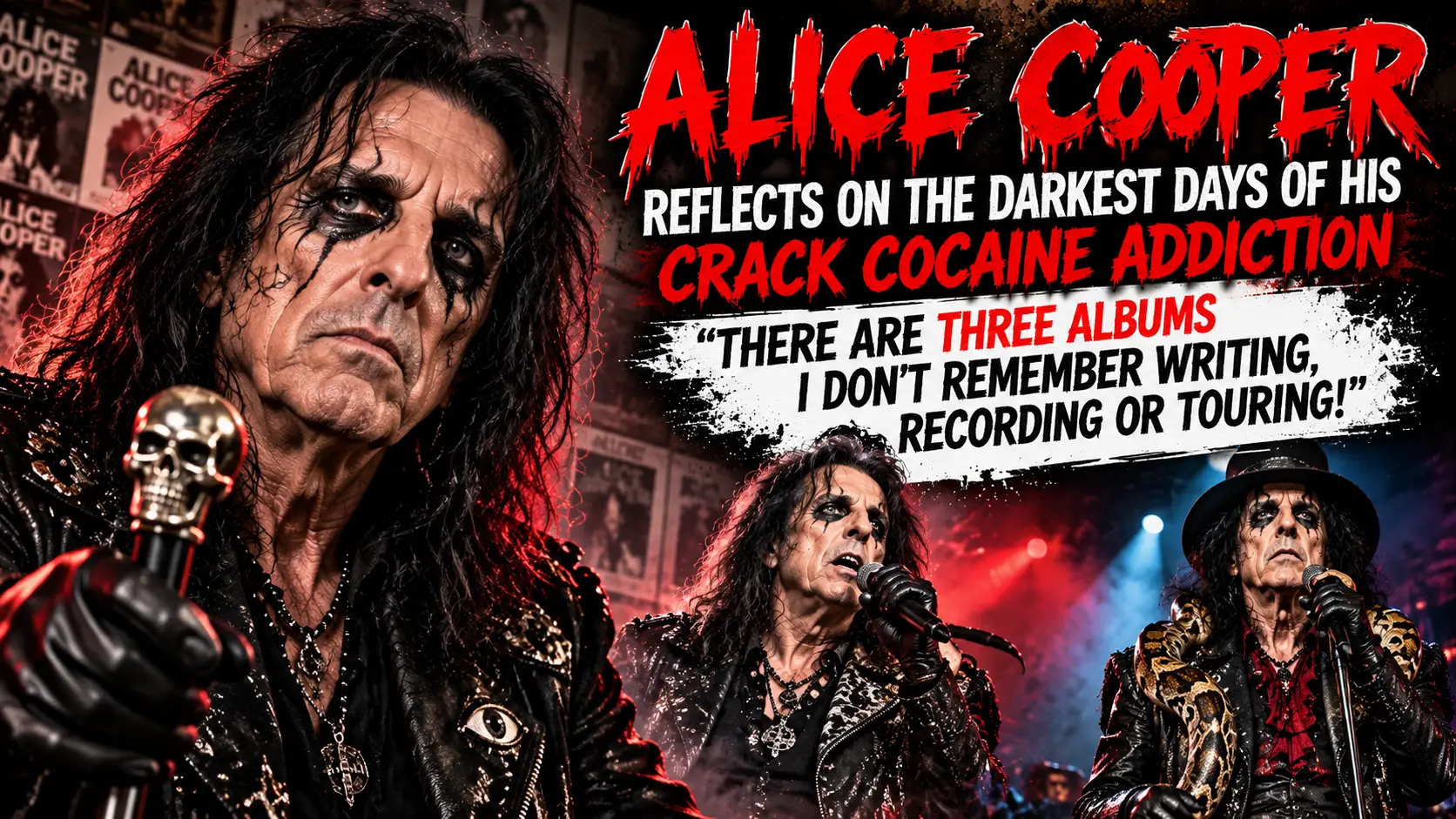
The Godfather of Shock Rock, ALICE COOPER, has opened up about one of the darkest periods of his extraordinary career, revealing how his addiction to alcohol and crack cocaine became so severe that he has virtually no memory of creating three of his own studio albums. Now 78 years old and celebrating more than four decades of sobriety, the legendary musician is looking back on the frightening reality of his addiction, the damage it caused to his personal life and the extraordinary journey that eventually saved him.
Behind the terrifying stage make-up, theatrical guillotines, blood-soaked performances and some of rock music’s greatest anthems, Alice Cooper has lived a life filled with extraordinary highs and devastating lows.
And while the legendary frontman has spent more than six decades entertaining millions of fans around the world, there was a period when his real-life struggles were considerably more frightening than anything he portrayed on stage.
During the late 1970s and early 1980s, Cooper’s problems with alcohol and drugs spiralled dangerously out of control.
His addiction became so severe that entire sections of his career are now missing from his memory.
Not just individual recording sessions or concerts.
Three complete studio albums.
And with the release of his new autobiography, Devil On My Shoulder, Cooper has been reflecting on how close those years came to costing him everything.
💀 “I Don’t Remember Writing, Recording Or Touring” – ALICE COOPER’s Lost Years
For most musicians, recording an album represents a significant creative achievement.
Countless hours are spent developing songs, experimenting in recording studios, rehearsing arrangements and preparing for tours.
Those experiences often become some of the most memorable moments of an artist’s career.
But for Alice Cooper, three albums released during the early 1980s represent an extraordinary gap in his memory.
The records are:
Album
Release year
Special Forces
1981
Zipper Catches Skin
1982
DaDa
1983
Cooper has frequently referred to these recordings as his “blackout albums” because of the substance misuse that dominated his life during their creation.
In previous interviews, he has admitted:
“I can’t remember writing, recording or touring for at least three albums.”
The statement is remarkable when you consider the amount of work involved in making even one studio album.
Yet Cooper has explained that his memories of this entire period remain fragmented.
He can listen to the music today.
He can recognise his voice.
He can appreciate the songwriting.
But he struggles to remember actually creating it.
An important distinction is that Cooper did not tour all three records individually. His recollection describes a wider period of missing memories rather than a confirmed tour for each album.
🔥 Crack Cocaine Addiction Nearly Cost ALICE COOPER His Life
Although Cooper’s problems with alcohol had already become serious during the 1970s, his subsequent addiction to cocaine created an even more dangerous situation.
Speaking about his experiences while promoting Devil On My Shoulder, Cooper revealed that he had been given dangerously misleading information about smoking cocaine.
He was told that using it in that way would not lead to addiction.
The reality was very different.
Cooper later developed a dependency on crack cocaine, which he has identified as one of the most dangerous periods of his life.
Reflecting on the experience, he said:
“That was really the thing that almost killed me.”
The singer has spoken candidly about the physical and psychological consequences of his addiction.
His health deteriorated, his personal relationships suffered and his ability to remember important periods of his career was severely affected.
For someone whose professional identity was built around portraying a terrifying character, the distinction between theatrical horror and real-life danger had become painfully clear.
The greatest threat to Alice Cooper wasn’t a guillotine, a snake or a stage illusion.
It was his addiction.
🎸 The Three Albums ALICE COOPER Can Barely Remember
Perhaps the most fascinating aspect of Cooper’s story is that the music he recorded during this difficult period remains an important part of his catalogue.
Although the albums did not achieve the enormous commercial success of earlier releases such as Billion Dollar Babies or Welcome To My Nightmare, they have developed dedicated followings among longtime fans.
⚡ SPECIAL FORCES (1981)
Released in 1981, Special Forces marked another stylistic change for Cooper.
Rather than concentrating entirely on the theatrical hard rock associated with his early career, the record incorporated elements of new wave, punk and stripped-back rock music.
Its songs included Who Do You Think We Are, Seven And Seven Is, Prettiest Cop On The Block and You Want It, You Got It.
The album represented an unusual creative period as Cooper experimented with new sounds and approaches to songwriting.
However, his substance misuse was taking an increasingly serious toll.
Looking back at photographs and television appearances from the era, Cooper has acknowledged that his physical appearance reflected the damage being caused by his lifestyle.
The Special Forces period included live performances, but the singer has admitted that he remembers surprisingly little about the experience.
💀 ZIPPER CATCHES SKIN (1982)
The following year, Cooper released Zipper Catches Skin.
The album continued his exploration of new wave and alternative rock influences, moving further away from the sound that had established his mainstream popularity during the 1970s.
Tracks included Zorro’s Ascent, I Am The Future, No Baloney Homosapiens and I Better Be Good.
Although the record was commercially unsuccessful, it remains an intriguing part of Cooper’s catalogue.
For collectors and dedicated fans, it offers a glimpse into a particularly experimental period.
Cooper himself has expressed surprise at the quality of some of its songwriting.
Listening back decades later, he has admitted that he enjoys several of the compositions despite having little recollection of creating them.
The album was not supported by a conventional concert tour.
🖤 DADA (1983)
Perhaps the most unusual of the three recordings is DaDa.
Released in 1983, the album reunited Cooper with producer Bob Ezrin, who had previously helped shape some of his most successful records.
Its dark, experimental atmosphere has led many dedicated fans to regard it as an overlooked entry in Cooper’s discography.
Songs such as Former Lee Warmer, Enough’s Enough, I Love America and Pass The Gun Around explored unusual musical arrangements and disturbing lyrical themes.
The record’s unsettling atmosphere is particularly striking when viewed alongside Cooper’s personal circumstances.
However, the singer has never suggested that addiction was responsible for any artistic brilliance associated with the album.
Instead, he has repeatedly emphasised that the music was created despite his problems, not because of them.
And with very little memory of the recording process, DaDa remains one of the most mysterious chapters in his career.
🎶 The Strange Legacy Of The ‘Blackout Albums’
One of the most surprising aspects of this period is Cooper’s attitude towards the music today.
Although he remembers little about its creation, he has frequently expressed admiration for the songs.
In fact, he has suggested that some of the writing was among his most inventive.
The records explored different musical styles, unusual lyrical ideas and experimental arrangements that were not always appreciated when they first appeared.
Over time, however, they developed something of a cult following.
Some longtime Alice Cooper fans consider the early 1980s albums to be among his most interesting releases.
Cooper has even discussed the possibility of revisiting and re-recording material from that period.
His reasoning is straightforward.
He believes some of the songs deserved more attention and better production than they originally received.
It’s a fascinating contradiction.
Three albums he can barely remember creating have become favourites among some of his most dedicated supporters.
But Cooper has made it clear that he would never want to return to the circumstances in which they were recorded.
🍻 Alcohol Addiction Had Already Taken A Devastating Toll
Cooper’s struggles began long before the release of those three albums.
During the height of his success in the 1970s, heavy drinking became an increasingly important part of his daily life.
At first, alcohol was closely connected to the rock ‘n’ roll culture surrounding the band.
Touring musicians frequently encountered environments where excessive drinking and substance use were considered normal.
However, Cooper’s consumption gradually became difficult to control.
He has recalled experiencing serious physical symptoms that eventually forced him to recognise the danger.
His first major period of rehabilitation came during the 1970s.
Those experiences subsequently inspired his 1978 concept album From The Inside.
The record explored life inside a treatment facility, transforming Cooper’s personal experiences into a collection of songs featuring unusual characters and emotional storytelling.
Yet his initial period of sobriety did not last.
He eventually returned to drinking, and his problems later escalated through drug use.
By the early 1980s, the situation had become increasingly dangerous.
❤️ SHERYL GODDARD – The Woman Who Helped Save ALICE COOPER
One of the most important people in Cooper’s journey towards recovery was his wife, Sheryl Goddard.
The couple married in 1976 and celebrated their 50th wedding anniversary in 2026.
But their relationship came under enormous pressure during the singer’s years of addiction.
Cooper has spoken openly about how his behaviour threatened their marriage.
By 1983, the situation had reached a breaking point.
Sheryl made it clear that he needed to address his addiction and make serious changes to his life.
For Cooper, that became a decisive moment.
He returned to treatment, recommitted himself to sobriety and began rebuilding his personal relationships.
His Christian faith also became an important part of his recovery.
The singer has credited the support of his wife, family and faith with helping him establish a healthier lifestyle.
Cooper has remained sober since 1983 – more than 43 years.
It’s an extraordinary achievement for someone who once believed his addiction might cost him his life.
🎭 ALICE COOPER Vs VINCENT FURNIER – Separating The Man From The Monster
Another important part of Cooper’s recovery involved learning to distinguish between his public persona and his private identity.
Born Vincent Damon Furnier in Detroit on 4 February 1948, the musician developed the Alice Cooper character during the late 1960s.
The name originally belonged to the band before becoming associated with its frontman.
Over time, Cooper’s elaborate stage performances became increasingly theatrical.
Guillotines.
Electric chairs.
Snakes.
Fake blood.
Monsters.
Nightmarish stage characters.
The musician transformed horror imagery into a distinctive form of live entertainment.
But during his struggles with addiction, the boundary between the performer and the individual became increasingly complicated.
Cooper has recalled an important conversation with a psychiatrist who encouraged him to recognise that the fictional Alice Cooper character was not responsible for his drinking.
That distinction changed the way he viewed his life.
He eventually learned to treat Alice Cooper as a theatrical role rather than an identity that needed to dominate his everyday existence.
Today, the singer describes himself as very different from the sinister character audiences see on stage.
And that separation has become an essential part of his personal wellbeing.
📚 ‘DEVIL ON MY SHOULDER’ Reveals The Man Behind The Make-Up
Cooper’s latest reflections arrive alongside the release of his autobiography, Devil On My Shoulder.
Published in the UK on 8 October 2026, the book explores the extraordinary experiences that have shaped his life and career.
Rather than simply presenting a collection of outrageous rock ‘n’ roll stories, the memoir examines the reality behind the mythology.
It covers his early years, the creation of the Alice Cooper persona, international success, famous friendships, addiction, recovery and family life.
The book also explores his relationship with the original ALICE COOPER band and the complicated journey that eventually led to his successful solo career.
Co-written with Daniel Richler, the memoir provides an opportunity for the musician to revisit stories that have sometimes been exaggerated or misunderstood over the decades.
For longtime fans, the most compelling chapters may be those exploring the real individual behind the theatrical character.
Cooper has spent decades entertaining audiences with horror.
Now, he is reflecting on the very real difficulties that nearly brought his career to an end.
🏆 ‘DEVIL ON MY SHOULDER’ Reaches Number One In The UK!
The autobiography has also achieved considerable commercial success.
Devil On My Shoulder climbed to the top of The Sunday Times non-fiction bestseller chart, providing Cooper with another major achievement.
The chart success demonstrates the enduring interest in the legendary musician’s life.
And following the book’s release, Cooper completed a series of special UK spoken-word appearances, allowing fans to hear stories from his career directly from the man himself.
The tour included a performance at Cardiff’s New Theatre on 11 October 2026, bringing the Godfather of Shock Rock to the Welsh capital.
Rather than delivering one of his traditional theatrical concerts, the appearances offered audiences an opportunity to discover the stories behind the music.
For fans who have followed Cooper’s career for decades, those conversations provided a different perspective on the musician.
🔥 ALICE COOPER Is Still Rocking At 78!
Despite everything he experienced during the 1970s and 1980s, Cooper remains an enormously active performer.
At 78 years old, he continues to record, tour and entertain audiences worldwide.
His live productions remain famous for combining classic rock anthems with horror-themed theatrical entertainment.
Songs such as School’s Out, Poison, No More Mr. Nice Guy, I’m Eighteen and Feed My Frankenstein continue to feature prominently in his performances.
And rather than relying entirely on nostalgia, Cooper continues to work on new recordings and creative projects.
His forthcoming North American Alice’s Attic Tour begins on 27 October 2026.
He is also preparing for special Las Vegas performances alongside magician Criss Angel, combining rock music with spectacular illusions.
For someone who once faced a life-threatening struggle with addiction, the ability to continue performing more than four decades later represents a remarkable personal achievement.
🎸 From Addiction To Recovery – An Important Message For The Music Community
Cooper’s story also highlights an important issue affecting the wider music industry.
For decades, excessive drinking and drug use were frequently romanticised as part of the rock ‘n’ roll lifestyle.
Stories of outrageous parties and destructive behaviour became part of the mythology surrounding famous musicians.
However, the reality was often considerably darker.
Addiction damaged relationships, disrupted careers and contributed to the deaths of numerous talented artists.
Cooper’s experiences demonstrate that the consequences can be serious, even for musicians who appear successful and confident in public.
His willingness to discuss the subject openly helps challenge the idea that destructive behaviour is an essential part of musical creativity.
And his years of sobriety demonstrate that a successful rock career does not depend on alcohol or drugs.
For musicians facing similar difficulties, there is an important message within his story.
Recovery and a creative life can exist together.
🤘 THE RIFF REPORT VERDICT – ALICE COOPER’s Greatest Victory Wasn’t On Stage
Alice Cooper’s revelations about his addiction provide a sobering reminder of the reality behind rock music’s most outrageous mythology.
For decades, the Godfather of Shock Rock has entertained audiences with terrifying characters, elaborate stage executions and unforgettable music.
But the challenges he experienced away from the spotlight were very real.
The fact that Cooper cannot remember creating three complete studio albums demonstrates just how seriously addiction affected his life.
Those recordings represent years of songwriting, studio sessions and musical experimentation.
Yet for the man responsible for creating them, much of that period remains a blur.
Perhaps the most remarkable part of his story is what happened afterwards.
He sought treatment.
He rebuilt his personal life.
He maintained his sobriety.
And he continued creating music for more than four decades.
Today, at 78 years old, Alice Cooper remains one of rock music’s most recognisable performers.
His new autobiography, Devil On My Shoulder, offers fans an opportunity to discover the difficult reality behind the theatrical legend.
And while the world will always remember the guillotines, snakes, make-up and spectacular performances, his greatest achievement may be something far more personal.
Surviving his addiction and finding a way to live a healthier, happier life.
Three forgotten albums. Decades of extraordinary music. More than 43 years of sobriety.
ALICE COOPER – THE GODFATHER OF SHOCK ROCK WHO SURVIVED HIS DARKEST NIGHTMARE! 🎸💀🖤🤘
THE RIFF REPORT BLOG – MUSIC JOURNALISM WITH BOOTS AT THE BARRICADE!