

At its core, the difference is simple: metal is rock music dialled up to eleven. Think of rock as being built on a foundation of blues scales, infectious grooves, and strong melodies. Metal takes that blueprint and injects it with a huge dose of aggression, speed, and technicality, using much heavier guitar distortion, blistering drum work, and often more extreme vocal styles.
The Core Differences Between Rock and Metal
The best way to get your head around the split is to see metal not as rock's enemy, but as its more intense, rebellious child. Both genres share a common ancestor in the blues-fuelled rock and roll of the 50s and 60s, but they started walking very different paths in the late 1960s and early 1970s. Rock music, for the most part, keeps one foot firmly planted in its roots, prioritising rhythmic swagger, singalong hooks, and lyrics about life, love, and society.
Metal, on the other hand, is all about pushing every single element to its absolute limit. The guitar sound is far more saturated and distorted. The riffs are often faster and more intricate, and the drumming introduces techniques like relentless double-kick patterns that create a powerful, driving force. This intensity carries over to the vocals, which span everything from the soaring, operatic highs of Judas Priest to the guttural, deep roars you'll hear in death metal. The subject matter gets a similar treatment, venturing into darker and more epic territories like mythology, fantasy, warfare, and existential dread.
It really boils down to feel and intent. Rock makes you want to tap your foot and sing along; metal makes you want to headbang. You're shifting from a sound built on groove and attitude to one built on sheer power and aggression.
This diagram gives a great visual summary of where rock and metal diverge.
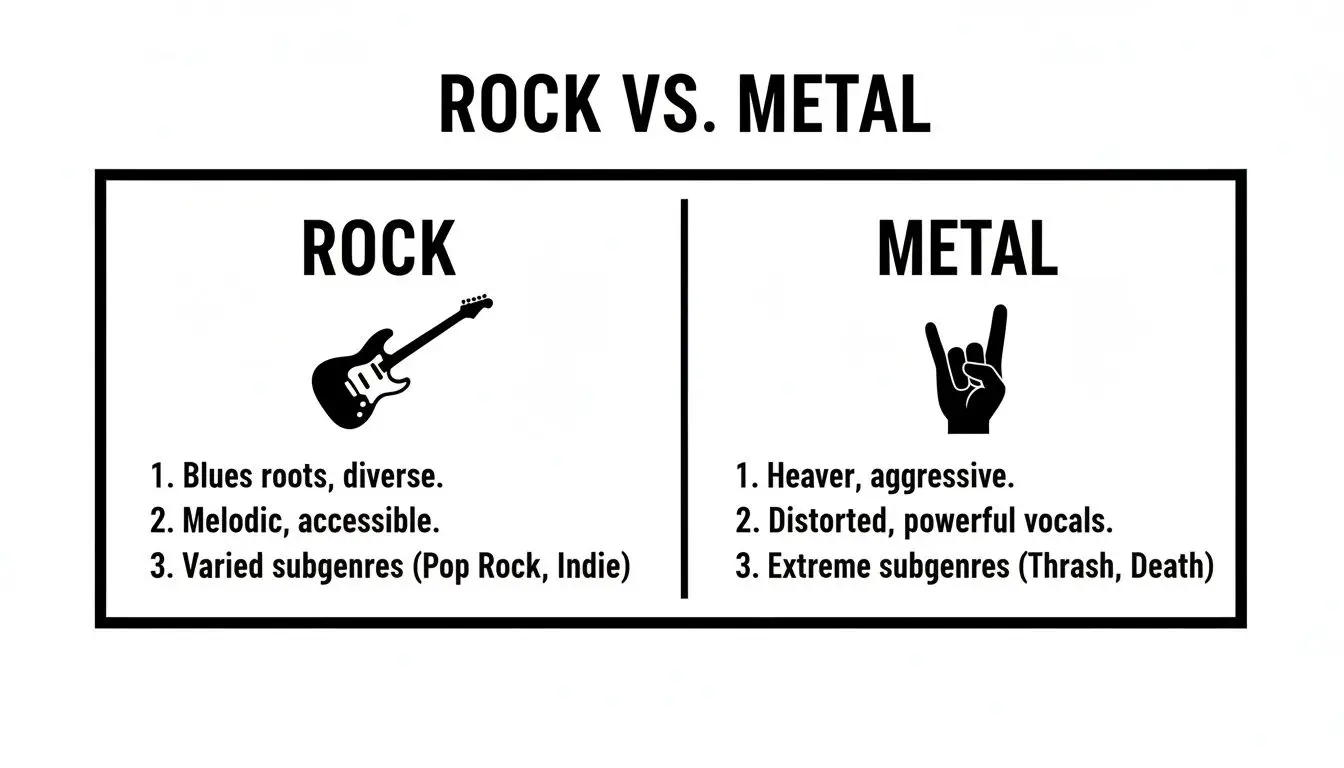
As you can see, metal essentially takes the core components of rock and pushes them into more extreme territory. To give you a clearer idea, here’s a more detailed breakdown of the sonic differences you'll hear.
Rock vs Metal A Quick Sonic Comparison
| Musical Element | Classic & Hard Rock | Heavy Metal |
|---|---|---|
| Guitar Tone | Warm overdrive, blues-based distortion | Saturated, high-gain, heavy distortion |
| Rhythm/Tempo | Groove-focused, steady backbeats | Faster, more complex, double-kick drums |
| Vocal Style | Melodic, bluesy, powerful singing | More diverse; clean, operatic, harsh, gutturals |
| Lyrical Themes | Rebellion, love, social issues, storytelling | Fantasy, mythology, war, darkness, horror |
This table neatly sums up the fundamental shift in sound and substance. While they come from the same family, the way they express themselves couldn't be more different.
Tracing the Roots of Rock and Metal
To really get under the skin of what separates rock and metal, you have to look at where their paths diverged. They both spring from the same well: the electrifying, rebellious energy of 1950s rock and roll, which itself grew out of American blues. This common ancestry is the very reason early hard rock and the first stirrings of metal can sound so alike—they’re cut from the same cloth.
By the mid-1960s, things were getting louder. Bands were pushing their equipment and their attitudes to the limit. You had The Kinks cranking up the distortion on "You Really Got Me" and The Who bringing sheer volume and aggression to the stage. This was the birth of hard rock—a sound that kept the bluesy swagger of rock but turned the power and attitude up to eleven.
The Great Schism of the Late 60s and Early 70s
The real fracture happened as the 1960s bled into the 1970s. It was largely driven by a trio of British bands, often dubbed the "unholy trinity," who laid the foundations for heavy metal: Led Zeppelin, Deep Purple, and Black Sabbath. Each one brought something new and vital to the table, pulling the sound further away from its rock origins.
- Led Zeppelin: They introduced an epic, almost mythic scale. Their sound was colossal, weaving heavy blues riffs with folk mysticism, all held together by Jimmy Page's ambitious production and John Bonham's seismic drumming.
- Deep Purple: These guys brought a new level of musicianship into the mix. Jon Lord's distorted Hammond organ duelling with Ritchie Blackmore's lightning-fast guitar solos injected a classical-inspired virtuosity that would become a staple of metal.
While Zeppelin and Purple were stretching the definition of rock, another band was busy digging its grave. When you're talking about the origins of metal, it’s impossible to overstate the impact of Black Sabbath, the band that truly steered rock into much darker, heavier waters.
The Sound of Industrial Britain
Hailing from the bleak, industrial landscape of Birmingham, Black Sabbath’s music sounded exactly like where it came from. The band made a conscious choice to turn their backs on the "peace and love" vibe that was so common in rock music. Their sound was the polar opposite: slow, menacing, and crushingly heavy.
This was partly born from necessity. After a factory accident cost him the tips of his fingers, guitarist Tony Iommi had to down-tune his guitar and use lighter strings to make playing possible. That happy accident gave birth to a sludgier, darker tone that had never been heard before. When paired with lyrics about war, social collapse, and the occult, it was clear this wasn't rock anymore. It was the blueprint for heavy metal.
Black Sabbath didn't just play loud rock; they summoned a different beast entirely. They used the "tritone," an interval once known as the "devil's interval" in music, to create a feeling of dread and unease that was completely alien to mainstream rock. This wasn't just a louder sound; it was a darker one.
As you dig into their early albums, you can hear them deliberately shedding rock's bluesy swagger. We explore this in much more detail in our feature, Black Sabbath The One Day Ritual That Created Heavy Metal.
The New Wave of British Heavy Metal
Sabbath lit the fuse, and in the late 1970s and early 1980s, the New Wave of British Heavy Metal (NWOBHM) was the explosion. Bands like Iron Maiden and Judas Priest grabbed Sabbath's heavy template and supercharged it with the frantic speed of punk and the complex arrangements of progressive rock.
This is where the line between rock and metal becomes a chasm. Judas Priest gave us the iconic twin-guitar attack and cemented the leather-and-studs look that defined metal culture for decades. Iron Maiden brought galloping basslines, intricate song structures, and lyrics drawn from history and literature. The bluesy shuffle of rock was all but gone, replaced by razor-sharp precision, speed, and aggression. From here, the two genres were on completely different journeys, each splintering into countless subgenres of their own.
What’s the Difference in Sound? Let’s Get Technical
While you can trace the family tree of rock and metal through history, the real proof is in the listening. To get what really sets them apart, you have to get inside the sound itself—the guitar tones, the rhythm, the vocals. That’s where the true character of each genre lives and breathes.
Take the guitar tone, for a start. A classic rock player, think someone like AC/DC's Angus Young, is all about overdrive. It’s that warm, slightly crunchy sound that gives the guitar some extra bite but still lets you hear the wood and wire. It's a tone with its roots firmly in the blues, designed to make a riff pop and a solo wail.
Metal, on the other hand, is after something else entirely. It's about raw, sonic power. Guitarists crank up the high-gain distortion, pushing the signal until it's a thick, saturated wall of sound. This gives you that immense sustain and chunky weight that's perfect for the kind of heavy, chugging riffs the genre is built on. It's less about bluesy feel and much more about brute force.
The Riff: The Heartbeat of the Song
The way riffs are written is a massive giveaway. Rock riffs often live in the pentatonic scale, that classic five-note scale that gives rock its bluesy, familiar, and incredibly catchy personality. The legendary opening to "Smoke on the Water" by Deep Purple is the perfect case study—it’s dead simple, unforgettable, and delivers maximum impact with just a few notes.
Metal riffs are a different beast. They're usually far more complex and rhythmically locked-in. A vital technique here is palm-muting, where you rest the side of your picking hand on the strings by the bridge. This gives you that tight, percussive "chugga-chugga" sound that is the very foundation for bands like Metallica and Trivium. Metal players also draw from a much wider palette of scales, using chromatic and modal patterns to create more intricate and often much darker-sounding music.
Here’s a quick breakdown of how those riffing styles stack up:
| Riff Characteristic | Classic & Hard Rock | Heavy Metal |
|---|---|---|
| Foundation | Bluesy, groove-oriented, often based on power chords. | Rhythmically precise, often syncopated and technically demanding. |
| Key Scales | Primarily pentatonic and major/minor scales. | Wider variety including modal, chromatic, and diminished scales. |
| Core Technique | Open, ringing power chords and melodic hooks. | Tight palm-muting, tremolo picking, and complex syncopation. |
| Example | The open, swaggering riff in "Whole Lotta Love" by Led Zeppelin. | The fast, palm-muted precision of "Master of Puppets" by Metallica. |
This fundamental difference in riff-writing changes the whole point of the song. A rock tune wants you to find the groove, to move with it. A metal track wants you to bang your head to its relentless, rhythmic assault.
The Rhythmic Engine: Drums and Bass
The rhythm section is the engine room, and it’s another place where rock and metal go their separate ways. In most rock music, the drummer’s job is to lock down a solid backbeat, smashing the snare drum on the second and fourth beats of the bar. It’s a simple, powerful groove that you can feel in your bones, whether it’s early rock and roll or a brand new indie anthem.
Metal drumming is something else. It's an athletic feat, demanding serious stamina and pin-point accuracy. The biggest game-changer for metal drumming was the widespread adoption of double-kick drumming. Using two pedals on one bass drum (or two separate bass drums), drummers can fire off lightning-fast patterns of notes, creating a constant, rumbling assault from the low-end.
When you hear that "machine gun" sound from the bass drum in a metal song, that's the double-kick in action. It completely changes the feel from a head-nodding groove into a powerful, driving force that feels like it’s physically pushing you forward.
On top of that, metal drummers use techniques you’ll almost never hear in rock, like the blast beat—an incredibly fast, chaotic pattern that alternates between the kick and snare. It’s a staple of more extreme metal genres, pushing the music’s speed and aggression to the absolute red line.
The Human Element: Vocal Styles
If there’s one immediate, in-your-face difference, it’s the vocals. Rock singers, almost without exception, are all about the melody. From Robert Plant’s soulful yowl to Freddie Mercury’s stadium-conquering power, the goal is always to deliver a killer melodic line that a crowd can sing back at you.
Metal vocals are a much broader and more extreme world. Of course, plenty of metal bands have incredible clean singers—often with a dramatic, almost operatic delivery, like Iron Maiden's Bruce Dickinson. But the genre is equally famous for its harsh vocal styles. And make no mistake, this isn't just shouting; these are controlled, technical approaches that take years to master without shredding your vocal cords.
- Growls: That deep, guttural roar you associate with death metal.
- Screams: The high-pitched, glass-shattering shriek common in black metal.
- Harsh Vocals: A catch-all term for the aggressive, distorted singing you'll find all over the metal map.
This incredible range of vocal textures lets metal express a much wider emotional spectrum, from epic tales of glory to pure, unfiltered rage. A rock song might show anger through a strained, passionate chorus, but a death metal band like Bridgend's own Venom Prison uses guttural growls to conjure a sound of raw, primal fury, showing just how far the human voice can be pushed.
Comparing the Culture and Identity of Rock and Metal

Once you get past the obvious sonic differences, you find that the real heart of the rock vs. metal debate lies in the culture. These aren't just genres; they're entire ways of life, complete with their own dress codes, philosophies, and community bonds that give each its powerful identity.
You can spot the difference from a mile off. Rock culture is built on a foundation of effortless, timeless cool. We're talking denim jackets, worn-in leather, band t-shirts, and drainpipe jeans. It’s a look that screams rebellion but is so iconic it's been folded into mainstream fashion, making it just as at home in the pub as it is at a stadium gig.
Metal, on the other hand, takes that aesthetic and forges it into a more deliberate, tribal uniform. The denim and leather are still there, but now they serve as a canvas. The battle vest (or 'kutte') is the perfect example—a sleeveless jacket plastered with patches that act as a personal CV, showing off band allegiances and concert histories. It's an identity you wear on your sleeve, or lack thereof.
Lyrical Worlds and Thematic Divides
The stories each genre tells also carve a clear line in the sand. Rock has always been brilliant at holding a mirror up to the world, its lyrics revolving around relatable themes of rebellion, romance, social gripes, and the general rollercoaster of life. Think of Bruce Springsteen’s working-class anthems or the sharp social commentary of our own Manic Street Preachers.
Metal, by contrast, tends to point its lyrical lens towards more fantastical or internal realms. It dives headfirst into darker, more epic subject matter that its crushing sound is perfectly built to carry.
- Mythology and Fantasy: Countless metal bands pull from folklore, epic poetry, and high fantasy, building entire worlds within their albums.
- Warfare and History: From Viking sagas to the trenches of WWI, historical conflicts are a rich source of inspiration, exploring the grand scale of human struggle.
- Existentialism and Horror: Metal has never shied away from the grim stuff, tackling death, nihilism, and the occult with a directness you won't find elsewhere.
A rock song might protest a specific government policy, but a metal song is more likely to explore the timeless, brutal nature of conflict itself. It's a fundamental shift from social observation to a more philosophical or fantastical exploration of heavy themes.
This thematic split is a massive part of what gives each genre its distinct emotional weight. For a deeper dive into the culture and identity of long-term fans, check out our piece on how metalheads and rockers age with style.
Community and Scene Dynamics
The sense of community that forms around the music also feels completely different. Rock’s wide-ranging appeal means its fanbase is massive and diverse. A Stereophonics show at the Principality Stadium will pull in people from every walk of life, all singing along to the same huge choruses. It’s an open, festival-ready atmosphere designed for everyone to join in.
The metal community, though smaller, is often far more tightly bonded. Head to a local death metal night at Fuel Rock Club in Cardiff, and you'll feel an almost tribal connection. There’s a powerful sense of belonging that comes from being part of a subculture that proudly exists outside the mainstream. This shared identity is a huge part of what is the difference between rock and metal on a human level.
Neither is better; they just fulfil different needs. Rock throws a huge party and invites everyone. Metal, on the other hand, builds a home for those who feel like outsiders, creating a fiercely loyal global family in the process.
This is where the rubber really meets the road. On a record, rock and metal can sometimes blur, but in a live setting, the differences are visceral. You don't just hear them; you feel them in the floorboards, see them in the crowd, and get hit by the sheer force of the performance. A rock gig and a metal show might share a venue, but they feel like entirely different worlds.
A classic rock show, whether it’s a stadium-filler or a packed-out pub gig, is all about the shared experience. The atmosphere is often electric and built around huge, singalong choruses. The energy flows from the stage, gets swallowed and amplified by thousands of people singing every word back, and creates this incredible loop. It's a massive, collective celebration.
A metal show, on the other hand, runs on a different kind of fuel. Of course, you’ll get singalong moments—try standing still during a power metal anthem—but the main response is much more physical and intense. The energy isn’t so much about vocal harmony as it is about a raw, kinetic release.
Audience Dynamics and Physical Expression
The most obvious giveaway is how the crowd moves. At a rock concert, you'll see a sea of people swaying, punching the air, and maybe a bit of good-natured shoving near the front. The focus is squarely on the stage, watching the band and adding your voice to the choir.
Metal concerts bring a kind of controlled chaos into the mix. The mosh pit is the genre’s most famous ritual—a swirling pocket of energy where fans let loose through pushing and shoving. It’s not a brawl, it’s a release, and it comes with its own unwritten rules, like the cardinal sin of not helping someone up if they fall. To really get what it’s all about, you need to discover heavy metal concerts for yourself and see the unique etiquette in action.
- Rock Crowd: Geared towards singing, swaying, and a huge vocal experience. The energy is overwhelmingly positive and celebratory.
- Metal Crowd: All about physical expression like headbanging, moshing, or the legendary "wall of death." The energy is intense, cathartic, and almost tribal.
A rock crowd sings with the band; a metal crowd moves with the music. Think of it as the difference between a massive pub singalong and a high-intensity, full-body workout.
This split in audience behaviour shows up in the numbers, too. A deep dive by YouGov into Britons' live music tastes found that classic rock gigs are enjoyed by 20% of the population. Heavy metal, in contrast, appeals to a more niche but incredibly dedicated 12%. This data really highlights rock's broader, more mainstream pull compared to metal's fiercely loyal following. You can see the full breakdown of Britons' tastes in live music on yougov.com.
Production Values and The Wall of Sound
The scale and focus of the production often differ as well. Big rock tours are famous for their stagecraft—spectacular light shows, massive video screens, and pyrotechnics designed to create a dazzling spectacle for a stadium-sized crowd. The goal is pure entertainment.
Metal shows, particularly in clubs and theatres, often prioritise a different kind of impact: raw, overwhelming volume. The sound itself is the main event. That physical punch of a palm-muted riff and the relentless thunder of double-kick drums is a non-negotiable part of the experience. While bigger metal acts certainly put on incredible visual shows, the foundation is always that unapologetic wall of sound that you feel right in your chest.
This focus on pure power shapes everything. Promoters and venues understand this fundamental part of what is the difference between rock and metal when they're putting on a show. Rock’s wider appeal can fill stadiums with fans looking for a great night out, while metal’s dedicated tribe ensures that clubs and specialised festivals like Bloodstock will be rammed with followers craving nothing less than pure, unfiltered sonic force.
Navigating The Blurred Lines And Hybrid Genres

Of course, it’s never that simple, is it? The space between rock and metal isn't a hard border; it’s a fertile, creative playground where some of music’s most thrilling and debated artists thrive. This is where bands throw the rulebook out the window, borrowing from both sides to forge something new.
It’s these "borderline" acts that spark the best arguments down the pub. Take Motörhead. With Lemmy’s gravel-gargling vocals, overdriven bass, and a dose of punk-rock speed, were they a ridiculously loud rock and roll band or the godfathers of speed metal? The truth, of course, is that they were both. Their refusal to be pigeonholed is a massive part of their legacy.
Then you have giants like Guns N' Roses. Their sound is pure blues-soaked, swaggering hard rock at its core. Yet, the raw fury, searing solos, and inner-city grit of Appetite for Destruction had a metallic bite that put them in a different league from their hairspray-and-spandex contemporaries. Understanding this fusion is key to grasping what is the difference between rock and metal and how those lines can be beautifully blurred.
Exploring Key Hybrid Genres
This deliberate mixing of rock and metal has spawned entire subgenres that live and breathe in that ambiguous space. They take the DNA of their parent genres and stitch it together into something fresh.
- Glam Metal: This was arguably the most commercially dominant hybrid. Bands like Mötley Crüe and Poison grabbed the huge, catchy songwriting of hard rock and powered it up with metal's heavier guitars and flashy, over-the-top musicianship. It was pure arena-ready spectacle, blending a rock and roll party with metal’s sonic punch.
- Alternative Metal: A far moodier fusion bubbled up in the early '90s. Alice in Chains is a perfect case study here. They meshed the sludgy, downtuned riffs of classic Sabbath with the dark, personal angst of alternative rock. The result was a sound that was both crushingly heavy and emotionally raw. In a similar way, our look at Metallica’s groundbreaking S&M concerts shows just how powerful genre-blending can be.
The most interesting music often happens at the borders. It’s where artists take the familiar rulebook of rock or metal and start tearing pages out, creating a sound that feels both familiar and entirely new.
Welsh Wizards Of The Grey Area
This spirit of creative fusion is roaring in the Welsh music scene. You only have to look at Newport's Skindred. Their signature "ragga metal" sound is a masterclass in splicing genres, throwing metal, reggae, and punk into a blender. They have all the crushing heaviness of metal but deliver it with a bounce and vocal cadence that owes nothing to metal conventions, proving the best music couldn't care less about neat labels.
Despite this constant cross-pollination, rock still has a much stronger grip on the mainstream. A study spearheaded by Sabaton on UK streaming habits gave rock an enormous 44,986 popularity points, dwarfing other styles. While metal did land in the top five, its specific score wasn't broken out, pointing to its more niche, but fiercely loyal, fanbase. You can dig into the data on the UK's most popular genres over at MetalInjection.net.
Right, theory is one thing, but the only way to truly get a feel for the chasm between rock and metal is to listen. Getting started can feel like staring at a mountain of records, so I've pulled together two 'starter packs' to give you a solid footing in each world.
These aren't meant to be the definitive "greatest hits" – that's a pub argument for another day. Instead, think of them as cornerstones. These are the albums that lay the groundwork for everything that followed, giving you a real taste of each genre's DNA.
The Rock Essentials Starter Pack
This first collection is all about the foundational pillars of hard rock: massive riffs you can't help but nod along to, choruses built for arenas, and a whole lot of swagger. It’s the perfect starting point to understand the powerful, groove-based heart of the genre. There's a reason rock still dominates the UK charts, and its creative spirit is alive and well far beyond the big cities. In fact, Oxford was recently crowned the UK's rock capital per capita, which you can read more about on the National Album Day website.
- AC/DC – Back in Black: This is the bible of no-frills, riff-first rock and roll. Every single track is a masterclass in how much power you can get from just a few chords played with absolute conviction.
- Queen – A Night at the Opera: If AC/DC is about powerful simplicity, Queen shows rock's flamboyant, ambitious side. It’s a glorious mix of intricate vocal harmonies, piano balladry, and blistering guitar anthems.
- Manic Street Preachers – Everything Must Go: A Welsh classic for a reason. This album is the perfect example of how rock can carry intelligent, politically charged lyrics on the back of huge, emotionally soaring tunes.
A Gateway To The Metal Kingdom
Now we cross the border into metal's darker and more aggressive territory. The albums here are landmarks – influential, powerful, but still accessible enough for anyone new to the scene. This is where you’ll hear the shift towards technical speed, precision, and the epic scale that defines metal.
- Judas Priest – British Steel: The sound of the New Wave of British Heavy Metal, boiled down to its absolute essence. It’s all here: the razor-sharp, iconic riffs and Rob Halford’s glass-shattering vocal range.
- Iron Maiden – The Number of the Beast: A masterclass in musical storytelling. Listen for the galloping basslines and the signature twin-guitar harmonies that became a blueprint for countless bands. This is a cornerstone of classic heavy metal.
- Metallica – Master of Puppets: Here’s your jump into thrash metal. The songs get longer, the structures more complex, and the riffing is defined by aggressive, palm-muted chugging. It’s a workout for your ears, but one that pays off massively.
Ultimately, your own ears are the only guide that matters. Pick an album from each list and really listen. Do you find yourself drawn to the bluesy swagger of AC/DC, or does the technical fury of Metallica grab you? Figuring that out is the first real step to finding your place in the wide world of heavy music.
Generated with Outrank