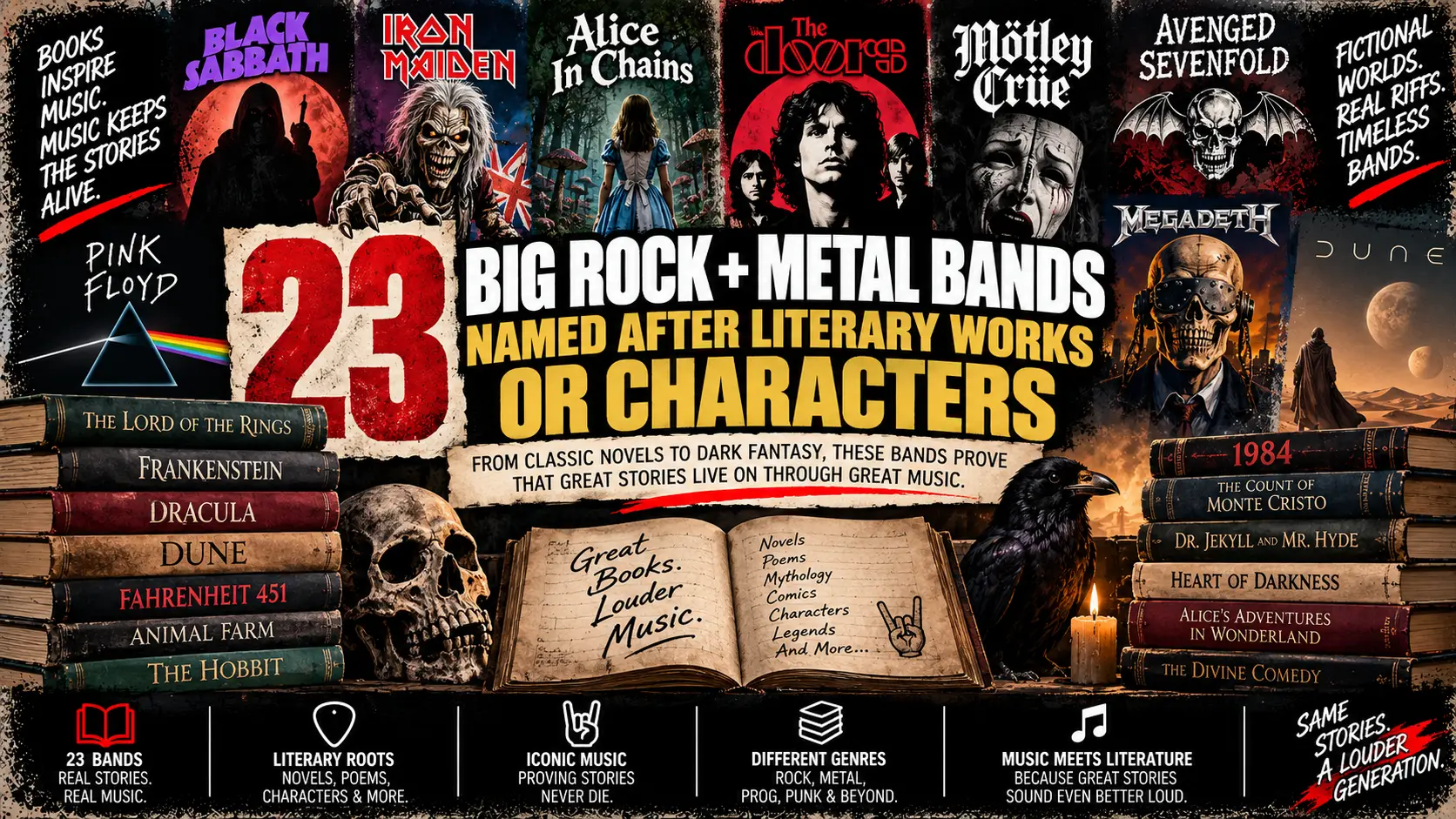
Rock and metal musicians have always nicked inspiration from books — and some of the biggest band names around owe everything to novelists, poets, fictional characters and fantasy worlds.
Choosing a band name is apparently one of the most difficult tasks known to humanity.
You need something memorable.
Something that looks good on a festival poster.
Something your drummer won’t hate six months later.
And preferably something that hasn’t already been claimed by four blokes playing covers in a pub outside Wolverhampton.
Naturally, plenty of musicians have solved the problem by heading straight to the bookshelf.
From Charles Dickens and J.R.R. Tolkien to William Shakespeare, Roald Dahl and Kurt Vonnegut, literature has quietly provided rock and metal with some absolutely massive names.
So grab your library card, turn the amps up and prepare for the most unnecessarily loud English lesson you’ve ever attended.
Here are 23 rock and metal bands whose names were inspired by literary works, characters or worlds.
1. 📖 The Doors — The Doors Of Perception
Before Jim Morrison became one of rock’s defining frontmen, literature was already firmly embedded in his worldview.
The Doors took their name from Aldous Huxley’s 1954 book The Doors Of Perception.
Huxley himself borrowed the phrase from poet William Blake, who wrote about cleansing the “doors of perception”.
Morrison clearly liked the idea.
The result became the name of one of the most influential rock bands of the 1960s.
Not bad for something that started on a bookshelf.
2. 🐺 Steppenwolf — Steppenwolf
Yes, the band responsible for Born To Be Wild owes its name to German-Swiss writer Hermann Hesse.
His 1927 novel Steppenwolf explores alienation, identity and the conflict between respectable society and humanity’s wilder instincts.
Which, when you think about it, isn’t a million miles away from early rock culture.
The band adopted the title and proceeded to help soundtrack the open road.
Get your motor running… and bring a library card.
3. ⚙️ Soft Machine — William S. Burroughs
Canterbury-scene experimentalists Soft Machine borrowed their name from The Soft Machine, the 1961 novel by countercultural writer William S. Burroughs.
Considering both Burroughs and the band became famous for tearing traditional structures apart, it feels extremely appropriate.
Soft Machine went on to become hugely important within psychedelic rock, jazz fusion and progressive music.
Normal song structures?
Absolutely optional.
4. 🖤 The Velvet Underground — The Velvet Underground
One of alternative rock’s most influential names actually came from a book discovered by the band.
The Velvet Underground was a paperback exploring hidden sexual subcultures in early-1960s America.
The title immediately suited the atmosphere surrounding Lou Reed, John Cale and company.
Dark.
Underground.
Slightly dangerous.
Perfect.
The book largely disappeared from popular consciousness.
The band most definitely didn’t.
5. 🎩 Uriah Heep — David Copperfield
British hard-rock legends Uriah Heep took their wonderfully unusual name from a character in Charles Dickens’ David Copperfield.
Dickens’ Uriah Heep is famously oily, manipulative and constantly insisting how wonderfully “humble” he is.
The band arrived in 1969, when Dickens was enjoying renewed attention around the centenary of his death.
More than five decades later, the character’s name is now equally likely to make rock fans think of Easy Livin’.
Sorry, Charles.
Metal got there eventually.
6. 🎸 Mott The Hoople — Mott The Hoople
Before All The Young Dudes, there was the novel.
The British rockers took their name from Willard Manus’ 1966 novel Mott The Hoople.
The book reportedly caught the attention of producer Guy Stevens, who thought the title would make a suitably unusual band name.
He was right.
Try forgetting Mott The Hoople once you’ve heard it.
7. 🧙 Marillion — The Silmarillion
Progressive-rock favourites Marillion originally performed under the name Silmarillion.
Yep.
Straight out of J.R.R. Tolkien.
The name referenced The Silmarillion, Tolkien’s sprawling collection of mythology surrounding Middle-earth.
The band eventually shortened it to Marillion, partly avoiding complications surrounding the original title.
The Tolkien connection remained obvious.
Prog rock and enormous fantasy books?
An alliance nobody saw coming.
Apart from absolutely everyone.
8. 🔥 Amon Amarth — Tolkien’s Mount Doom
Swedish melodic-death-metal giants Amon Amarth also ventured into Middle-earth for inspiration.
Amon Amarth is a Sindarin name used for Mount Doom, the volcanic mountain at the heart of Tolkien’s The Lord Of The Rings mythology.
Which is an astonishingly metal thing to name your band after.
Technically, Amon Amarth’s music is far more obsessed with Vikings than hobbits.
Still…
Mount Doom Death Metal has a certain ring to it.
9. ⚔️ Cirith Ungol — The Lord Of The Rings
Tolkien strikes again.
American heavy-metal cult heroes Cirith Ungol took their name from the treacherous pass leading towards Mordor in The Lord Of The Rings.
It’s also where Frodo and Sam have that extremely unpleasant encounter involving Shelob.
Giant spider.
Dark mountains.
Mordor.
Doom.
If you were inventing a heavy-metal band name generator, Tolkien had already completed half the database.
10. 🌑 Paradise Lost — John Milton
British gothic-metal pioneers Paradise Lost borrowed one of literature’s grandest titles.
Paradise Lost is John Milton’s 17th-century epic poem dealing with Satan, humanity, temptation and the fall of man.
So naturally somebody eventually turned it into doom metal.
The name fitted the Yorkshire band’s bleak, enormous sound perfectly and went on to become synonymous with the development of gothic metal.
Milton would probably have wanted royalties.
11. 🐉 Atreyu — The NeverEnding Story
Metalcore favourites Atreyu borrowed their name from Atreyu, the young warrior in Michael Ende’s fantasy novel The NeverEnding Story.
Many people will understandably know the character through the legendary 1984 film adaptation.
But before the film?
There was the book.
Atreyu is charged with saving Fantastica from destruction.
The band were charged with helping fill MySpace profiles with metalcore.
Both noble quests.
12. 🌊 Caliban — The Tempest
German metalcore veterans Caliban went considerably further back through literary history.
Caliban is a central character in William Shakespeare’s The Tempest.
He is the strange inhabitant of the island ruled over by Prospero and has become one of Shakespeare’s most debated characters.
Several centuries later?
His name ended up above crowds full of circle pits.
English teachers everywhere should be delighted.
13. 🪱 Shai Hulud — Dune
Hardcore/metalcore favourites Shai Hulud owe their wonderfully unusual name to Frank Herbert’s Dune.
Shai-Hulud is the reverential Fremen name for the enormous sandworms of Arrakis.
And when we say enormous, we mean eat-your-entire-tour-bus enormous.
The creatures are central to Dune mythology and considered sacred by the Fremen.
This might be the only band on the list named after something capable of swallowing the entire Download Festival main stage.
14. 🧊 Ice Nine Kills — Cat’s Cradle
Horror-loving metalcore favourites Ice Nine Kills have a particularly brilliant literary connection.
The “Ice Nine” part of their name references ice-nine, the fictional substance appearing in Kurt Vonnegut’s 1963 novel Cat’s Cradle.
In the book, ice-nine can cause ordinary water to freeze into the same structure.
Which becomes…
Slightly problematic.
By which we mean potentially world-ending.
Exactly the sort of cheerful subject matter you’d expect from the band that later made horror movies its entire playground.
15. ⚰️ As I Lay Dying — William Faulkner
Metalcore giants As I Lay Dying share their name with William Faulkner’s 1930 novel As I Lay Dying.
Faulkner’s book follows the Bundren family’s journey to bury their deceased matriarch.
So yes.
Not particularly upbeat.
Then again, As I Lay Dying was never likely to be the name of a cheerful ska band singing about ice cream.
16. 🐁 Of Mice & Men — John Steinbeck
American metalcore band Of Mice & Men borrowed their name from John Steinbeck’s 1937 novella Of Mice And Men.
The book itself takes its title from a line by Scottish poet Robert Burns concerning the best-laid plans of mice and men.
So technically we’ve got literary inspiration inside literary inspiration.
Very fancy.
Steinbeck’s story remains one of the most widely taught works in English-language literature.
Just imagine the GCSE lesson with breakdowns.
17. 👠 The Devil Wears Prada — Lauren Weisberger
Yes.
The metalcore band The Devil Wears Prada shares its name with the famous novel by Lauren Weisberger.
The book was published in 2003 and later became the enormously successful film starring Meryl Streep and Anne Hathaway.
The band formed shortly afterwards.
Which means we live in a universe where Runway magazine and metalcore breakdowns share the same title.
Wonderful.
18. 🧪 My Chemical Romance — Irvine Welsh
The origin of My Chemical Romance can be traced back to Scottish author Irvine Welsh.
Bassist Mikey Way encountered the title Ecstasy: Three Tales Of Chemical Romance while working in a bookshop.
The phrase “chemical romance” helped inspire the eventual band name.
Add the “My”…
…and suddenly one of the biggest alternative-rock bands of the 2000s had its identity.
From Irvine Welsh to Welcome To The Black Parade.
Quite the journey.
19. 🍫 Veruca Salt — Charlie And The Chocolate Factory
Alternative rockers Veruca Salt borrowed their name from one of Roald Dahl’s most memorably unpleasant children.
Veruca Salt appears in Charlie And The Chocolate Factory as the thoroughly spoiled girl who wants absolutely everything.
Immediately.
Her biggest moment involves demanding a trained squirrel before things go spectacularly wrong.
The band formed in Chicago decades later and turned the name into an alternative-rock staple.
“I want it now!”
Still a pretty good description of somebody waiting for festival tickets to go on sale.
20. 🏚️ The Boo Radleys — To Kill A Mockingbird
British alternative favourites The Boo Radleys took inspiration from Boo Radley, the mysterious neighbour in Harper Lee’s To Kill A Mockingbird.
The character spends much of the novel surrounded by frightening rumours before the reality turns out to be considerably more complicated.
Years later, the band carrying his name gave us Wake Up Boo!
Which remains an extremely efficient way of annoying anyone attempting a lie-in.
21. 🐭 Modest Mouse — Virginia Woolf
Modest Mouse found inspiration in the writing of Virginia Woolf.
The phrase comes from Woolf’s story The Mark On The Wall, which contains a description involving “modest, mouse-coloured people”.
Band frontman Isaac Brock lifted the combination and created one of indie rock’s most recognisable names.
Fast-forward years and Float On was everywhere.
Virginia Woolf accidentally helped name an American rock band.
Literature is brilliant.
22. 🩸 Titus Andronicus — Shakespeare
New Jersey punk-rock outfit Titus Andronicus went straight for one of Shakespeare’s bloodiest plays.
Titus Andronicus is an early Shakespeare tragedy packed with revenge, mutilation, murder and enough grotesque behaviour to make most metal concept albums look restrained.
Seriously.
Everyone remembers Romeo And Juliet from school.
Nobody warns you how completely bonkers Titus Andronicus gets.
It’s basically Elizabethan extreme metal.
23. 📚 Good Charlotte — Good Charlotte
Pop-punk heavyweights Good Charlotte also have a literary story behind their name.
The Madden brothers and company took inspiration from the children’s book Good Charlotte: Girls Of The Good Day Orphanage by Carol Beach York.
From an obscure children’s book title came the name behind The Anthem, Lifestyles Of The Rich & Famous and millions of studded belts during the early 2000s.
Libraries have much to answer for.
🤘 THE RIFF REPORT VERDICT
Turns out the path from bookworm to headbanger is remarkably short.
Rock and metal history is absolutely riddled with literary influence.
Tolkien alone could probably have launched an entire record label.
Shakespeare provided metalcore names centuries before electricity existed.
Roald Dahl accidentally wandered into ’90s alternative rock.
And Kurt Vonnegut supplied one of modern metalcore’s most recognisable names with a fictional substance capable of ending civilisation.
Books and riffs have always made excellent bedfellows.
And the next time somebody tells you reading isn’t metal?
Hand them Tolkien.
Point towards Amon Amarth and Cirith Ungol.
Then slowly walk away while Mount Doom erupts behind you.
Libraries: considerably heavier than advertised. 📚🔥🤘