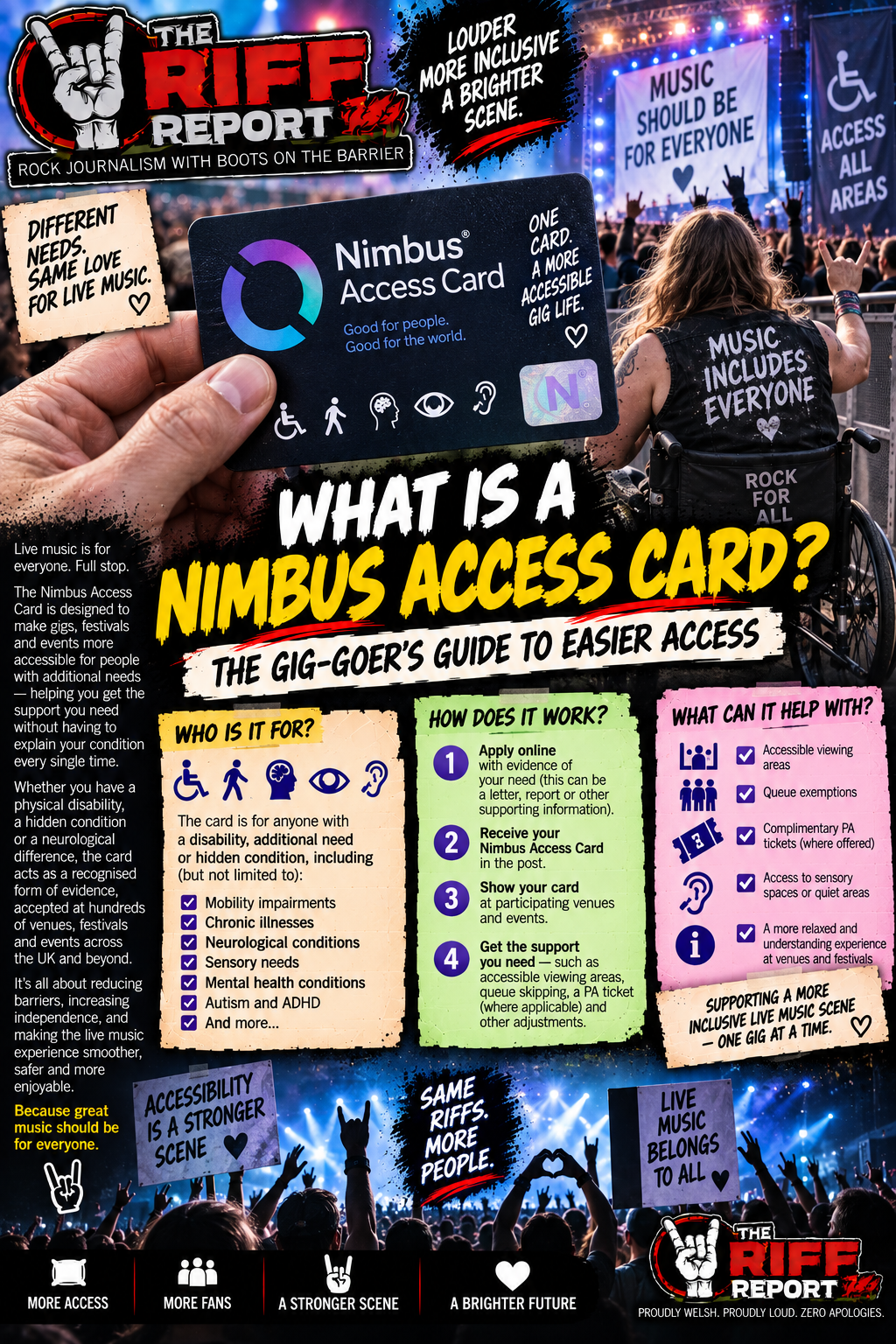
The Nimbus Access Card helps disabled people communicate their verified access requirements at festivals, concert venues, theatres, attractions and thousands of other locations — without repeatedly explaining personal medical information.
Booking a gig should be about choosing where you want to stand, deciding which band shirt gets the honour and working out whether your bank balance can survive the merch stall.
It shouldn’t involve repeating the same deeply personal explanation to a different member of staff every time you buy a ticket.
That is where the Nimbus Access Card comes in.
Created by Nimbus Disability, the Access Card is a photo card displaying symbols that represent the barriers a disabled person faces and the reasonable adjustments they may require.
Instead of listing a diagnosis across the front, it focuses on practical needs. A venue can look at the symbols and understand that the cardholder may need level access, cannot stand for long periods, requires urgent access to a toilet or needs substantial support from another person.
Simple, discreet and a lot less exhausting, mun.
What Does the Nimbus Access Card Do?
Nimbus reviews the applicant’s supporting evidence and identifies the access requirements demonstrated by it. Those requirements are then translated into recognisable symbols on the card.
The card can help when arranging accessible tickets and facilities at places such as:
- Concert venues
- Music festivals
- Theatres and cinemas
- Theme parks
- Sports grounds
- Museums and visitor attractions
- Other participating events and services
It saves cardholders from submitting the same documents and explaining the same circumstances repeatedly — although individual venues may still ask what practical support is needed for a particular event.
The Access Card is not a bank card, discount card or replacement for a Blue Badge. It is specifically designed to communicate verified access requirements.
What Do the Symbols Mean?
The front of an Access Card has space for up to nine symbols. Each represents a particular barrier or adjustment.
Difficulty Standing
This is for people whose mobility impairment makes standing for long periods difficult or impossible. At a gig, that might be relevant when discussing queueing arrangements or access to seating.
Difficulty With Crowds
This applies when crowded environments or queues can become overwhelming or distressing, including barriers related to neurodivergence or mental-health conditions.
Level Access
This symbol shows that the cardholder requires wheelchair-accessible facilities or cannot manage steps and therefore needs a step-free route.
Distance
This is for people who cannot move themselves comfortably over more than a short distance. The exact distance will vary because access needs are personal rather than one-size-fits-all.
Urgent Toilet Needs
The WC symbol indicates that the person may require urgent access to a toilet because of continence-related needs. Participating providers should recognise that access may be needed immediately and without questioning the person at the door.
Essential Companion — the +1 Symbol
The famous +1 symbol is awarded when somebody would find it significantly difficult to access a service without substantial, frequent or essential support from another person.
This is the symbol many gig-goers associate with a personal-assistant or companion ticket — but there is an important catch.
Visual Information
This identifies a barrier to accessing visual information. It may apply to someone who needs information in an alternative format or requires guidance because of a visual impairment.
Audible Information
This is for people who have difficulty hearing or processing audible information and may require a suitable adjustment.
Other Access Requirements
The miscellaneous symbol covers needs that do not fit neatly into the other categories, such as adjustments connected to photosensitive epilepsy. It prompts the provider to discuss the person’s particular requirements.
Does the +1 Symbol Guarantee a Free Companion Ticket?
No — the +1 symbol does not automatically guarantee a free companion ticket at every venue or event.
It confirms that Nimbus has recognised a substantial need for support from another person. The organisation providing the service decides how it will meet that need.
Depending on its access policy, a venue may offer an essential-companion ticket, provide additional assistance through its own staff or propose another reasonable arrangement.
That is why you should always read the venue or festival’s current accessibility information before buying your tickets. Check whether advance registration is required, which evidence is accepted, how companion tickets are issued and whether accessible viewing areas must be reserved separately.
Never assume you can arrive at the gate, flash the card like a backstage laminate and stroll straight onto the accessible platform. Festival admin loves a form almost as much as metalheads love complaining about clashes.
How Much Does an Access Card Cost?
The full physical Nimbus Access Card currently costs £15 and lasts for three years.
That card can be used with participating venues and organisations rather than being tied to a single location.
Some venues use Nimbus to operate their own free registration schemes. If you apply through one of those providers, you may receive a Digital Access Pass, sometimes called a DAP, instead of a physical card.
The Digital Access Pass is free but generally works only with the organisation whose registration scheme you used. The paid Access Card is the broader, portable option.
What Evidence Do You Need?
Applicants are asked to upload photo identification and official supporting documentation relating to their disability or impairment.
Nimbus is interested in the barriers you experience and the adjustments you need, not simply the name of a condition. Two people with the same diagnosis can face completely different barriers, so a diagnosis alone may not establish every symbol requested.
Useful evidence could include relevant documents from medical professionals, benefit decisions or other official services, provided they clearly support the access requirements being claimed.
The application form asks questions about how your condition affects you. It is worth explaining the practical impact clearly: what happens in queues, how far you can move, why support from another person is essential or what makes a crowded environment inaccessible.
Can People With Invisible Disabilities Apply?
Yes. An impairment does not need to be visible for someone to experience genuine access barriers.
The symbols can represent requirements connected to physical disabilities, sensory impairments, neurodivergence, mental-health conditions and other long-term conditions. Eligibility and the symbols awarded depend on the evidence supplied and the impact described.
That is one of the card’s biggest strengths. It communicates the adjustment without requiring the person to announce their private medical history in a queue surrounded by strangers dressed as inflatable dinosaurs.
Is the Access Card Accepted Everywhere?
The scheme is recognised by thousands of events, venues and attractions across the UK and beyond, but it is not automatically accepted everywhere.
Use the provider directory on the official Access Card website and check the event’s own accessibility page before booking. Even participating venues can have different procedures for accessible seating, viewing platforms, queue assistance, parking, camping and companion tickets.
For festivals, it is common for accessible facilities to require a separate application by a published deadline. Your event ticket and your accessibility application may be two different things, so get both sorted early.
Nobody wants to be completing paperwork on a phone while balancing a warm pint and attempting to locate Tent Z in a field with one bar of signal.
How to Apply
You can apply online through the official Access Card website.
The basic process is:
- Complete the application form and describe the barriers you face.
- Upload suitable supporting documentation and photo identification.
- Request the symbols that match your access requirements.
- Allow Nimbus to assess the application.
- If approved, receive the card showing the symbols awarded.
Give yourself plenty of time before the gig or festival you plan to attend. You should also complete any separate accessibility registration required by the organiser.
The Riff Report Verdict
The Nimbus Access Card is a cracking idea because it puts the focus where it belongs: on removing barriers.
It cannot make every venue perfectly accessible, and it does not guarantee identical treatment everywhere. What it can do is provide a recognised, discreet way to show that your requirements have been assessed — cutting down the need to repeatedly send sensitive documents or explain why you need support.
For disabled music fans navigating ticket sites, queues, viewing platforms, toilets, campsites and the glorious chaos of festival fields, that can make planning considerably easier.
The golden rule remains simple: check the event’s policy, apply early and never assume the +1 symbol automatically means a free ticket.
Accessible live music should not feel like trying to headline Download armed with a kazoo. The fewer unnecessary barriers standing between fans and the bands they love, the better.
Everybody deserves to feel the roar of the crowd and the thump of the speakers. Turn it up, make room and let the riffs roll, butt. ♿🎸🔥