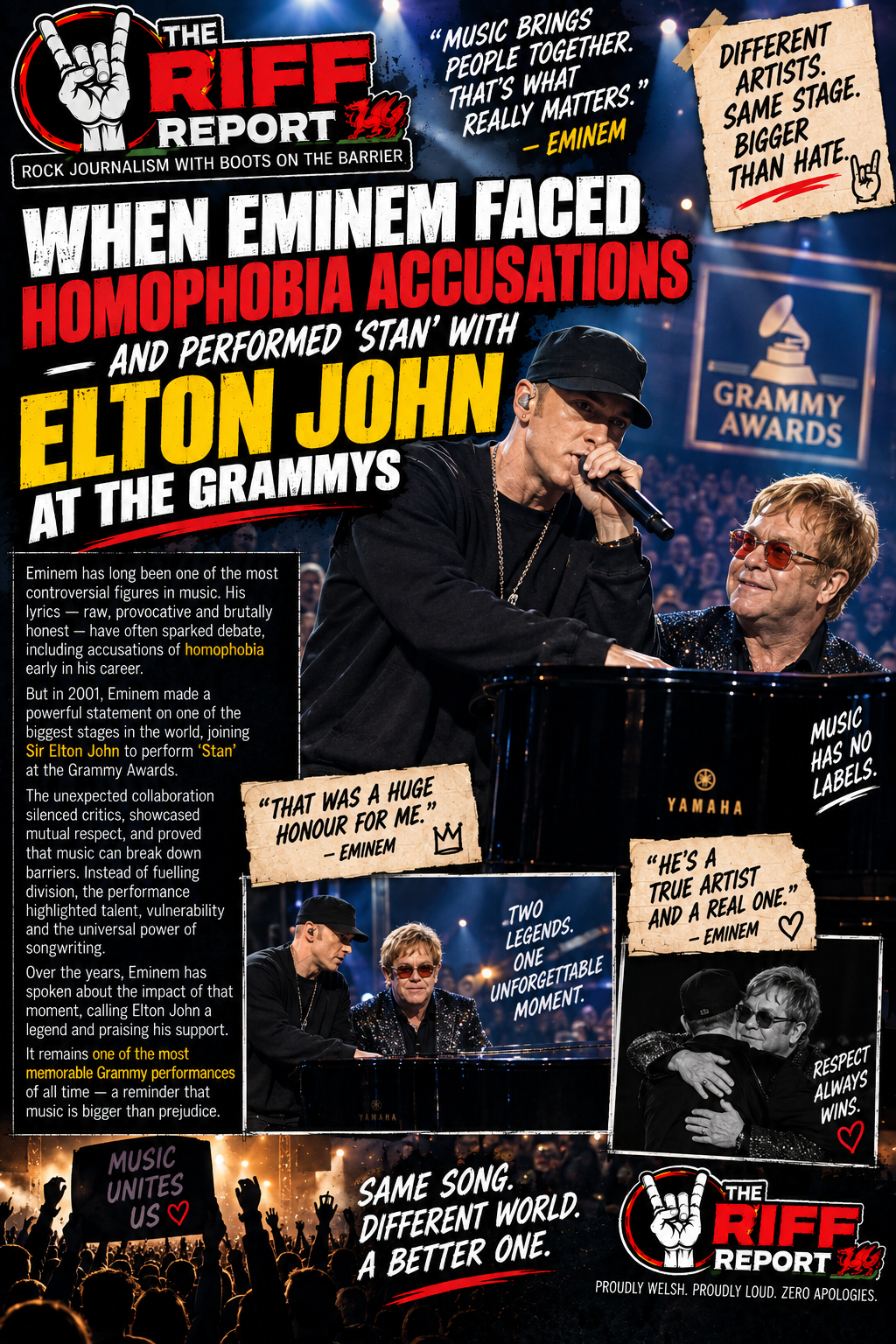
There are Grammy performances that win applause, there are Grammy performances that create headlines — and then there is Eminem and Elton John performing ‘Stan’ together in 2001.
On paper, it sounded like somebody had pulled two names out of a backstage hat after three cans of energy drink. One was the most controversial rapper on the planet, dressed in white and surrounded by outrage. The other was one of Britain’s most celebrated openly gay music icons, seated at a piano beneath the glare of millions of television viewers.
What followed was not merely a surprise duet. It became one of the boldest, strangest and most fiercely debated moments in Grammy history.
🔥 Eminem Was Right in the Middle of a Firestorm
By the time the 43rd Annual Grammy Awards arrived on 21 February 2001, Eminem was already a cultural lightning rod.
His blockbuster album The Marshall Mathers LP had turned him into a global superstar, but its violent imagery, misogyny and repeated use of homophobic slurs had attracted serious criticism.
LGBTQ+ advocacy organisation GLAAD was among those condemning his lyrics, and protesters gathered outside the Staples Center in Los Angeles on the night of the ceremony.
Eminem argued that his lyrics came from characters, provocation and the brutal, anything-goes language of battle rap. His critics maintained that intent did not cancel the harm such words could cause.
It was a proper cultural scrap, with no shortage of anger on either side.
Then came the announcement nobody expected: Eminem would perform ‘Stan’ with Elton John.
Yes, that Elton John. Captain Fantastic himself. A gay icon joining the artist at the centre of a storm over homophobic language.
You could practically hear jaws hitting living-room carpets around the world, mun.
🎹 The Curtain Opened — And There Was Elton
The performance began in darkness, with Eminem taking on the role of the song’s troubled central character inside a bedroom-style set.
‘Stan’ was already one of the most disturbing and brilliantly constructed songs of its era.
Built around a sample from Dido’s ‘Thank You’, it tells the fictional story of an obsessive fan whose admiration turns into rage and ends in tragedy. It was less a conventional rap single and more a miniature psychological horror film set to music.
As Eminem delivered the verses, a curtain opened to reveal Elton John at a piano, singing the haunting chorus originally associated with Dido.
The contrast was astonishing.
Elton’s delicate vocal floated through the darkness while Eminem spat out Stan’s increasingly desperate letters. There was no giant dance routine, no mountain of pyro and no army of backing performers.
The tension did all the heavy lifting.
At the end, the pair embraced and raised their joined hands to the audience.
For television viewers, it was an instantly unforgettable image: two artists who many assumed should have been standing on opposite sides of the argument, united on one of music’s biggest stages.
🏳️🌈 A Powerful Gesture — But Not a Magic Eraser
It is tempting to package the moment as a neat story in which one duet ended the controversy and proved everybody wrong.
Real life, of course, is messier than a three-minute awards-show montage.
Elton John had defended Eminem, saying that he interpreted the rapper’s work as storytelling rather than a reflection of his personal beliefs. Their appearance was intended as a public display of solidarity and became the beginning of a genuine friendship.
However, GLAAD did not suddenly withdraw its objections.
The organisation had criticised Elton’s decision to take part and maintained that the language in Eminem’s music carried real consequences. For many LGBTQ+ listeners, sharing a stage with a gay superstar did not automatically erase the words that had caused offence.
That distinction matters.
The performance was bold, symbolic and capable of opening a conversation — but it was not a backstage laminate granting permanent immunity from criticism.
Rock and rap have always thrived on provocation, but freedom to provoke also leaves the door open for audiences to answer back.
That friction is one reason the duet is still discussed more than two decades later.
🤝 An Unlikely Friendship That Lasted
What could easily have been dismissed as a one-night publicity stunt developed into something far more genuine.
Eminem and Elton John remained friends after the Grammys. Elton later became a supportive figure during Eminem’s recovery from addiction, with the pair keeping in contact away from the cameras.
That lasting bond gave the original performance a depth that no PR team could have manufactured in a dressing room five minutes before airtime.
It also showed something rarely allowed in the loudest corners of celebrity culture: people do not always fit into the tidy boxes built for them.
Elton did not pretend the controversy did not exist. He simply believed there was more to Marshall Mathers than the Slim Shady character found in the lyrics.
Eminem, meanwhile, trusted Elton enough to share one of the most important stages of his career with him.
That does not settle every debate surrounding Eminem’s language, but it does explain why the image of the two men embracing carried such weight.
🏆 The Night Eminem Took the Controversy Head-On
Eminem also collected the Grammy for Best Rap Album for The Marshall Mathers LP that night.
During his acceptance speech, he thanked those who had looked beyond the controversy and judged the record for what it was — and what it was not.
But it was the performance that became the night’s defining Eminem moment.
The Recording Academy has since remembered the duet as one of its landmark collaborations, and it is easy to understand why.
It had danger, theatre, vulnerability and two performers from completely different musical worlds refusing to deliver the safe, predictable option.
No bland medley. No grinning celebrity pile-on. Just a chilling song, a piano, a curtain and enough cultural tension to power half of Los Angeles.
Properly unforgettable stuff.
🎤 More Than a Shock Collaboration
The lasting power of Eminem and Elton John’s ‘Stan’ comes from its contradictions.
It was an act of solidarity staged amid a protest. It was defended as a challenge to prejudice while being criticised as insufficient by those who felt directly targeted.
It united two artists, divided opinion and left the wider argument unresolved.
That is precisely why it still matters.
Great live music does not always hand us a comfortable answer. Sometimes it throws two apparently incompatible figures under the same spotlight and forces everybody watching to confront the question for themselves.
In 2001, Eminem and Elton John did exactly that — and delivered a Grammy moment the world is still talking about.
What did you make of the performance? A brave show of unity, a calculated response to the backlash, or a bit of both? Let us know, butt — the debate is still raging all these years later. 🤘🔥
Proudly Welsh. Proudly Loud. Zero Apologies.