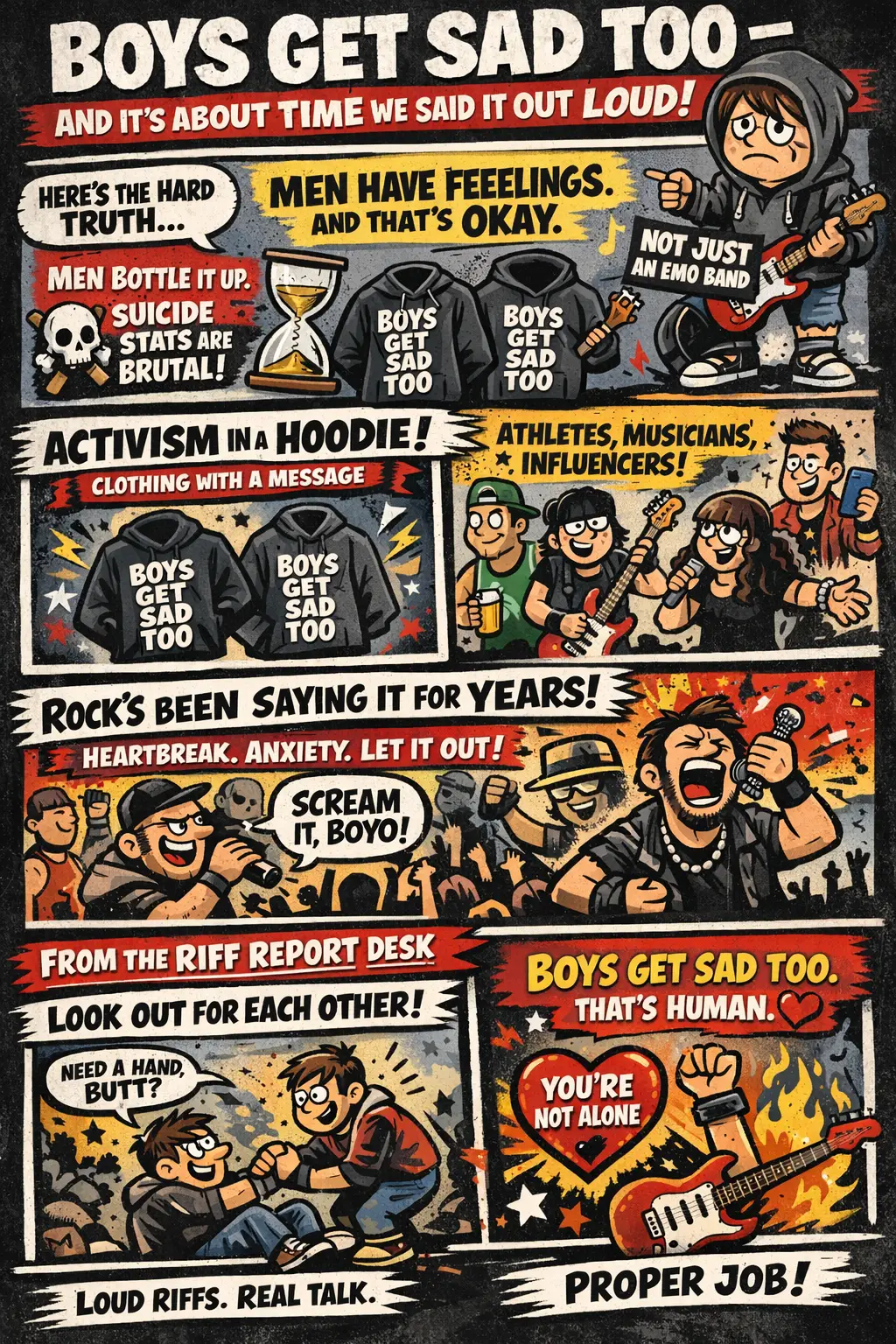
Let’s get one thing straight, c’mon butt — sadness ain’t weakness. Not in the pit, not in the studio, and definitely not behind a mic. “Boys Get Sad Too” might sound like a slogan slapped on a tote bag at Camden Market, but it’s also a cultural truth wrapped in distortion pedals, eyeliner, and raw lyricism that’s echoed through decades of music — from Cobain’s screams to YUNGBLUD’s tears.
In this Riff Report deep-dive, we’re peeling back the band tees, bravado, and beer cans to explore how music’s loudest lads have given sadness a spotlight. It’s not a pity party — it’s a proper job.
So grab your headphones, your heartbreak playlist, and maybe a Greggs sausage roll for emotional support — we’re diving into the black parade of emotion 🤘🖤
🎤 1. “Sad Bangers” Are a Rite of Passage
Whether it’s your first breakup or your fifth existential crisis, everyone’s had that moment. You’re sat in your room, hoodie up, staring out the window like you’re in a music video — and BAM — “I’m just a kid and life is a nightmare…” hits different. Thanks Simple Plan.
It’s no coincidence that so many iconic rock, emo, and punk songs are dripping in sadness. Sadness is a muse. A firestarter. A sonic diary entry scrawled in eyeliner.
Some anthems that got us in our feels:
- “Adam’s Song” – Blink-182
The ultimate emo curveball from a band better known for fart jokes. It gave a generation permission to feel. - “Black” – Pearl Jam
A gut-punch of grief wrapped in that classic Vedder wail. - “Hurt” – Nine Inch Nails (or Johnny Cash’s version if you really want to sob)
Industrial sorrow or aged regret — either way, it’s haunting. - “Welcome to the Black Parade” – My Chemical Romance
Peak theatrical misery. And yet… somehow uplifting? - “Someone Else” – The 1975
Synth-pop depression never sounded so good.
From stadium singalongs to bedroom ballads, sad bangers are timeless. Why? Because they speak the truths we’re scared to say out loud.
💔 2. Masculinity vs. Mental Health in Music
Let’s address the elephant in the mosh pit: toxic masculinity. For decades, boys were told to “man up,” “grow a pair,” or just “get over it.” And while that attitude might’ve worked for cavemen and dodgy PE teachers, it doesn’t cut it in the age of emotional intelligence (or WiFi).
Enter the brave, broken, and brutally honest boys of rock. These lads — from emo icons to indie crooners — challenged the myth that men should be emotionless brick walls.
🧠 Key Voices Who Opened Up:
- Kurt Cobain
Grunge’s ghost king. Sang about alienation and agony before the world knew how to respond. His vulnerability was his weapon. - Chester Bennington (Linkin Park)
He screamed what millions felt but couldn’t articulate. A voice that still echoes — painfully and powerfully. - Frank Carter
From hardcore chaos with Gallows to introspective punk poetry with The Rattlesnakes, Frank’s opened up about addiction, rage, and healing. - Lewis Capaldi
Alright, not technically “rock,” but this Scottish sad boi makes sobbing cool. And we stan. - YUNGBLUD
Loud. Proud. And not afraid to cry on stage. A Gen Z icon giving a big two fingers to emotional repression.
It’s not about glorifying sadness — it’s about normalising it. And for boys? That’s revolutionary.
🧥 3. From Eyeliner to Empathy: The Emo Explosion
We can’t talk about sad boys without paying tribute to the 2000s emo scene — where fringe met feelings and every Myspace profile had a Fall Out Boy lyric in its bio.
Emo wasn’t just a genre. It was therapy. In skinny jeans.
Bands like Taking Back Sunday, Dashboard Confessional, and Death Cab for Cutie gave a whole generation permission to cry, scream, and feel like the world was ending — in 3-minute increments.
And let’s not forget the fashion. Black eyeliner? Check. Studded belt? Check. Fingerless gloves from Claire’s Accessories? Oh, absolutely.
But beyond the aesthetics, emo was a lifeline for young men wrestling with identity, emotions, and… well… life. It said:
“You’re allowed to hurt. You’re allowed to feel.”
Tidy, innit?
📢 4. Modern-Day Sad Bois: The New Wave of Vulnerable Rockstars
Fast forward to today, and the sad boy torch is burning brighter than ever — just with less hairspray and more therapy. Mental health is front and centre in the music world, and artists are opening up like never before.
Some of today’s tear-stained trailblazers:
- Sam Fender – Writing working-class anthems about depression and suicide prevention. Absolute legend. Also lush.
- Kid Brunswick – Alt-punk with raw, rage-fuelled sadness baked in.
- Bring Me The Horizon – From deathcore to existential synthcore, BMTH’s latest work is practically one long scream-cry.
- Nothing But Thieves – Vulnerable vocals. Emotional lyrics. Like Muse on a comedown.
- Slowthai – Blending punk attitude with rap, tackling toxic masculinity, trauma, and mental illness.
And let’s not ignore the impact of platforms like TikTok and Instagram, where emotional expression isn’t just accepted — it’s expected. These artists are showing their breakdowns, bad days, and backstage tears. And fans are lapping it up.
Because relatability is the new rebellion.
🖋️ 5. Lyrics That Cut Deeper Than a Stanley Knife
Let’s give a nod to the lyrical surgeons out there — the ones who know how to twist a phrase and rip your heart out in the process.
Here are some lines that hit harder than a Steelhouse mosh pit:
“The shadow of the day / Will embrace the world in grey…”
– Linkin Park
“And in the end, I’d do it all again / I think you’re my best friend…”
– Yeah Yeah Yeahs
“I used to hear a simple song / That was until you came along…”
– The Lumineers
“I’m not okay, I promise.”
– My Chemical Romance (aka the national anthem of sad boys everywhere)
“Sometimes quiet is violent.”
– Twenty One Pilots
Words matter. Especially when you feel like nobody’s listening. These lyrics? They scream in the silence.
🧠 6. Boys Get Sad Too… And That’s Rock ’n’ Roll
Sadness isn’t a side-effect. It’s the fuel. The truth. The heartbeat behind the snare drum and distortion pedal. Without it, music would be beige. Like, Ed Sheeran-in-a-turtleneck beige.
“Boys Get Sad Too” isn’t a gimmick — it’s a movement. A reminder that vulnerability doesn’t kill rock ‘n’ roll — it amplifies it.
From Bowie’s alienation to Billie Joe Armstrong’s anxiety, from the screamers to the whisperers — sadness has shaped the greatest moments in music history.
So let the boys cry. Let them write breakup albums and therapy ballads and acoustic sob-fests. Let them bleed all over the fretboard and howl into the void.
Because at the end of the day?
Feeling is punk as fk.**
🏁 Final Chorus: A Mosh Pit for the Mind
If you take one thing from this post (other than a renewed urge to blast From Under the Cork Tree), let it be this: Music is medicine. For all of us. And the boys? They’ve finally got a seat at the group therapy circle.
To the sad lads screaming into the abyss, journaling in power chords, and letting the eyeliner run — we see you. And we hear you.
Now go cry in the pit, dance in the rain, and wear your heart on your sleeve — preferably with safety pins. 😭🖤🎸
💬 Join The Cry Club
Drop your favourite sad boi anthem in the comments. Got a lyric that ruins you every time? Let us know. C’mon — let’s be emotional wrecks together.
And hey… if you’re really struggling, don’t just mosh through it — reach out. Talk to your mates. Message a support line. You’re not alone, butt. Promise.
#BoysGetSadToo #SadBoiAnthems #EmoForever #TheRiffReport 🖤

Michael is the founder, editor, and chief riff wrangler behind The Riff Report, an independent Welsh rock and metal publication built by fans, for fans. With a lifelong passion for loud guitars, unforgettable live shows, and the incredible community that surrounds rock and metal, he created The Riff Report to celebrate everything that makes the scene special—from legendary headline acts and grassroots venues to rising bands that deserve to be heard.
A familiar face at festivals across the UK, Michael spends much of the year covering events including Download Festival, Bloodstock Open Air, Steelhouse Festival, Firevolt, Plumpton Revival, and many more. Whether he’s battling the Welsh weather on a mountainside, surviving a weekend in a muddy campsite, or squeezed against the front barrier with thousands of fellow fans, he’s always searching for the next great story to share.
As editor of The Riff Report, Michael writes festival guides, breaking news, album reviews, gig reviews, interviews, opinion pieces, nostalgia features, and behind-the-scenes stories from across the rock and metal world. His writing combines honest opinions, humour, and a genuine love for live music, bringing readers closer to the bands, festivals, venues, and people that keep the scene alive.
Michael is particularly passionate about supporting independent artists, local venues, charities, and the wider UK rock and metal community. He believes every band deserves a chance to be discovered and every festival has a story worth telling. Through The Riff Report, he aims to shine a spotlight on both the biggest names in rock and the future stars waiting to break through.
When he’s not writing or interviewing artists, you’ll probably find him exploring festival campsites, photographing live shows, chatting with fellow fans over a pint, or planning the next road trip in search of more riffs, bigger crowds, and unforgettable moments.
Above all, Michael believes rock and metal are about more than music—they’re about community, friendship, and creating memories that last a lifetime. That’s exactly what The Riff Report exists to celebrate.
Proudly Welsh. Proudly Loud. Always chasing the next great riff. 🤘
Comments