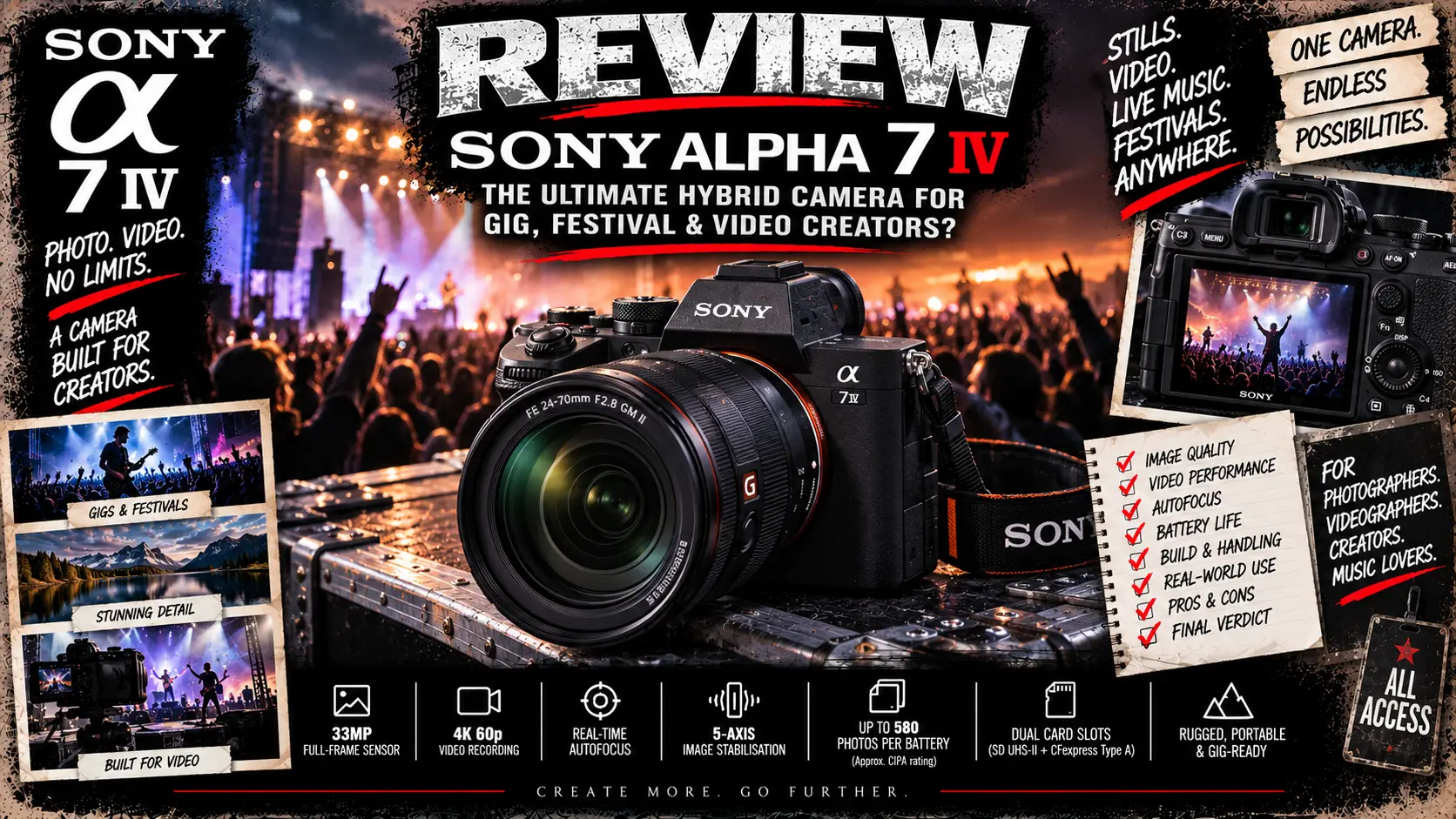

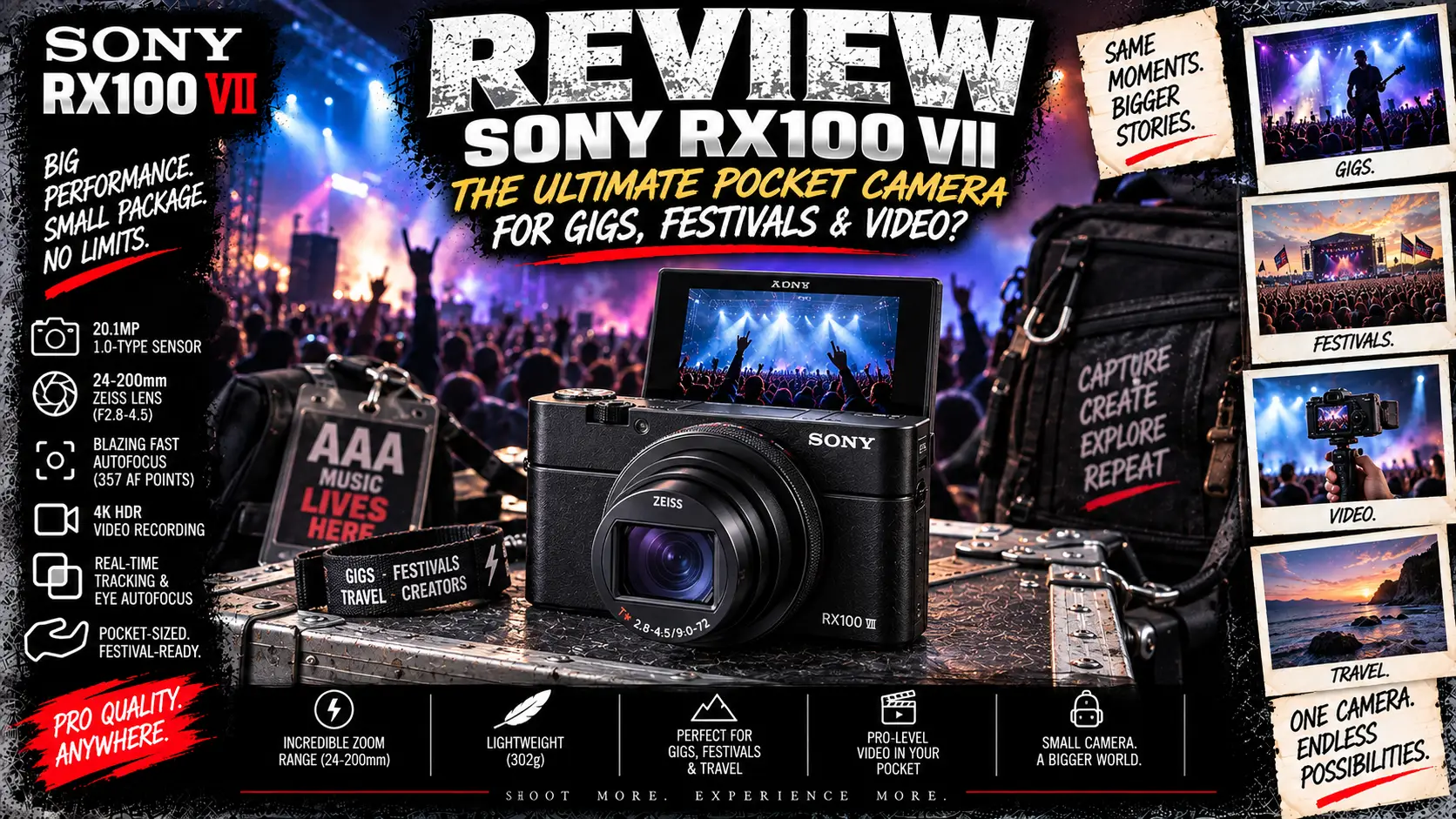
There are cameras you carry because you’re going out specifically to take photographs.
Then there are cameras you can carry everywhere.
The Sony RX100 VII belongs firmly in the second camp.
This tiny premium compact squeezes a 20.1-megapixel 1-inch sensor, 24–200mm equivalent ZEISS zoom lens, 20fps burst shooting, ridiculously quick autofocus, 4K video, electronic viewfinder and microphone input into something small enough to disappear into a jacket pocket.
That’s a pretty outrageous specification sheet for something weighing only around 302g including its battery and memory card. (Sony UK)
For travelling photographers, festival-goers, content creators and anyone who doesn’t fancy carrying several kilograms of camera equipment around for twelve hours, it sounds almost perfect.
But can something this small genuinely handle concert photography and videography?
Let’s get stuck in.
💷 Sony RX100 VII Price
Here’s the first stumbling block.
The RX100 VII isn’t a cheap point-and-shoot.
Sony’s current UK price is around £1,049, putting this little camera firmly into premium territory. (Sony UK)
That’s a lot of money for a compact camera, especially considering the RX100 VII first appeared several years ago.
You’re paying heavily for the combination of:
- Exceptional portability
- 24–200mm zoom range
- Very fast autofocus
- High-speed burst shooting
- Quality 4K video
- Built-in viewfinder
- Proper manual controls
And unlike an interchangeable-lens camera, you don’t need to buy lenses afterwards.
Your 24–200mm equivalent range is already built in.
That considerably changes the value equation.
⚡ Sony RX100 VII Specifications
Feature
Sony RX100 VII
Sensor
20.1MP 1-inch Exmor RS stacked CMOS
Lens
ZEISS Vario-Sonnar T*
Equivalent focal length
24–200mm
Aperture
f/2.8–4.5
Optical zoom
8x
Continuous shooting
Up to 20fps
Single Burst
Up to 90fps
Autofocus
357 phase + 425 contrast AF points
AF acquisition
Approx. 0.02 sec
Video
4K UHD
4K bitrate
Up to 100Mbps
Full HD
Up to 120fps
HFR
Up to 960/1000fps
Screen
3-inch tilting touchscreen
Viewfinder
2.36-million-dot pop-up OLED EVF
Microphone input
Yes – 3.5mm
Headphone socket
No
Battery
NP-BX1
Official battery life
Approx. 240–310 photos
Weight
Approx. 302g
Dimensions
Approx. 101.6 × 58.1 × 42.8mm
Sony rates the RX100 VII for blackout-free shooting at up to 20fps with AF/AE tracking, while its special seven-frame Single Burst mode can reach an equivalent 90fps. (Sony UK)
📸 Photography Performance
Don’t look at the size of this thing and assume we’re talking about an ordinary holiday snapper.
The RX100 VII is ridiculously capable.
Its 1-inch stacked Exmor RS sensor produces 20.1MP images, which is more than enough for websites, social media, promotional photographs and decent-sized prints. (Sony UK)
You can shoot JPEG or Sony RAW files, giving photographers plenty of latitude when editing afterwards.
Twenty megapixels doesn’t give you the enormous cropping freedom of the 33MP Sony A7 IV, but it’s comfortably enough for everyday work.
And then we get to this camera’s greatest trick.
🔭 That 24–200mm Lens Is Brilliant
The built-in 24–200mm equivalent ZEISS f/2.8–4.5 lens is arguably the biggest reason to buy this camera.
Think about what that actually gives you.
At 24mm, you’ve got a proper wide-angle view suitable for:
- Festival crowds
- Whole stages
- Venue interiors
- Backstage photographs
- Groups
- Travel photography
Then twist the zoom towards 200mm and suddenly you can isolate:
- Singers
- Guitarists
- Drummers
- Stage details
- Performers several rows away
Normally you’d need something approaching a 24–70mm plus a 70–200mm setup to cover a similar range on an interchangeable-lens camera.
Sony has essentially stuffed both perspectives into something weighing around 302 grams. (Sony UK)
For festivals, that is absolutely fantastic.
🎪 Why The RX100 VII Makes Sense At Festivals
Here’s where this camera becomes properly interesting.
Imagine wandering around Download, Bloodstock, Steelhouse or another festival all day.
With a full-frame setup you might have:
Camera body.
24–70mm lens.
70–200mm lens.
Spare batteries.
Camera bag.
Maybe another body.
Suddenly you’re hauling several kilograms around a field.
The RX100 VII?
Stick it in a small case or suitable jacket pocket and off you go.
That’s enormously appealing for:
Festival journalism Behind-the-scenes photographs Crowd shots Band interviews Social media content Travel coverage Quick video clips General festival atmosphere
There’s also no lens changing.
When Wales inevitably decides you’ve enjoyed twelve consecutive minutes without rain and opens the heavens, that’s rather useful.
🌑 Low-Light Performance
And here comes the first important reality check.
The RX100 VII is good in lower light for a compact camera.
It is not going to match the Sony A7 IV.
The sensor is dramatically smaller than a full-frame sensor.
Its normal still-image ISO range goes from ISO 100 to 12,800, with some additional extended options. (Sony UK)
At the wide end the lens opens to f/2.8, which is reasonably bright.
Unfortunately, as you zoom towards 200mm the maximum aperture falls to f/4.5.
That’s the biggest problem for gig photography.
At an outdoor festival during daylight?
Lovely.
A well-lit arena?
Absolutely workable.
A dark grassroots venue illuminated by one purple LED apparently purchased from B&M in 2008?
That’s where things become harder.
You’ll find yourself increasing ISO considerably or dropping your shutter speed.
And performers have an annoying habit of moving.
How inconsiderate.
For serious low-light concert photography, the A7 IV with an f/2.8 or faster lens comfortably wins.
But considering the RX100 VII fits in your pocket, its results remain impressive.
🎯 Autofocus
The autofocus is one of the RX100 VII’s strongest features.
There are 357 phase-detection and 425 contrast-detection AF points, plus Sony’s Real-time Tracking and Real-time Eye AF. (Sony UK)
Sony quotes autofocus acquisition as fast as approximately 0.02 seconds.
And it genuinely feels fast.
That’s enormously important for live music.
Musicians don’t exactly stand patiently under perfect studio lighting while you carefully focus.
They’re running around, headbanging, disappearing behind microphones and occasionally deciding that jumping off something is an excellent idea.
Real-time Tracking helps keep them locked.
Eye AF is particularly handy for singers and guitarists.
It’s one of those technologies you quickly start taking for granted — until you return to an older camera and wonder how you ever survived without it.
🚀 20fps Burst Shooting
Twenty frames per second.
From a compact.
Absolutely bonkers.
Sony’s blackout-free electronic shutter allows the RX100 VII to shoot at up to 20fps while maintaining AF/AE tracking. (Sony UK)
That’s actually twice the headline burst speed of the A7 IV.
For gigs, you’ve got plenty of speed for:
- Guitar jumps
- Drumstick throws
- Hair flying
- Crowd interaction
- Pyro
- Confetti
- Singers launching themselves around the stage
The special Single Burst mode can even capture seven photographs at equivalent speeds of 30, 60 or 90fps.
You probably won’t use that constantly, but it’s another indication of just how quick that stacked sensor is.
🔋 Battery Life – How Many Photos?
This is one area where the RX100 VII definitely doesn’t match Sony’s larger cameras.
It uses the compact NP-BX1 battery.
Sony’s official CIPA ratings are:
Method
Approximate Battery Life
Rear screen
260 photos
Rear screen with 2-sec auto-off
310 photos
Electronic viewfinder
240 photos
Actual movie shooting
Approx. 40 minutes
Continuous movie shooting
Approx. 70 minutes
(Sony UK)
So realistically I’d think of the RX100 VII as a roughly 250–300 photograph-per-battery camera under official testing conditions.
That’s considerably below the A7 IV’s roughly 500-plus official figure.
🎪 How Many Batteries For A Festival?
For casual festival photography:
Two batteries minimum.
For an entire day of heavy photography:
Three batteries would make me much happier.
If you’re regularly shooting 4K video as well:
I’d seriously consider three or four.
Thankfully, the NP-BX1 is tiny.
Carrying several spare batteries is hardly going to break your back.
The camera also supports USB charging and USB power, which makes topping it up from a power bank particularly useful during festivals. (Sony UK)
That is a massive practical advantage.
🎬 Video Quality
The RX100 VII is also a remarkably capable little video camera.
It records 4K UHD at up to 100Mbps, using full-pixel readout with approximately 1.7x oversampling rather than crude pixel binning. (Sony UK)
That helps produce detailed 4K footage with reduced aliasing and moiré.
You’ve also got:
S-Log2 S-Log3 HLG HDR Picture Profiles Zebras Gamma Display Assist Proxy recording Timecode Clean HDMI output
Those are proper video features rather than “we’ve put a record button on it, that’ll do”.
Sony also provides Real-time Tracking and Eye AF during video recording. (Sony UK)
For festival interviews, backstage footage, travel videos, social clips and B-roll, the RX100 VII is an incredibly useful machine.
🎞️ 4K Limitations
There are still compromises.
This isn’t a modern Sony cinema camera.
The RX100 VII tops out at 4K 30p in NTSC operation, rather than giving you the 4K 50/60p options found on newer hybrid cameras. (Sony UK)
That means if you want high-frame-rate slow motion you’ll need to drop to Full HD.
Sony also notes that temperature settings and operating conditions can affect sustained 4K recording times. (Sony UK)
For recording entire concerts continuously, this would not be my first choice.
For clips, interviews, backstage material and festival content?
Far more convincing.
🐌 Slow Motion
You can shoot Full HD at up to 120fps, which is perfect for genuinely useful slow motion.
Sony also provides its specialist HFR mode reaching up to 960/1000fps, allowing extremely dramatic slow-motion capture. (Sony UK)
The ultra-high frame rate modes involve compromises in resolution and recording workflow, so I wouldn’t treat them like normal video modes.
But for occasional creative shots they can be great fun.
Flying drumsticks at ridiculous slow motion?
Go on then.
🎤 Sound Quality & Microphone Input
One of the major improvements Sony made with the RX100 VII was adding a 3.5mm external microphone input. (Sony UK)
That’s extremely important for videographers.
The built-in microphones are fine for ambient sound and scratch audio.
For interviews?
Use an external microphone.
For serious video?
Definitely use an external microphone.
There’s one annoying limitation:
There is no headphone socket.
So you can’t properly monitor incoming audio with headphones directly from the camera.
Another practical nuisance is the lack of a normal hotshoe on top.
If you’re attaching a shotgun microphone, you’ll normally want some kind of bracket, grip or cage.
🖥️ Screen
You get a 3-inch 921,600-dot LCD touchscreen.
It tilts approximately:
180° upwards 90° downwards
(Sony UK)
That means you can flip it forwards for self-recording and vlogging.
It’s also really handy at gigs.
Want to hold the camera over the crowd?
Tilt the screen.
Want to get down low without kneeling in a mysterious puddle of festival liquid?
Tilt the screen.
The display itself is decent rather than spectacular.
At roughly 922k dots it’s noticeably behind the displays fitted to many modern cameras.
But usability is excellent.
👁️ Pop-Up Electronic Viewfinder
This is one of my favourite features.
Push a little switch and a 2.36-million-dot OLED electronic viewfinder pops out of the body. (Sony UK)
It’s proper James Bond camera stuff.
The EVF is incredibly useful outdoors when sunlight makes the rear screen difficult to see.
That’s particularly important at summer festivals.
And when you’ve finished?
Push it back into the camera.
Brilliant.
💾 Memory Cards & Storage
The RX100 VII uses a single memory-card slot.
For 100Mbps XAVC S recording, Sony specifies an SDHC/SDXC UHS-I U3 or faster card. Lower-bitrate recording has less demanding requirements. (Sony UK)
It also supports several older Sony Memory Stick formats, although in 2026 there isn’t much reason to bother with those.
For photographers I’d suggest a decent fast SDXC card.
For frequent 4K recording, I’d use a good quality U3/V30 or better SDXC card from a reputable manufacturer.
There is no dual-card backup.
That’s understandable given the camera’s size, but professional event photographers should remember that you’re relying on a single card.
✋ Handling
Here’s the price you pay for having a camera this small.
There isn’t much to hold.
The body is compact, relatively smooth and significantly less substantial in the hand than an A7-series camera.
With dry hands it’s manageable.
With sweaty hands after standing in a festival field for ten hours?
I’d definitely use the wrist strap.
Sony also offers an attachment grip, and third-party grips can make handling considerably more secure.
The controls themselves are understandably compact.
People with larger hands may find the buttons and rear control wheel a little fiddly.
⚖️ Weight
Now we reach the killer feature.
Approximately 302g including battery and memory card. (Sony UK)
That’s absolutely tiny.
For comparison, the A7 IV body alone is around twice the weight before you’ve attached a lens.
Put a 70–200mm lens on an A7 IV and the difference becomes enormous.
Yet this little RX100 still reaches the equivalent of 200mm.
That is why this camera makes so much sense as a festival companion.
👖 Is It Really Pocketable?
Mostly, yes.
It’s not smartphone thin.
At around 42.8mm deep, this is a chunky little compact camera. (Sony UK)
It’ll fit comfortably into:
- Jacket pockets
- Cargo pockets
- Small camera pouches
- Festival bags
- Larger trouser pockets
Skinny jeans?
You’ll either need another plan or considerably more ambitious trousers.
📸 RX100 VII vs Sony A7 IV For Gig Photography
This is where buying decisions become interesting.
RX100 VII
A7 IV
Sensor
1-inch
Full-frame
Resolution
20.1MP
33MP
Lens
Built-in 24–200mm
Interchangeable
Burst
20fps
10fps
Low light
Good
Excellent
Background blur
Moderate
Much better
Portability
Outstanding
Moderate
Battery
240–310 photos
500+
4K
Up to 30p
Up to 60p
Weight
302g complete
658g before lens
Convenience
Exceptional
Good
Ultimate image quality
Good
Excellent
If I were officially photographing a concert from the pit, I’d take the A7 IV.
If I were attending a festival all day as a journalist and wanted one camera for photographs, videos, interviews and general coverage without carrying a huge bag, the RX100 VII becomes seriously tempting.
🎪 Using It At A Gig
For well-lit gigs, I’d expect some very good results.
The fast AF and 20fps shooting are absolutely capable of tracking performers.
At 24mm you can capture entire stages.
At 200mm you can get surprisingly tight performer shots.
The main problem arrives when the lights disappear.
At 200mm you’re working at f/4.5, and the smaller sensor means you’ll reach uncomfortable ISO territory quicker than with a full-frame camera.
For professional photo-pit work, that matters.
For documenting gigs and producing website/social photographs?
It can absolutely do the job.
🌧️ Festivals & Weather
One thing I’d be careful about is bad weather.
I wouldn’t treat the RX100 VII like an indestructible weather-sealed professional body.
At UK festivals — particularly Welsh ones where four seasons can occur between soundcheck and the opening song — I’d carry a small waterproof pouch or protective bag.
Fortunately the camera is so tiny that protecting it is easy.
👍 The Good Stuff
The RX100 VII packs an absolutely ridiculous amount of camera into 302 grams.
Highlights include:
- Fantastic 24–200mm zoom range
- Excellent autofocus
- Real-time Eye AF
- 20fps shooting
- Very good 4K
- RAW photography
- Microphone input
- Pop-up EVF
- Flip-up touchscreen
- USB charging
- Tiny dimensions
- Excellent travel camera
- Brilliant festival companion
- No lenses to carry
- Extremely discreet
👎 What Could Be Better?
The biggest negatives are:
- Expensive for an older compact
- Smaller sensor can’t match full-frame low-light performance
- Lens drops to f/4.5 at telephoto
- Battery only around 240–310 photos officially
- No headphone socket
- No hotshoe
- No 4K 50/60p
- Only one card slot
- Screen resolution now feels dated
- Small body can be fiddly
- No interchangeable lenses
🏆 Riff Report Scores
Category
Score
📸 Photography
8.5/10
🎯 Autofocus
9.5/10
🌑 Low Light
7.5/10
🔭 Zoom Range
10/10
🎬 Video
8.5/10
🎤 Audio
8/10
🖥️ Screen
7.5/10
🔋 Battery
7/10
🤲 Handling
7.5/10
🎪 Festival Use
9.5/10
👖 Portability
10/10
💷 Value
8/10
⭐ Overall
8.8/10
🤘 The Riff Report Verdict
The Sony RX100 VII is one of the most impressive compact cameras ever made.
Not necessarily because it beats every other camera for outright image quality.
It doesn’t.
A modern full-frame interchangeable-lens camera will comfortably beat it in challenging light.
What makes the RX100 VII special is what it manages to achieve while remaining ridiculously small.
You’ve essentially got a 24–200mm lens, 20fps still photography, excellent Sony autofocus, RAW shooting, proper manual controls, 4K video, a microphone input and electronic viewfinder in something weighing approximately 302 grams.
For a festival photographer or journalist who doesn’t want to carry an enormous camera bag around all day, that’s extremely compelling.
Would I replace an A7 IV with one for professional gig photography?
No.
Would I happily carry an RX100 VII alongside the A7 IV as a backup, travel camera, backstage camera and video machine?
Absolutely.
And if I were heading to a festival recreationally where professional camera equipment wasn’t practical, this would be near the top of my list.
The biggest issue remains low-light performance.
That 1-inch sensor simply can’t perform miracles, and the f/4.5 aperture at 200mm becomes restrictive when stage lighting gets properly dark.
Battery life is another consideration.
Sony officially rates the camera for approximately 260 photographs using the rear screen, 240 using the EVF, or up to around 310 when using the screen’s aggressive auto-off setting.
So pack spare NP-BX1 batteries.
They’re considerably easier to carry than another two kilograms of camera equipment.
For festivals, travel, gigs, interviews, backstage coverage, YouTube, social media and everyday photography, the Sony RX100 VII remains an incredibly capable little beast.
⭐ The Riff Report Rating: 8.8/10
Tiny camera. Massive zoom. Lightning-fast autofocus. Proper photography chops.
Sometimes the best camera isn’t the biggest one in your bag.
It’s the one you actually bothered to bring with you. 📸🔥🤘