
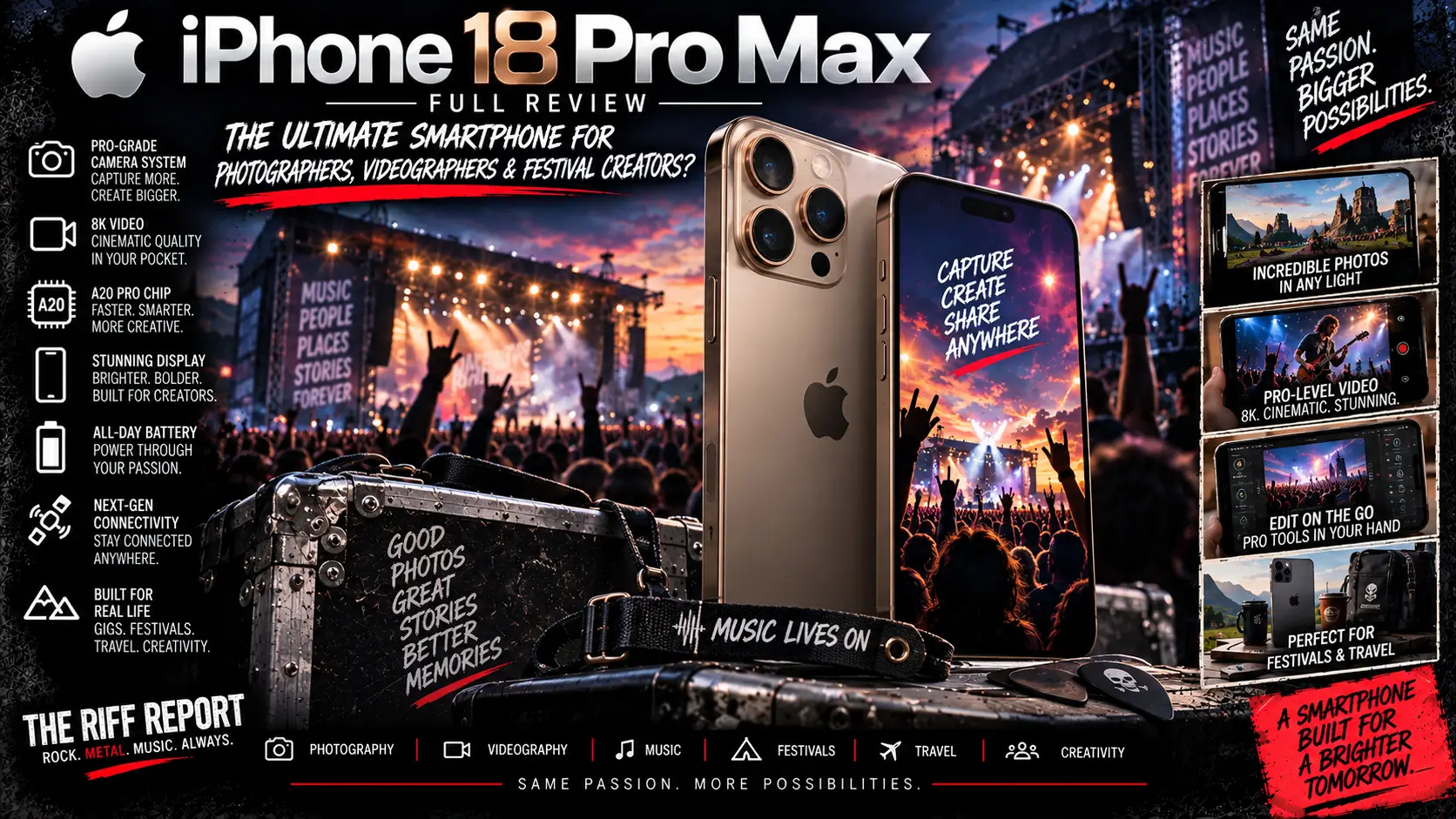
Apple’s biggest, most expensive conventional iPhone is back — and this time, Cupertino appears to have looked directly at photographers and filmmakers and said: “Fine. You want a proper camera? Have some proper controls.”
Meet the iPhone 18 Pro Max.
Announced on 9 September 2026 and arriving in the UK on 18 September 2026, the latest Pro Max combines a huge 6.9-inch display, Apple’s new A20 Pro processor, up to a frankly bonkers 2TB of internal storage and, most importantly for us, an upgraded 48MP Pro Fusion triple-camera system.
And there’s one feature that could be particularly significant.
A variable aperture.
Yep. On an iPhone.
Apple has also added manual-style controls for aperture, shutter speed and white balance, alongside ProRAW, Apple Log 2, ProRes RAW, 4K/120fps recording, external recording, USB 3 transfer speeds and Genlock support.
This isn’t just aimed at someone filming their lunch for Instagram anymore.
Apple wants the iPhone 18 Pro Max sitting in filmmakers’ camera bags.
But when the price can reach an absolutely wallet-murdering £2,499, does it actually deserve to be there?
Grab an energy drink. We’re going in. 🤘
Riff Report note: At the time of writing, the iPhone 18 Pro Max has been announced and pre-orders are open, but general availability begins on 18 September 2026. Our verdict therefore assesses the confirmed hardware, capabilities and early hands-on impressions rather than pretending we’ve subjected a retail handset to months of long-term testing.
📱 iPhone 18 Pro Max – Key Specifications
| Feature | iPhone 18 Pro Max |
|---|---|
| Display | 6.9-inch Super Retina XDR OLED |
| Resolution | 2868 × 1320 |
| Refresh rate | ProMotion up to 120Hz |
| Outdoor brightness | Up to 3,000 nits |
| Processor | Apple A20 Pro |
| Main camera | 48MP Fusion Main |
| Main aperture | Variable f/1.48, f/1.8, f/2.8, f/4 |
| Ultra-wide | 48MP, 13mm equivalent |
| Telephoto | 48MP, 100mm / 4x |
| Extended telephoto | 12MP optical-quality 200mm / 8x |
| Front camera | 18MP Centre Stage |
| Maximum photo resolution | 48MP |
| Video | Up to 4K Dolby Vision 120fps |
| Pro video | ProRes, ProRes RAW, Apple Log 2 |
| Storage | 256GB / 512GB / 1TB / 2TB |
| USB | USB-C, USB 3 up to 10Gbps |
| Water resistance | IP68 |
| Weight | 249g |
| UK launch date | 18 September 2026 |
The headline is obvious: all three rear cameras now use 48MP sensors, while the main camera finally introduces physical aperture control.
💷 UK Pricing – Brace Yourself
Nobody has ever accused a Pro Max iPhone of being cheap.
Apple has apparently taken that as a challenge.
| Storage | UK Price |
|---|---|
| 256GB | £1,299 |
| 512GB | £1,499 |
| 1TB | £1,899 |
| 2TB | £2,499 |
Yes.
Two thousand four hundred and ninety-nine quid for a phone.
At that point your bank account doesn’t cry. It simply walks out of the room.
For ordinary users, the 2TB model is complete overkill. For somebody shooting huge quantities of ProRes, ProRes RAW or high-resolution photography, however, that enormous storage ceiling suddenly starts making considerably more sense.
The 512GB model at £1,499 is probably the sweet spot for serious photographers.
For video creators recording lots of ProRes internally, we’d seriously consider 1TB — although external USB-C recording changes the equation considerably.
Apple has confirmed UK pricing of £1,299, £1,499, £1,899 and £2,499 across those four capacities.
📸 The Camera System – This Is Where Things Get Interesting
The iPhone 18 Pro Max packs a 48MP Pro Fusion camera system consisting of three rear cameras.
And unlike older smartphones where the enormous megapixel number was plastered across the box while half the cameras were considerably weaker, Apple is giving you 48MP capability across the main, ultra-wide and dedicated telephoto cameras.
That makes the whole setup considerably more attractive to photographers.
📷 48MP Fusion Main Camera
The main camera gives you a 24mm equivalent focal length with second-generation sensor-shift optical image stabilisation.
But the headline feature is that new physical variable aperture.
You can select:
| Aperture |
|---|
| f/1.48 |
| f/1.8 |
| f/2.8 |
| f/4 |
That may sound like standard camera stuff to DSLR and mirrorless photographers.
On an iPhone?
That’s massive.
Previous iPhones relied primarily on computational processing and software-generated depth effects. The 18 Pro Max finally allows photographers to influence how much light physically reaches the sensor.
At f/1.48, you’re maximising light gathering for dark environments.
Move towards f/4 and you’ve got more flexibility in bright environments and greater control over exposure.
For gig photography, that f/1.48 setting is particularly tasty.
Dark venue.
Singer sprinting around the stage.
Red lights everywhere.
Smoke machine going absolutely berserk.
Exactly the kind of conditions that make smartphone cameras start questioning their life choices.
The wider aperture should give photographers more light to work with before computational processing even enters the equation.
🤘 Gig Photography
This could genuinely be one of the best use cases for the iPhone 18 Pro Max.
Phones are increasingly important at concerts because there are plenty of occasions where you’re not allowed to bring a dedicated camera inside.
An iPhone doesn’t attract the same attention.
Suddenly you’ve got something in your pocket offering equivalent focal lengths from ultra-wide right through to approximately 200mm territory.
For smaller venues, the 24mm main camera should be brilliant for stage-wide shots.
The 48MP 100mm telephoto becomes more useful when you’re several rows back.
And Apple’s 12MP optical-quality 8x 200mm equivalent option gives you considerably more reach for larger venues.
Does that mean it’s replacing a Sony Alpha body with a 70-200mm f/2.8?
Absolutely not.
Sensor size still matters.
Glass still matters.
Dedicated autofocus systems matter.
And a proper interchangeable-lens camera gives photographers creative possibilities that phones simply can’t reproduce.
But as something that’s permanently sitting in your pocket?
Crikey.
🔭 Telephoto Camera
The dedicated telephoto is another serious part of the package.
You’re getting a 48MP Fusion Telephoto camera at a 100mm equivalent focal length with an f/2.8 aperture.
Apple then uses that system to provide an 8x optical-quality 200mm equivalent option at 12MP.
Digital zoom stretches all the way to 40x for still photographs.
Ignore the marketing temptation to live at maximum digital zoom.
For photographers, the strongest results should come around the native and optical-quality focal lengths.
But 100mm and 200mm equivalents inside something you can shove into your jeans is seriously useful.
At a festival, that potentially means grabbing stage shots without carrying a second camera body.
🌄 48MP Ultra-Wide
The ultra-wide camera also gets 48 megapixels, using a 13mm equivalent perspective and a huge 120-degree field of view.
Festival photographers will have an absolute field day with this.
Think:
massive crowds,
huge festival stages,
arena architecture,
crowd surfers,
confetti cannons,
pyrotechnics,
and those gloriously ridiculous moments where the entire crowd has its horns in the air. 🤘
You’ve also got 48MP macro photography, giving the phone another creative weapon for detail shots.
Album artwork.
Guitar pedals.
Merchandise.
Drum hardware.
Backstage passes.
Tattoo details.
Even that suspicious festival burger you’re debating whether to risk.
🎨 ProRAW – Serious Editing Potential
Professional photographers will probably spend a lot of time inside Apple ProRAW.
Unlike a heavily processed JPEG, ProRAW gives you significantly more information to work with when adjusting exposure, colour and dynamic range.
That becomes particularly valuable with concert lighting.
Anyone who has photographed gigs knows the pain.
The guitarist looks perfect.
Then someone blasts a red LED fixture directly at their forehead and everything turns into radioactive tomato soup.
RAW files give you much greater editing flexibility afterwards.
Pair the iPhone with Lightroom, Capture One workflows or another serious editing setup and it becomes considerably more than a point-and-shoot smartphone.
🎛️ Proper Camera Controls
This could actually be more important than the megapixel numbers.
Apple now provides Pro controls for:
lens aperture, shutter speed, white balance and a viewing histogram.
Those are the things photographers actually think about.
Instead of simply pointing the phone at something and hoping Apple’s computational photography makes the correct decisions, experienced shooters finally have considerably more direct control.
That pushes the iPhone experience noticeably closer to operating a traditional camera.
🎬 Video – Now We’re Getting Properly Serious
If photography is impressive, the video specification is where the iPhone 18 Pro Max starts behaving like somebody accidentally shrunk a professional filmmaking toolkit.
You can record 4K Dolby Vision at 24, 25, 30 and 60fps, with the main camera additionally supporting 100fps and 120fps.
For UK creators, having proper 25fps support is particularly welcome.
And 4K/120 gives you some glorious slow-motion possibilities.
Hair flying.
Drummer smashing the kit.
Crowd surfer going over the barrier.
Guitarist launching themselves off a monitor.
Pyro exploding behind the band.
Slow it down and suddenly your festival recap looks considerably more cinematic.
🎥 ProRes RAW
This is where Apple stops mucking around.
The iPhone 18 Pro Max supports ProRes video up to 4K/120fps when recording externally, along with ProRes RAW.
For casual creators, that’s excessive.
For filmmakers?
Very interesting.
RAW-style video workflows give editors far more flexibility when working with exposure and colour.
The downside is obvious.
Files become enormous.
Seriously enormous.
Which is exactly why external storage support becomes important.
🎨 Apple Log 2
Apple Log 2 gives filmmakers a flatter image designed for colour grading.
Straight out of camera, Log footage won’t necessarily look particularly exciting.
That’s the point.
You take it into software such as Final Cut Pro or DaVinci Resolve, apply your grade and build your final look there.
If you’re mixing iPhone footage with footage from professional cinema or mirrorless cameras, Log capture can help the images integrate more naturally.
For music video creators, documentary shooters and festival videographers, that’s a major advantage.
🎞️ Genlock
And then there’s Genlock support.
We’re now officially miles away from “phone camera for TikTok”.
Genlock is primarily useful in professional multi-camera environments because it allows cameras to synchronise their video timing.
That could make several iPhones viable within sophisticated multi-camera production environments.
Apple has also included support for the Academy Color Encoding System, further reinforcing exactly which audience some of these features are aimed at.
📱 6.9-Inch Display – Your Portable Editing Monitor
The Pro Max features an enormous 6.9-inch Super Retina XDR OLED display with a resolution of 2868 × 1320 at 460ppi.
You’ve also got:
ProMotion up to 120Hz, HDR support, P3 wide colour, True Tone, Always-On functionality and up to 3,000 nits of outdoor peak brightness.
For photographers and videographers, that’s brilliant.
Images look superb.
Video playback is excellent.
Scrolling through Lightroom libraries feels wonderfully fluid.
And that outdoor brightness could be genuinely valuable at festivals.
Anyone who has tried checking exposure on a dim phone display underneath blazing afternoon festival sunshine will understand exactly why.
The new anti-reflective coating should also help.
🎨 Editing Photos On The Phone
The sheer size of the Pro Max makes it far better suited to mobile editing than smaller phones.
Lightroom.
Photoshop.
Affinity.
Snapseed.
Final Cut.
DaVinci workflows.
There’s enough display real estate here that quick edits don’t feel like you’re attempting surgery through a letterbox.
Would we replace a calibrated desktop monitor with it?
No.
Would we happily process several photos backstage and upload them before the headliner has even finished?
Absolutely.
That’s where smartphone photography becomes incredibly powerful.
Capture → edit → caption → publish.
One device.
🚀 A20 Pro Performance
Underneath everything sits Apple’s A20 Pro chip.
There’s a six-core CPU, seven-core GPU and Apple’s dual 16-core Neural Engine.
Apple has also redesigned its thermal system with an upgraded vapour chamber, claiming major improvements to sustained performance.
That’s significant for creators.
Short benchmark bursts don’t matter much when you’re exporting twenty minutes of high-resolution footage.
Sustained performance does.
Video rendering generates heat.
Gaming generates heat.
AI processing generates heat.
Long camera sessions generate heat.
A phone that can stay cooler for longer should maintain better performance during demanding workflows.
💾 Storage – 2TB In A Phone!
You can choose between:
256GB, 512GB, 1TB and 2TB.
There is no microSD card slot.
That’s hardly surprising — Apple would probably announce the return of the headphone socket before fitting a microSD reader — but professional photographers should absolutely consider storage carefully.
For mainly JPEG/HEIF photography and occasional 4K video, 256GB can work.
For photographers shooting a lot of ProRAW, 512GB makes much more sense.
For professional video, 1TB is where we’d start looking.
And the absolutely gigantic 2TB version exists for creators who want maximum internal space and apparently dislike having money.
Thankfully, internal storage isn’t your only option.
🔌 USB-C & External SSDs
This is absolutely crucial.
The USB-C connection supports USB 3 transfer speeds up to 10Gbps plus DisplayPort output.
That means photographers can transfer large amounts of material substantially faster than with old Lightning-equipped iPhones.
Videographers can also attach compatible external storage and record demanding ProRes workflows externally.
Picture the festival setup:
iPhone.
USB-C SSD.
Compact microphone.
Small handheld rig.
Power bank.
Suddenly you’ve got an extremely portable production system that fits inside a tiny shoulder bag.
That’s brilliant.
🎙️ Audio Recording
Apple has equipped the phone with four studio-quality microphones, Spatial Audio recording, stereo recording, wind noise reduction, Audio Zoom and Audio Mix.
Built-in smartphone microphones still aren’t replacing properly positioned external microphones for professional interview recording.
But for spontaneous content?
They’re enormously useful.
Festival vox pops, backstage clips, social media interviews and quick pieces to camera become much easier.
For serious interviews we’d still plug in a wireless lavalier system or external directional microphone via USB-C.
🤳 18MP Centre Stage Front Camera
The front camera is now an 18MP Centre Stage camera with autofocus.
It supports 4K Dolby Vision up to 60fps, ProRAW, Apple Log 2 and even external ProRes capture up to 4K/60.
That’s bordering on ridiculous for a selfie camera.
For presenters and journalists, though, it’s fantastic.
You could genuinely record a respectable stand-up report outside a venue or festival stage using nothing more than the front camera and a microphone.
Dual Capture also allows simultaneous recording involving front and rear perspectives.
That could be brilliant for reactions, interviews, festival coverage and behind-the-scenes footage.
🔋 Battery Life
Battery life matters enormously when you’re covering an event.
The UK iPhone 18 Pro Max is rated for up to 43 hours of video playback and up to 38 hours of streamed video playback. Apple also advertises faster charging, reaching approximately 50% in around 15 minutes with a suitable 60W-capable wired adapter.
Don’t mistake video playback ratings for continuous professional camera recording.
Recording 4K video, running maximum screen brightness, using mobile data, editing photos and uploading media will absolutely hammer the battery harder.
For festival photographers, we’d still carry a decent USB-C power bank.
Always.
Because Sod’s Law states that your phone battery will reach 3% approximately thirty seconds before something spectacular happens.
☀️ Festival Use
This might be where the Pro Max makes the strongest case for itself.
You’ve got an extremely bright display, IP68 water and dust resistance, strong battery life, excellent stabilisation, huge storage options, long telephoto reach and immediate connectivity for publishing content.
IP68 certification covers water resistance to a maximum depth of six metres for up to 30 minutes under controlled testing conditions.
That doesn’t mean we’d deliberately take it swimming.
But Welsh weather?
That’s practically a product-testing programme of its own. 🌧️🐉
Rain at Download?
Mud at Bloodstock?
Random sideways downpour on a Welsh mountain?
The phone is far better prepared than most traditional camera equipment without weather protection.
Stick a proper rugged case around it and you’ve got an extremely capable festival companion.
⚖️ Weight & Handling
There is one catch.
The iPhone 18 Pro Max weighs 249 grams.
That’s chunky.
Add a protective case, external SSD, microphone and perhaps a cage and you’ll very quickly stop pretending it’s an ultra-lightweight setup.
For normal use, 249g is manageable.
For handheld video sessions lasting hours, we’d consider a grip, cage or gimbal.
The upside is that you still end up with something substantially more compact than carrying a mirrorless body, multiple lenses and associated filmmaking accessories.
🌧️ Concert & Festival Photography – The Big Question
Could It Replace A Proper Camera?
No.
And that’s important.
An iPhone 18 Pro Max isn’t replacing a full-frame Sony Alpha, Canon EOS R or Nikon Z system for serious professional concert photography.
A large sensor and quality telephoto glass still deliver advantages in low light, autofocus, dynamic range, genuine optical depth of field and image quality.
But that’s not necessarily the right comparison.
The better question is:
Could it replace the camera you didn’t bring?
Absolutely.
If you’re attending a gig without accreditation and professional cameras aren’t permitted, this thing could be phenomenal.
If you’re walking around a festival and don’t fancy carrying £7,000 worth of camera kit everywhere, it’s incredibly useful.
If you’re a journalist trying to publish something immediately, it’s arguably better suited to the task than a traditional camera.
That’s the iPhone’s superpower.
✅ What We Love / ❌ What We’d Change
- Love: the genuine variable-aperture main camera, all-48MP rear camera array, 4K/120fps recording, ProRes RAW, Apple Log 2, ProRAW, 100mm telephoto, 200mm optical-quality option, USB 3 speeds, external SSD recording, huge 6.9-inch display, impressive brightness and up to 2TB storage.
- Less keen: that £1,299 starting price is painful, £2,499 for 2TB is utterly savage, there’s still no expandable storage, 249g is hefty, accessories can turn it into an expensive rig very quickly, and smartphone sensor size still places limits on what all those clever camera features can ultimately achieve.
🏆 Riff Report Creator Verdict
The iPhone 18 Pro Max might be Apple’s strongest argument yet that the “phone camera” and “professional camera” worlds are starting to overlap.
Not merge.
Not completely.
But overlap.
The variable-aperture main camera is particularly exciting because it gives photographers control over an actual optical component rather than another software-generated imitation of one.
Add the 48MP ultra-wide and telephoto cameras, ProRAW, proper shutter and white-balance controls, 4K/120 recording, ProRes RAW, Apple Log 2, external SSD recording, Genlock, USB 3 and that massive 6.9-inch OLED display and you’ve got a genuinely powerful creative tool.
For gig photographers, journalists, social media creators and festival videographers, the biggest advantage isn’t necessarily ultimate image quality.
It’s speed.
Shoot the band.
Edit backstage.
Upload before the encore.
Then film an interview outside the venue.
One device.
No laptop.
No card reader.
No enormous camera bag.
That workflow is bloody impressive.
Would we sell our mirrorless cameras?
Absolutely not.
Would we happily have an iPhone 18 Pro Max sitting beside them in the camera bag?
Hell yes.
🎸 Riff Report Scores
| Category | Score |
|---|---|
| 📸 Main Camera | 9.7/10 |
| 🔭 Zoom & Telephoto | 9.3/10 |
| 🌙 Low-Light Potential | 9.5/10 |
| 🎬 Video Features | 10/10 |
| 🎨 Professional Controls | 9.8/10 |
| 📱 Display | 9.7/10 |
| 🚀 Performance | 9.8/10 |
| 💾 Storage Options | 9.5/10 |
| 🔋 Battery & Charging | 9.5/10 |
| 🎙️ Audio | 9.2/10 |
| 🤘 Gig & Festival Use | 9.7/10 |
| 💷 Value For Money | 7.7/10 |
⭐ Overall Riff Report Pre-Release Creator Score: 9.5/10
🏆 Riff Report Award: Editor’s Choice – Mobile Content Creation
Best suited to: concert photographers, festival creators, mobile filmmakers, journalists, vloggers, social media teams, documentary creators and photographers wanting a genuinely capable secondary camera.
Skip it if: you’re perfectly happy with an iPhone 17 Pro Max, rarely use your phone camera professionally, or the thought of spending £1,299–£2,499 on a smartphone makes your bank card hide behind the sofa.
🤘 Final Word
The iPhone 18 Pro Max isn’t going to replace your Sony, Canon, Nikon, Panasonic or cinema camera.
But it doesn’t need to.
It’s the camera that’s already in your pocket.
And now that camera has a 48MP triple-camera system, physical aperture control, a 200mm-equivalent option, RAW photography, ProRes RAW video, Apple Log 2, 4K/120fps recording, external SSD support and enough processing power to edit the results immediately afterwards.
For photographers and videographers constantly bouncing between gigs, festivals, interviews and backstage areas, that combination could be incredibly powerful.
The price?
Absolutely brutal.
The creator toolkit?
Properly impressive.
📱📸🎬🔥🤘
The Riff Report verdict: Apple’s biggest iPhone is increasingly looking less like a phone with a good camera — and more like a tiny production studio that occasionally receives phone calls.