
Sometimes this gig isn’t just about riffs, releases, and arguing over who nicked whose guitar tone in 1994. Sometimes it’s about proper conversations with bands who live and breathe what they do — and that’s exactly what we got when OÏKOUMEN took time out of their world to sit down with The Riff Report.
From the jump, the chat was honest, thoughtful, and gloriously free of PR fluff. No copy-and-paste answers. No rehearsed nonsense. Just real talk about music, creativity, the grind, and what it actually means to be in a band in 2026 when the scene is loud, chaotic, and constantly evolving. 🔥
We’re genuinely grateful to the band for:
- Being open and generous with their time
- Letting us dig deeper than the surface-level soundbite
- Supporting independent, community-driven music journalism (that’s us, butt 🖤)
Interviews like this are why we do what we do. They remind us that behind every crushing riff and atmospheric passage is a group of humans grafting their arses off for the art they love — and inviting listeners along for the ride.
So yeah. Huge thanks to OÏKOUMEN for trusting us with their story and letting our readers into their world. We’re buzzing to see what’s next for the band, and we’ve got a feeling this won’t be the last time our paths cross. 👀🤘
Stay loud. Stay curious. Support the scene.
— The Riff Report Crew 🥁🔥
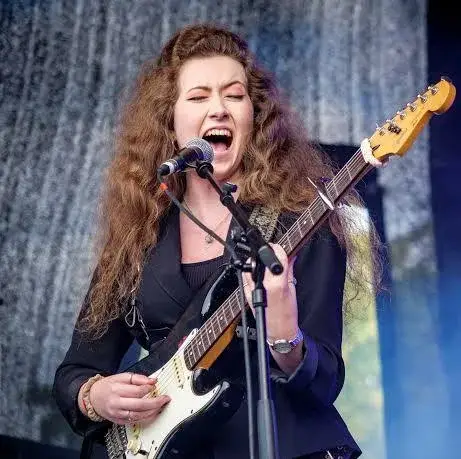
Interview responses provided by Laura Mazard (vocals, lyrics), following consultation with the other Oïkoumen band members (Elie Veux : guitar and composition; Yael Febvray: bass) for THE RIFF REPORT. February 5, 2026.
🌍 ORIGINS, IDENTITY & THE BIG IDEA
Let’s start at the core — what sparked Oïkoumen into existence, and why was this project something you had to create?
The initial impulse came from Elie. When I met him, a project he had been part of throughout his entire adolescence had just come to an end, and he felt a visceral need to reconnect with something. For him, music is essential to life. He needs to make music, so he needed to find a new project. It’s an instinctive, almost primal need.
When we talked about it, I thought we could create our own project together. It took time to find its final form, but for me, the original idea was to find a means of expression for a whole range of subjects and emotions that live inside me and need to come out.
In both cases, Oïkoumen was born from a need for musical and verbal expression. It’s a visceral project that gives us the outlet we needed.
The name carries weight. What does Oïkoumen mean to you beyond its literal definition?
The literal definition of Oïkoumen indeed comes from the Greek word oikoumenē, meaning “the known world.” We use this concept in our music to highlight the deeply human and personal dimension of the project. Oïkoumen is limited to what we know.
Even when we talk about subjects or events we haven’t experienced ourselves, we always approach them through the lens of our own feelings. For example, we haven’t lived through a natural disaster, but the images we’ve seen and the testimonies we’ve heard have made us feel certain emotions and created strong mental images. That’s what we express in our music.
Even when some songs are more biographical, we’re still exploring the “known world” : human emotions, from the most joyful to the darkest.
This feels more like a statement than just a band. Was that always the intention?
Absolutely. When I shared my lyrics with the other band members, they immediately connected with that idea as well. It gives us the feeling that our music isn’t pointless, because for us, making music means expressing a form of discourse.
Music is a language (even when there are no lyrics) so you have to choose your words carefully. We didn’t want to speak just to say nothing. And in our case, we do have things to say.
At what point did you realise this project wasn’t going to fit neatly into any genre box?
We really realised it with the release of our first album. Because my musical direction was very symphonic, we initially labelled ourselves that way, but the feedback we received didn’t really align with it. Many people and institutions didn’t agree with that classification.
Some said it could fit, but many others described us as progressive. So we adopted the “prog” label (especially since the scene inspires us a lot) but then that same scene told us we were too symphonic.
In the end, we couldn’t find a box that truly fit us, so we built our own. For now, we call it orchestral / symphonic progressive metal. We like the idea of “prog” because we often work with complex, evolving structures. “Orchestral” because orchestras are extremely important to us musically and that will be even more obvious on the upcoming album.
Elie often starts with the orchestral parts when he writes, spending a lot of time on each instrument, writing counterpoints and lines that could stand on their own. In fact, we’re planning a 100% orchestral version of the next album to really shine a light on that work.
And “symphonic” because we do draw from that scene, while trying (on our humble scale) to renew it a bit, rather than being a pale copy of what already exists.
That said, we don’t really need to be put in a box. In the end, we make Oïkoumen and that’s enough.
🎻 ORCHESTRA MEETS METAL
The orchestra plays a huge role in your sound — how do you stop it becoming decoration and make it truly emotional?
Elie explains that to avoid the orchestra feeling like mere decoration or a backdrop, you can’t think of it as a single block. In the metal section, bass, guitar, and vocals are written independently but interwoven and the same applies to the orchestra.
Each instrument is written separately, with the idea that its line should be playable by a real musician if we were lucky enough to have an orchestra with us. That’s really the direction we took for the upcoming album; it wasn’t quite there on the first one.
When Elie writes, he doesn’t think of it as “writing for a metal band.” He writes to express a specific theme and conceives the piece as a symphony that includes amplified instruments. As a result, the orchestra often carries the main melodies. It’s not supporting the metal part, it’s a full entity in its own right.
Great care is taken with timbre as well: a horn telling a story doesn’t have the same emotional impact as a guitar telling that same story. Ultimately, Elie thinks of the whole thing as a kind of concerto between the metal block and the orchestra. There’s a real dialogue between the two.
When writing, what comes first: the human feeling, the orchestration, or the metal framework?
Most of the time, the order is: human emotion, orchestration, then the metal structure (though of course there are exceptions).
For the first album, it was different. Elie was still finding his musical identity, and I tended to start from what he had written, asking myself what emotion it evoked and then building a theme around that.
With the second album, Elie started directly from the themes, asked himself what emotions emerged from them, how to translate those emotions through the orchestra, and how to amplify them with metal.
As a result, he writes everything directly on the score and very rarely with a guitar (except for solos). He builds his riffs on the score itself, taking the orchestra into account, or deliberately leaving space in the orchestration when he wants the guitars to take over for more aggressive moments.
What challenges come with blending orchestral elements and heavy music without losing intensity?
It’s a very difficult balance to achieve. What Elie does is avoid having everything playing at once: when the orchestra leads, the metal section steps back and becomes more restrained and vice versa.
Sometimes, though, it’s unavoidable. In those cases, the challenge shifts to timbre choices: Elie favours brass for powerful moments, while woodwinds are more present in calmer sections.
But the real challenge is handled by our programmer and mixing engineer, Julien Prost. To preserve intensity, he does an enormous amount of work on instrument interpretation and articulation. Everything has to sound tight, perfectly in time, with minimal latency and not too much reverb. We need very precise articulation and that’s a huge part of the final result.
Was there a moment during writing or recording where you thought: “This is exactly what Oïkoumen is meant to be”?
Honestly, that moment didn’t happen during writing (Elie composes using Guitar Pro and synthetic sounds, which only give a partial idea) nor during recording, because you’re too focused on your own part.
It was during the first demos, and especially during the mixing stage, that we thought: “There it is… that’s it.” And then we also thought: “We really need an orchestra.” And after that, we sighed, realising that this ambition isn’t exactly easy to achieve right away.
🧠 THEMES, EMOTION & STORYTELLING
Your music tackles trauma, resilience, and the human condition — why was it important to explore these themes so openly?
It’s important to explore these themes openly because they are precisely the kinds of subjects that were considered taboo for a long time and that still often call for silence today. Even if it’s no longer “forbidden” to talk about them, they remain uncomfortable.
Yet many people feel better once they’re able to put words to what hurts them. So we wanted to add our own small contribution to those who speak out, in the hope that one day these topics can become fully accepted and understood.
A very clear example is school bullying. Over the years, we’ve gained a word to describe the phenomenon, along with the general awareness that “it’s not okay.” And yet, when a student speaks up, they’re still often met with dismissal or minimisation from adults. Of course, not all adults react this way (things are improving) but it remains a disturbing topic. You still hear things like: “Are you sure you’re not exaggerating?”, “Come on, it’s just a joke,” or “Well, you kind of brought it on yourself.”
So I think we still need to shout loud and clear that the problem exists and that it’s still dangerous. That’s the intention behind these themes: to make them heard, to provoke a reaction, and maybe (ambitiously) to help change things.
Is there a track that still hits hard every time you hear it?
Personally, I’m particularly affected by Self-Service, because it’s my own story, told in a very raw and honest way. It’s not like Reign of Idiocy, where we chose a more grandiose approach that creates a bit of distance. Self-Service is a requiem. It represents so precisely what I lost years ago that every listen hits me in the gut. During rehearsals, I sometimes feel tears welling up. I don’t think that will happen on stage, because adrenaline and performance act as a shield, but in the intimacy of a rehearsal room or solitary listening, it’s very intense. Revenge also affects me deeply, but because it’s extremely demanding to sing, I find it harder to fully let myself sink into it emotionally.
Elie shares that choice as well. Self-Service emotionally exhausts him every time he plays it. The theme is heavy, the harmony dark, the melodies dramatic, the structure tortured. He’s also very struck by Break the Silence, whose driving rhythm leaves him breathless. It’s a track that speaks to him a lot and has a kind of “stadium” dimension (a bit like Impulse).
Yaël is particularly affected by Lost Woods of Mind and its sinuous structure, moving from a prog rock song with brilliant harmonies seemingly foreshadowing a hidden catastrophe and its majestic orchestra to a complex metal centerpiece with hypnotic riffs, before culminating in a climax of complex emotions. He also loves Revenge, mainly because of its overall raw energy, which is constantly on the verge of blowing up.
How do you balance vulnerability with musical power?
It’s extremely difficult, because we don’t want to aestheticise vulnerability : we want people to truly feel it. It’s a constant tightrope walk, and we’re always asking ourselves whether we’ve actually succeeded.
Do you hope listeners see their own stories reflected in the music, or simply feel less alone?
We just hope listeners make the music their own. If they see their own story in it, that’s great. If they see a similar story that isn’t theirs and it helps them feel less alone, that’s just as perfect. Maybe for some people it helps put words to an emotion, a feeling, or an event. Either way, we just want to share something meaningful and powerful.
📀 CONCEPTS, ALBUMS & STRUCTURE
Your work feels cinematic and carefully structured — how important is narrative flow across an album?
Narrative flow is essential for us. Even if we don’t make strict concept albums where every song directly follows the previous one, coherence is crucial. For us, an album isn’t a collection of tracks : it’s a work in itself.
If we want fully standalone songs, we release singles. And if we have less to say about a topic but still want to explore it, we’ll make an EP with three, four, or five tracks.
The recurring leitmotif is a powerful idea. Why was that thread so important to the story you’re telling?
The leitmotif is essential because it carries the concept of resilience, which is the album’s title. It allows something to remain constant from beginning to end, while also evolving just as a human being evolves throughout life and is able to achieve resilience.
Resilience isn’t about erasing trauma; it’s about transforming it, learning to live with it, and building yourself despite it. That’s why the album opens with a lullaby which best evokes childhood, where many traumas take root. It also creates a tender emotional space for the listener, one that will eventually be shattered.
Midway through the album, there’s a ballad with the same leitmotif. Stylistically, it’s completely disconnected from the rest of the record, because it represents a pause, a moment of reflection. A pause to look at one’s life. After trauma, it’s time to gain perspective, move forward, rebuild.
But trauma doesn’t disappear so easily, so it comes back. And in the final track, we finally break free. We reach the end of the resilience process, which is why we wanted that song to be fully orchestral as if the metal parts represented the traumas we’ve left behind.
Do you see each release as a chapter, or a complete world in itself?
For now, each album is a complete world in itself, but in a broader sense, it’s also a chapter in our musical journey. Thematically, each album stands alone. They’re not connected beyond the band’s name.
Stylistically, however, you can clearly see our evolution from one album to the next, as well as our experimentation through singles. In that sense, they can be seen as chapters.
How much planning goes in before writing… and how much is instinct?
Our music is extremely planned before the writing begins. I come in with a concept and themes for each song (I always have plenty ready) and Elie chooses what speaks to him most in that moment, what he feels the strongest urge to write about.
Once he starts, though, he composes from the gut. So there’s definitely a strong instinctive element as well.
🎤 LIVE PERFORMANCE & TRANSLATION
Oïkoumen feels deeply immersive — how do you translate that intensity to a live setting?
Live performance is complicated because we’re dependent on venues. We can’t afford a dedicated crew or fully design our sound and lighting the way we’d like which is very frustrating.
So we compensate through the way we embody the music. Even when the sound isn’t great (because we don’t always play ideal venues) or when there’s little to no lighting, we give everything we have to convey our message to the audience.
That’s often what people tell us afterward: that we seem inhabited by our music (except when we play in overheated rooms and spend half the set trying not to pass out…). It feels similar to a conversation where someone tells you a story and your brain creates the images on its own.
What do you want an audience to feel when they leave one of your shows?
To be completely honest… we’re very proud when people come up to us after the show and say, “That hit me like a slap.” And that’s exactly what we try to achieve every time.
We want those who took the time to come to leave with emotional and intellectual substance. To have had a good time. To have emptied themselves of negative emotions and to walk away feeling energised.
Does performing these songs live change their meaning for you?
The meaning doesn’t change, but I do gain some distance from what I’m singing, because there’s an additional element: the stage and the performance itself. Adrenaline gives me a kind of armour that changes how I approach the music. I’m less focused on myself and more on what I’m transmitting.
Elie also insists that performing the songs isn’t the same as listening to them. In that sense, the meaning shifts: when listening, everything hits you at once, whereas on stage you’re much more isolated with your own instrument (especially since it’s more prominent in the in-ear monitors).
Yaël believes that the meaning of a piece of music by playing in front of an audience because of the interaction. Recording a piece, especially in our case where we do everything ourselves, is a solitary act in which only the musician recording gives meaning to the music, by making a bunch of choices. So, every time the song is played in front of an audience, the meaning is altered both by the musician, because there are changes in terms of musical choices (mainly gear and interpretation), but above all by the audience and its interaction with the band. The song changes meaning ever so slightly every time it is played in front of an audience.
Are live shows cathartic, exhausting, or both?
They can be both ! It really depends on the conditions. If the venue is comfortable, we can fully immerse ourselves in the music and it becomes 100% cathartic. But if it’s unbearably hot, if we can’t hear ourselves, then it becomes purely exhausting (even frustrating) especially if we feel we couldn’t go all the way and deliver the show we wanted to give.
🌌 ART, PURPOSE & CONNECTION
This project feels rooted in honesty rather than image — how important is authenticity to Oïkoumen?
Authenticity is absolutely central to Oïkoumen. We never want to sacrifice it, even if it comes at the cost of success. Either we succeed with our own DNA, or we don’t succeed at all but we never want to counterfeit our project or do something that doesn’t truly speak to us.
That doesn’t mean we don’t stay open or try new things. We probably will make mistakes, or regret certain choices, but the approach has to remain personal. That’s what allows us to assure listeners that our process is sincere, and that we’re not here to please at all costs.
We do what we love to do, and we reach the audience that resonates with that. It may be a long road, but it’s worth it.
What role do you think heavy music plays in helping people process difficult emotions?
For me (and I’m speaking from experience, not from any sense of omniscience) it’s the genre best suited for that, precisely because it’s heavy. It can carry difficult subjects and intense emotions.
It’s a style where screaming is a form of singing, where noise becomes melody. You can express everything through it, and make what’s raging inside of you rumble in your ears.
It’s a music that deeply involves the listener, that can overwhelm them (much like orchestral music, actually, but with an added layer of aggression and a more visceral edge) just like emotions themselves so often do.
Do you see Oïkoumen as art, therapy, protest, or all three at once?
A bit of everything, but first and foremost, it’s art. Even when we talk about trauma, for example, what we write isn’t what heals it. The healing process happens alongside the art, not through it directly.
In the same way, we denounce certain aspects of society (like the work culture that leads to burnout) so there is a form of protest there. But it’s less structured than a true act of protest, because we can only develop our ideas within the length of a song. That inevitably limits the scope.
Above all, we’re here to offer our perspective, and everyone is free to make it their own. That’s why we’d rather say that Oïkoumen remains an artistic project born from protest, and one that can support a therapeutic process.
Has creating this music changed you personally?
It’s hard to say, but certainly yes. It gave me a life priority I wouldn’t have dared imagine before. Leading an artistic project requires a lot of resources, and it forces you to grow and improve in many areas. That said, I’d say it’s accompanied me more than it’s changed me.
As for Elie, it’s clearly shaped his life choices, pushing him to make them fully compatible with the project in the hope that one day it can truly take off and become both his passion and his profession.
As for Yaël, it mainly changed the way he thinks about what a musician is: he comes from a very punk perspective on art and, for the purposes of the project, had to think more like a technician, which made him change his mind about some of his preconceptions about what a musician is. Also, playing in Oïkoumen is a real source of joy for him, which he thinks is the most important thing.
🇪🇺 SCENE, COMMUNITY & INFLUENCE
Where do you see Oïkoumen fitting within the wider metal and progressive scene?
That’s very hard to say. As mentioned earlier, we struggle to classify ourselves, so positioning ourselves within the metal scene is complicated.
I do feel that we follow in the lineage of symphonic metal, while trying to bring in a more progressive approach but honestly, I don’t really know where we fit. More than anything, I feel like we’re trying to find our place.
Are there artists or composers — metal or otherwise — who’ve influenced your approach?
Of course. Within the metal scene, Nightwish is without a doubt our biggest influence (even though people often compare us to Epica as well). Their way of writing music, their ambition, and the way they build a whole universe around their work have deeply inspired us.
They’re actually the only metal band that truly influences us. Beyond that, we look much more toward orchestral music: Joe Hisaishi, Sarasate, Debussy, Chausson, Holst… The way orchestral pieces are written, and how they convey emotion, that’s what speaks to us the most.
I’d also add video game soundtracks, which are incredibly inspiring: Final Fantasy, Kingdom Come: Deliverance, Baldur’s Gate, Warcraft, and others.
How important is the listener–artist connection to you?
Personally, I enjoy nurturing that connection, but I don’t want to force it. If someone wants to listen to our music without forming any bond with the musicians behind it, that’s perfectly fine too.
That said, we do tend to cultivate a human connection with the people who follow us. We spend a lot of time talking with those who come to see us live, and on social media I enjoy chatting with listeners, even taking an interest in what they do themselves once we get to know each other. Because they’re not just “listeners.” They’re people with whom we share a sensitivity, interests, and emotions. So yes, that connection really matters.
What kind of community do you hope forms around this project?
We’d like to build a caring community, a kind of safe space where everyone can be who they truly are inside and find their place among like-minded people.
⚡ QUICKFIRE (YES, EVEN YOU DON’T ESCAPE THIS)
Studio immersion or live emotional release?
Laura : Live
Elie : Live
Yaël : Live
Orchestra or distortion — gun to your head?
Laura : Orchestra
Elie : Orchestra
Yaël : Distortion
Planned precision or emotional instinct?
Laura : planned precision
Elie : emotional instinct
Yaël : emotional instinct
One word that defines Oïkoumen right now.
Laura : Authentic
Elie : Powerful
Yaël : Soulful
🔊 FINAL THOUGHT
What do you hope someone carries with them after experiencing Oïkoumen for the first time?
Good memories, a sense of safety, and the feeling of being understood.
Finish this sentence:
“Oïkoumen exists because life is short, and it has to be lived fully while hoping to leave a trace.”