
There are bad days at work… and then there’s being handed a bus ticket, kicked out of Metallica and sent packing across America while the band carries on without you.
That was the brutal reality facing Dave Mustaine in 1983.
For most musicians, getting booted from a band on the verge of greatness would have been enough to send the guitar straight into the loft alongside the Christmas decorations and a broken exercise bike.
Mustaine, however, did something far more metal.
He got angry.
He got ambitious.
And he created Megadeth.
What began as one of the harshest sackings in rock history eventually helped produce another legendary band, intensified the thrash metal revolution and created a rivalry that fans are still arguing about more than four decades later.
Honestly, mun, heavy metal has rarely benefited so much from one spectacularly awkward employment dispute.
⚡ Dave Mustaine’s Early Days in Metallica
Before Metallica became stadium-filling giants, they were a hungry young metal band playing fast, aggressive music in clubs, rehearsal rooms and anywhere else that would tolerate the noise.
Dave Mustaine joined the band as lead guitarist in 1982.
His playing brought speed, aggression and technical fire to Metallica’s developing sound. Mustaine was already showing the sharp, frantic riffing style that would later become one of Megadeth’s defining characteristics.
He also contributed musical ideas that would remain connected to Metallica’s earliest material.
But behind the scenes, things were becoming increasingly unstable.
Mustaine’s relationship with the other members of the band was reportedly volatile, with arguments, heavy drinking and clashes in personality creating a situation that couldn’t continue forever.
Eventually, Metallica made their decision.
And they didn’t exactly organise a leaving do with cake and a card signed by everyone in the office.
🚌 The Bus Ride That Changed Metal
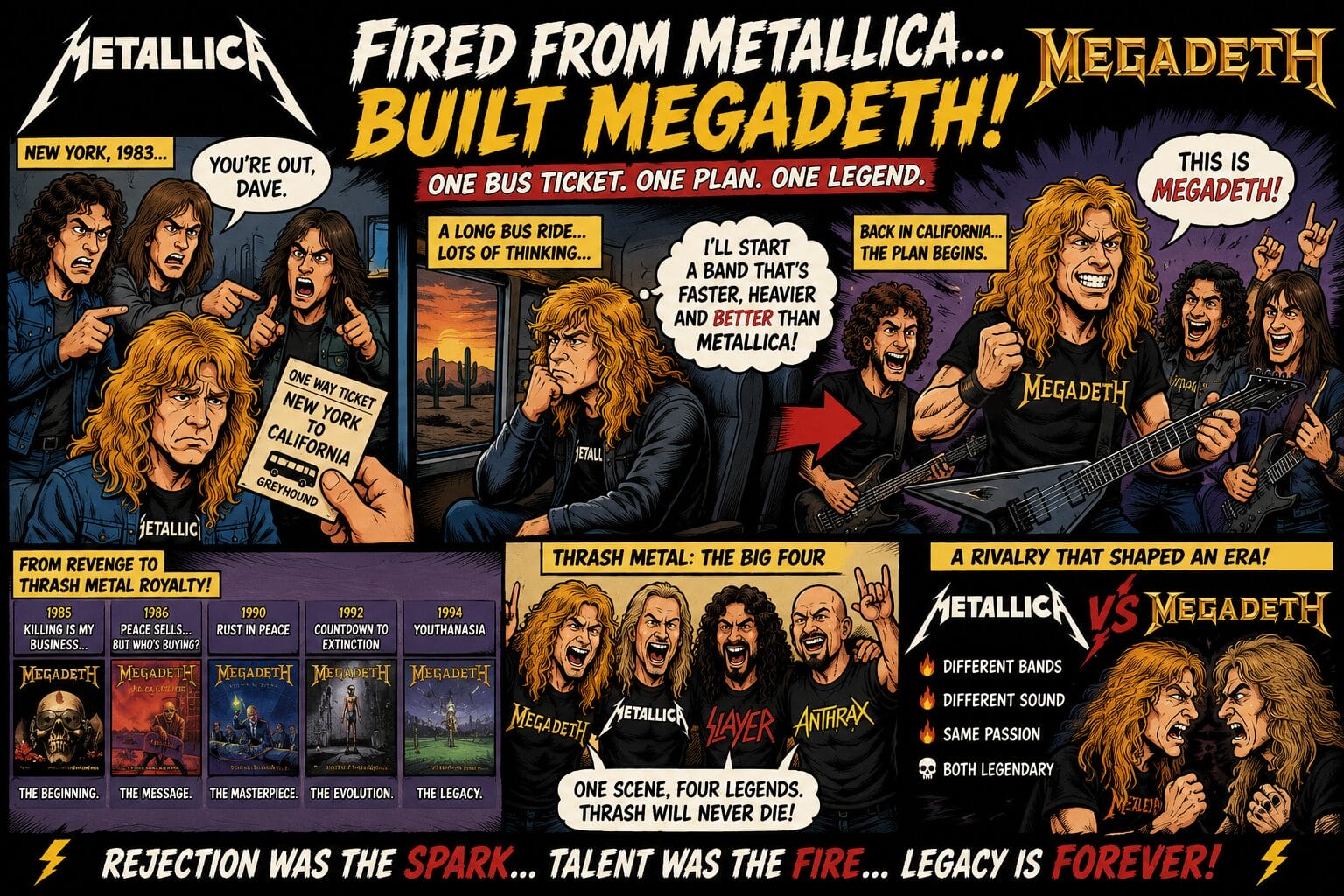
In April 1983, while Metallica were in New York preparing to record their debut album, Mustaine was informed that he was no longer in the band.
He was reportedly woken up, told he had been dismissed and handed a bus ticket back to California.
No long meeting.
No farewell performance.
No emotional group hug beneath the glow of a flickering rehearsal-room light.
Just a very long bus journey home.
That trip would become one of the most famous moments in heavy metal history.
Mustaine had hours to think about what had happened. He had lost his band, his opportunity and what could have been his route to success.
But rather than allow the rejection to destroy him, Mustaine transformed the humiliation into motivation.
He decided he would create a new band.
Not just any band, either.
He wanted his new group to be faster, heavier and more technically demanding than Metallica.
There are healthier ways to process workplace rejection, admittedly, but very few of them produce albums like Rust in Peace.
☢️ The Birth of Megadeth
Once back in California, Mustaine began putting together the band that would become Megadeth.
The mission was clear from the beginning: create music that was aggressive, intelligent, technically challenging and absolutely relentless.
Megadeth’s early sound was raw and furious, but it also carried something different from many of the other emerging thrash bands.
Mustaine’s songwriting introduced complex arrangements, political themes, sharp social commentary and guitar work that often sounded like someone had thrown a swarm of angry wasps into an amplifier.
The band released their debut album, Killing Is My Business… and Business Is Good!, in 1985.
It was fast, dangerous and rough around the edges — exactly what early thrash metal was supposed to be.
Megadeth had arrived.
And they weren’t interested in quietly standing at the back.
🎸 From Revenge Project to Thrash Metal Royalty
What could have remained a short-lived revenge mission quickly developed into one of the most important careers in heavy metal.
Megadeth went on to release landmark albums including:
- Peace Sells… but Who’s Buying?
- So Far, So Good… So What!
- Rust in Peace
- Countdown to Extinction
- Youthanasia
Each album helped establish Mustaine as one of metal’s most distinctive guitarists, vocalists and songwriters.
Megadeth’s music combined speed with precision. The riffs twisted and turned, the solos arrived like lightning strikes and the lyrics tackled politics, war, addiction, religion and social collapse.
It wasn’t simply metal designed for headbanging.
It was metal that expected you to keep up while it sprinted down a staircase carrying three guitars and a copy of the evening news.
By the early 1990s, Megadeth had become one of the biggest metal bands in the world.
The man who had been removed from Metallica had built his own empire.
Proper job, butt.
🔥 Metallica Versus Megadeth
The history between Mustaine and Metallica created one of rock’s longest-running rivalries.
Fans picked sides.
Arguments erupted in pubs, record shops, magazines and eventually internet comment sections where calm discussion goes to die.
Who had the better riffs?
Who had the stronger albums?
Who was more technically gifted?
Who truly represented thrash metal?
The debate became part of metal culture.
Metallica developed into one of the biggest bands in music history, while Megadeth carved out their own place as technical thrash legends.
Their styles evolved differently, but the connection between them never disappeared.
Mustaine’s history with Metallica was mentioned constantly throughout his career, sometimes fairly and sometimes as though he hadn’t spent decades building a monumental catalogue of his own.
There was anger.
There was resentment.
There were interviews where old wounds appeared to open faster than the bar queue when someone shouts “last orders”.
But there was also respect.
Whatever happened personally, the musicians involved understood the importance of what they had created.
🤝 The Big Four Moment
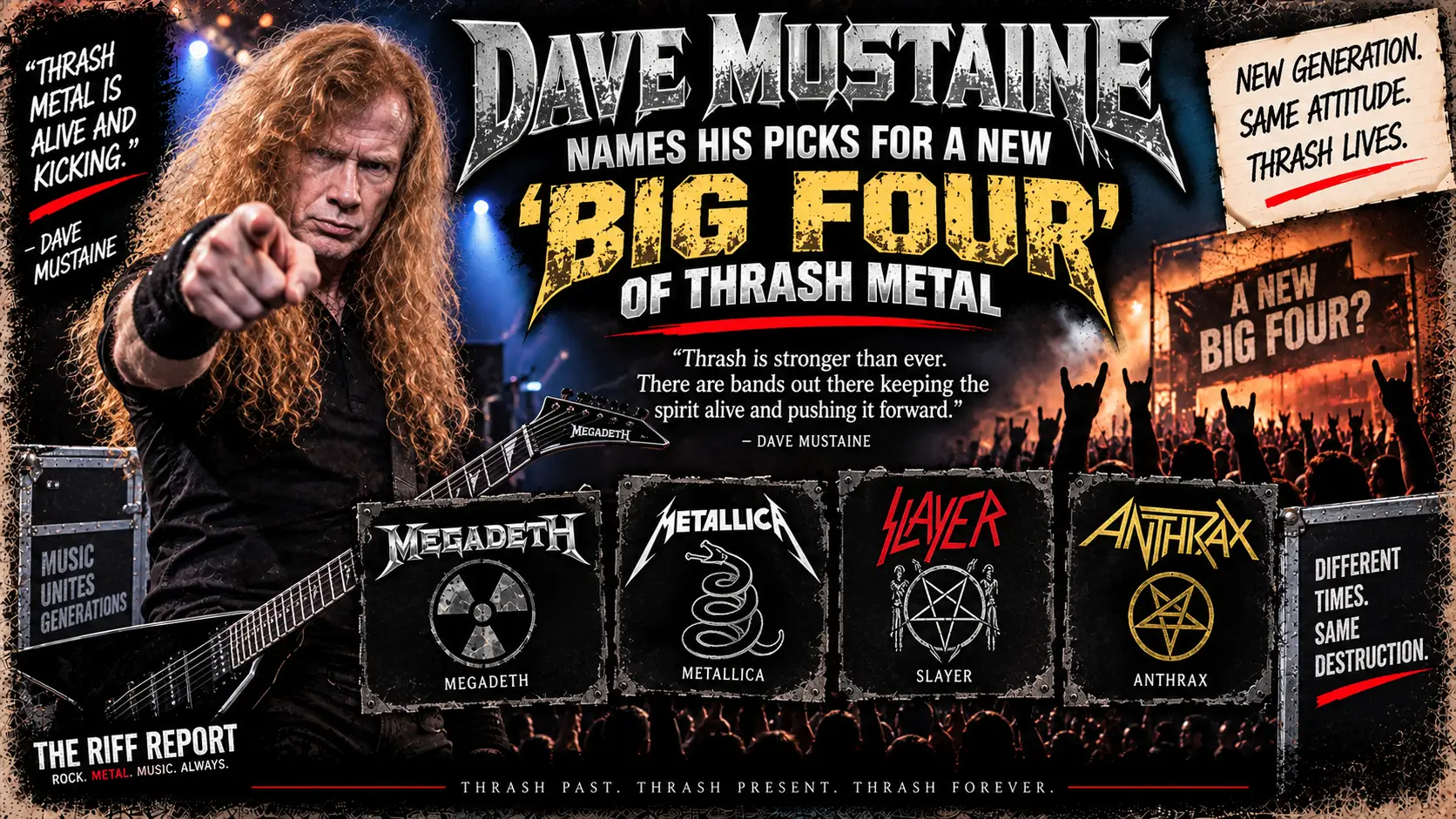
The rivalry eventually softened enough for Metallica, Megadeth, Slayer and Anthrax to perform together as The Big Four of Thrash Metal.
For fans, these shows were historic.
Four bands that had shaped the genre were finally appearing on the same bill, celebrating the movement they had helped create.
One of the most memorable moments came when members of all four bands joined together onstage.
Seeing Mustaine performing alongside his former Metallica bandmates carried enormous emotional weight.
Decades of history, bitterness, competition and success were suddenly standing shoulder-to-shoulder beneath the same lights.
It didn’t erase the past.
But it proved that the story had become bigger than one dismissal.
🤯 What If Dave Mustaine Had Stayed in Metallica?
This is where metal fans disappear down the greatest alternate-history rabbit hole since someone asked what Black Sabbath would have sounded like without Tony Iommi.
What would have happened if Mustaine had remained in Metallica?
Would Metallica’s sound have become more technical?
Would Kirk Hammett still have joined?
Would Megadeth ever have existed?
Would thrash metal have developed in the same way?
There’s no definite answer, but it’s difficult to imagine the genre without both bands.
Metallica became masters of enormous riffs, unforgettable songs and ambitious metal that reached audiences far beyond the underground.
Megadeth became champions of technical aggression, razor-sharp musicianship and politically charged thrash.
Without Mustaine’s dismissal, metal may have gained one version of Metallica — but lost the entire Megadeth catalogue.
No Peace Sells.
No Holy Wars… The Punishment Due.
No Hangar 18.
No Symphony of Destruction.
That is a timeline nobody needs to visit.
💥 The Ultimate Heavy Metal Comeback
Dave Mustaine’s story isn’t simply about revenge.
It is about turning rejection into momentum.
He could have walked away from music after Metallica fired him. Instead, he used the experience to create something that stood on its own.
Megadeth didn’t become successful because Mustaine had once been in Metallica.
They became successful because the songs, musicianship and relentless ambition demanded attention.
The anger may have lit the first match, but talent kept the fire burning.
Across decades of line-up changes, personal struggles, health battles and shifts in the music industry, Mustaine continued moving forward.
That determination helped Megadeth become one of the most influential bands in metal history.
🤘 The Riff Report Verdict
Getting fired from Metallica must have felt like the end of the world for Dave Mustaine.
Instead, it created another world entirely.
The dismissal led to Megadeth, strengthened the growing thrash metal movement and gave heavy music one of its most fascinating rivalries.
Metallica went on to become global giants.
Megadeth went on to become thrash metal royalty.
And fans received two legendary catalogues instead of one.
Sometimes the door slamming behind you is just the opening chord of something louder.
In Mustaine’s case, it was the opening chord of a band that would spend the next four decades delivering riffs, chaos and enough guitar solos to frighten the local electricity grid.
Getting fired from Metallica didn’t destroy Dave Mustaine’s career.
It accidentally helped change heavy metal forever.
Now be honest — Metallica or Megadeth? Or are you sensibly choosing both and avoiding a 900-comment argument? Let us know, mun. 🤘🔥