🩸 The Birth of the Beast
1. CATTLE HAMMER is not a cosy name. When this project first took shape, what emotional or sonic itch were you trying to scratch that other bands couldn’t?
DW – Hey, thanks for reaching out, its appreciated. At the point that Cattle Hammer was born, I’d been muddling through figuring out home recording, and had managed to write & record a decent number of projects over the course of a couple of years – Disentry, Balb Kubrox, Sutcliffe Richard, Mouth Toilet all put out releases in that time before I wrote what would become the first bunch of Cattle Hammer tracks.
All of those projects were very similar in terms of tempo (FAST) and after a couple of moments of inspiration – seeing Bell Witch live and the most recent Khanate release in particular – I decided to try and explore the slower side of things for the first time since the early days of Mistress, before our collective grindometer turned up a few notches. For some reason I’d never really felt comfortable (or more accurately, confident enough) to attempt anything less than D-Beat speed so it was a challenge to sit down and attempt it, but as soon as the first two notes were written, and the space in between them was figured out, ‘Watchmen, Alone’ came out almost immediately.
2. The music feels like it comes from a very real place of discomfort. Is this band therapy, punishment, or something closer to ritual?
DW – Unfortunately so, yes. My interest in home recording really started in the fallout of a failed long term relationship as something that could occupy my mind, or at least distract it somewhat. At the time I didn’t really have any active live bands either, so the writing, recording and releasing online of these projects was almost just a conveyor belt of ideas that once released, were moved aside to concentrate on whatever I had in mind next. So even then, I guess you could say that music was a form of therapy for me somewhat, and once Cattle Hammer developed into an active live band it became somewhere in between therapy and punishment I guess. All of our material so far is borne from a solo project, so there’s no ritualistic aspect process to the writing in that regard.
3. Loss, self-loathing, isolation… these aren’t abstract concepts in your lyrics. How much of CATTLE HAMMER is lived experience versus deliberate artistic excavation?
DW – I wish it wasn’t the case, but 99% is lived experience. The other 1% is artistic licence – I mean I’m not actually rotting you know? Jokes aside, the band lyrically and thematically were built upon foundations of loss and self-loathing, reflecting on the past couple of years of my life at that time. I was encouraged by someone indescribably important to me to consider taking to the stage with Cattle Hammer shortly after I’d started writing, and in those early formative days, my personal life had taken a turn for the better. I had never been happier, nor enjoyed a more profound connection with another human being in my life at that point. So during that relatively small window of happiness, I could approach the lyrics from a more detached perspective when rehearsing at least. When that relationship ended without warning, every lyric took on an even deeper meaning and resonated even more intensely within me than ever before. Since that point the feelings of loneliness and isolation have only intensified, and lyrics for many of our upcoming tracks reflect upon these emotions in as untarnished a way as ever.
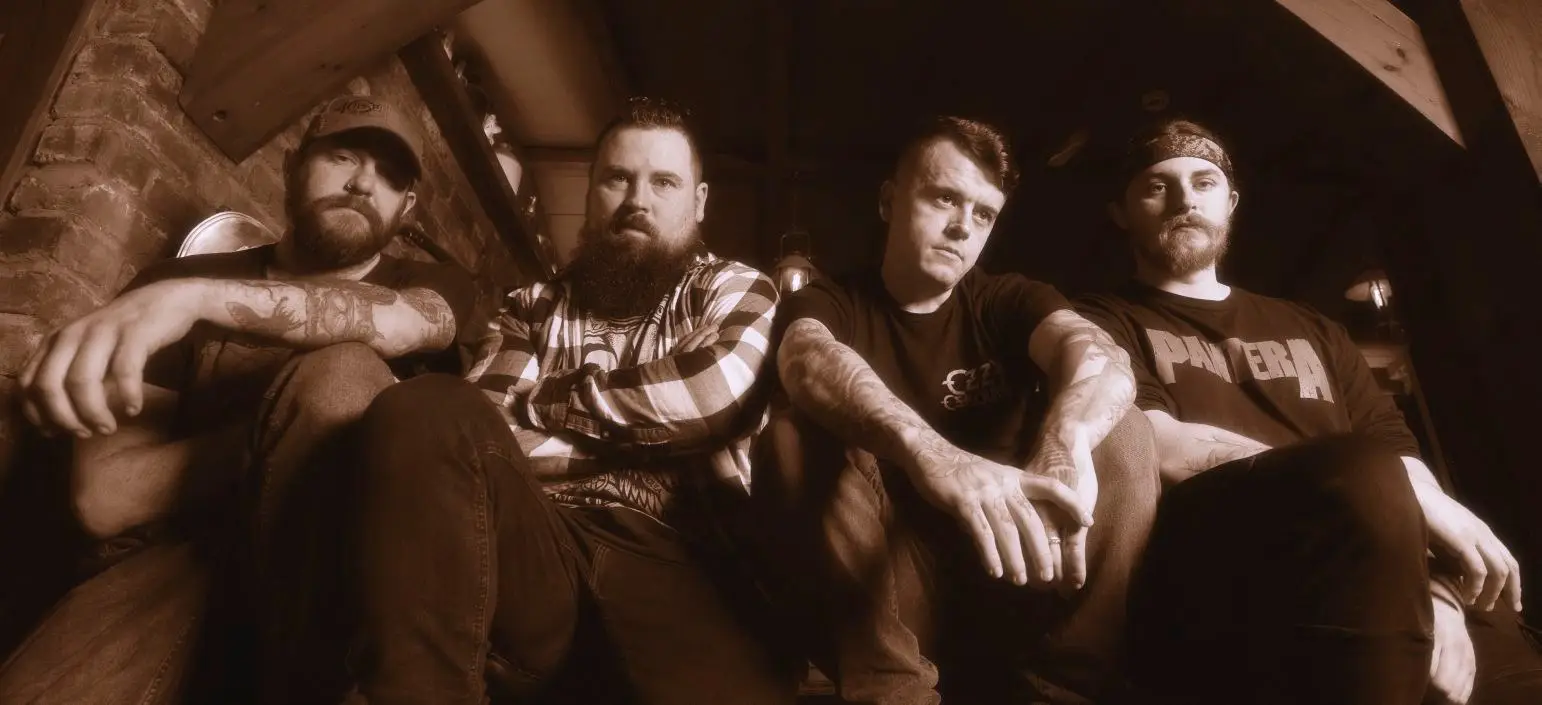
Duncan Wilkins – Vocals / Guitar
4. You’ve been involved in some famously hostile sonic projects over the years. What does CATTLE HAMMER allow you to express that your previous bands didn’t?
DW – The fact that it exists in this form at all is not something I’d have believed when I started this. I hadn’t led a band with songs that I’d written myself since my very first band, deadsunrising, back in the late 90’s (fuck!). I’ve obviously been pretty busy band-wise for the past 25+ years now (double fuck!) – but I’d never since been the main songwriter, if songwriter at all.
I was content just writing, recording and releasing as I had been, and jamming with a project called Gloam every now and then but never getting to the stage of playing live. I had neither the confidence or belief that the Cattle Hammer songs were any good in the first place, never mind being able to handle getting an actual band together. Luck had it that Ike and Joe were also in Gloam, had listened to the tracks and liked them – and suggested that we attempt a couple of rehearsals just to see if they could translate live, but I assumed it’d be nothing more than a side project of a side project at the time. I hadn’t even played guitar in a band since the last Mistress show in 2009.
It was around this time that the person I alluded to previously entered my life, and almost immediately gave me the confidence, inspiration, strength and belief that I had it in me to get an actual band together and make it work. Dirty Von had played alongside me in Mistress, Fukpig, Exploder and has been one of my closest friends since then. I knew that Burden of the Noose and Kroh were on the backburner at the time so offered him the role of bass, so I was chuffed when he agreed. It took us until the end of 2024 to finally play live, but during the interim we spent a lot of time rehearsing and honing our live sound, in particular developing the ability to recreate all of the additional sampling, electronic and synthesised parts I’d written.
I think that additional wait before playing live meant that we could really hit the ground running and appear so much fully formed when we finally did as opposed to a first band muddling through their first gig when they may not be particularly ready.
5. Your vocals feel less like performance and more like confession dragged through broken glass. Do you write lyrics first and build music around them, or does the noise pull the words out of you?
DW – Thankyou. The reality is somewhere in the middle. For probably 95% of the time I’ve more than enough lyrics to work with. They’ll either be noted on my phone or scribbled in a notebook, so I guess technically they come first, but in terms of song creation I’ll always start with the music. Generally I’ll pick a BPM at random and just stick a temporary 4/4 beat over it, and start playing with riffs from there. Once the song has taken shape, its a case of referring back to my lyric stash and identifing any common thematic threads to bring the song together and playing a bit of word Tetris to get them to fit the music.
I’m certainly not the type to approach vocals performatively, they are basically whatever comes out of me now after probably 25 years worth of attempting to emulate the likes of Morrow, Hellion, Filth, Von Till & Edwardson and having them ferment over time. Over time I’ve less wanted to copy anyone, but more try to convey a particular feeling or emotion in it’s optimal style of unpleasantness whether a grunt, a growl, a shout or a scream.
6. The track ‘Rotting’ has that chilling line: “that’s what you’re entitled to… pain, suffering, misery…” — where did that voice come from, and does it ever shut up?
DW – The quote is actually a chopped up sample from a wrestling podcast referencing the Von Erich family and the idea of being born into an environment that was almost predestined to end tragically. But as soon as I heard it, it absolutely resonated in terms of the band’s aesthetic and my own feelings at the time, seemingly that the only joyful times I experience are so fleeting as to only intensify the lows that inevitably follow. But no, that voice doesn’t seem to want to shut up any time soon I’m afraid.
7. Do you ever worry about going too far emotionally with this material, or is that edge exactly where CATTLE HAMMER needs to live?
DW – At this moment in time I’m more worried about my mental health in general just going too far, so the band is a fucking godsend for me to at least release some emotion if only for a short while. It’s the only medium at the moment where I can honestly express and release my very real feelings of sadness, anger and love all at the same time in a safe place. When we play live, from before the intro tape starts I’m locked into this headspace where I’m rabidly desperate to wring every ounce of emotion from out of me for the next forty minutes, whether from my guitar, throat or body in general. All to ensure that what I attempt to convey with this material is performed authentically, with as much honesty and integrity as I can physically muster.
Issac Cartwright – Drums / Production 🥁(Not sure where Ian came from. Its Issac. Ike for short: incase anyone references me in their answers)
8. The drumming feels oppressive rather than flashy — like it’s closing walls in rather than showing off. Was restraint a conscious decision?
IC – I feel like I am quite a restrained drummer anyway, firmly in the pocket. My job is purely to keep time in Cattle Hammer, sometimes I will have a bit of fun but I don’t like to draw focus away from the entire experience.
9. How do you approach rhythm in a band where space, tension, and suffocation matter as much as sheer heaviness?
IC – So far, Duncan has demo’d everything including programmed drums, so I get an immediate idea of tempo and feel, and if you listen to the early demos there is kind of industrial repetitive feel to everything. Almost Godflesh / Asva in places. I don’t want to stray too far from that. But I also don’t want to phone in my parts, I think when a part needs driving then I’ll drive it. When we get to a bleak part I want to add as much negative space as possible.
10. When tracking drums for material this bleak, do you aim to lock into the guitars… or deliberately fight them?
IC – I rehearse, record, and play live to a click track. I don’t think I could cope without it. In terms of my parts. It depends on the track, but I will try and lock in with at least something outside of the click, whether that be the bass or to accentuate vocals or a guitar line or whatever. During the end of ‘Watchmen, Alone’ I am playing a polymeter against what the guitars are playing. Accidentally I was trying to give the piece a faster feel without speeding up, but I don’t think it gave that effect, rather a very disjointed feeling section, which is also fine.
Duncan Wilkins / Joe Wyles – Guitar
11. There’s a sense of crawling dread in the guitar work — not riffs you headbang to, but riffs that stalk you. What influences shaped that approach?
DW – When I first started Cattle Hammer I knew I didn’t want to go too stoner rock and bluesy – I was inspired more by the likes of Dystopia, Noothgrush & Grief than I was by Goatsnake or Electric Wizard for example (not that they aren’t both fucking amazing bands). Even Eyehategod was maybe a touch too far for me, although admittedly there is a tad of EHG influence in ‘Rotting’. Khanate and TSIB-era Neurosis are also influences but also Sex Prisoner and Man Is The Bastard. Some of the slower breakdown parts of powerviolence are heavy as fuck but are often forgotten or slept on as the genre is so grind-adjacent I guess. That idea’s always been nagging at me in the back of my mind too when writing, like those stabby, punchy parts which can be as effective as Burning Witch’s feedback breaks so its kinda of a mix between the slow bits of fast bands and the slow bits of slow bands! Slowerviolence!
12. How do you decide when a part should repeat into madness versus when it needs to fracture and collapse?
DW – A number of factors I guess. Where in the song is it? What has built to it before? There’s always the notion of building and dynamics in mind when writing. I think both lead to the same endgame – tension. You can build tension by repetition with the listener not being quite sure as to when the cycle is about to break. Alternatively the tension could be built by not knowing when the hammer is to drop again after a brief pause in punishment.
13. Is there a danger with music this dense that it becomes impenetrable, or is that actually part of the point?
DW – I certainly don’t want it to be an easy listen given the amount of pain that has been poured into it but I hope that fans of extreme or challenging music should find something to latch onto, whether a riff, a particular feeling, or the lack of comfort or respite to be found. Both live and on record, we really try to avoid providing breathing space – we always aim to create an uninterrupted experience in some form. Even if it’s just feedback in between songs, I think it helps create an uncomfortable atmosphere sonically. Both ‘Through Silver In Blood’ by Neurosis and ‘This Decaying Schizophrenic Christ Complex’ by an old UK band called Koreisch were big influences on how I wanted the album to sound. They are both incredibly overwhelming and punishing listens in their own right but in both cases, even the quieter moments don’t offer respite, instead being unsettling, tense and unnerving, building to something bigger than the sum of its parts.
Dirty Von Donovan – Bass
14. The bass in CATTLE HAMMER feels like a subterranean presence — more pressure than melody. How important is that low-end weight to the band’s identity?
IC – As well as the bass, there is also a Moog Minitaur reinforcing the sub bass. I’d say a lot of our sound is in the lower half of the frequency spectrum.
DVD – Type O Negative.
15. Do you see your role as anchoring the chaos, or amplifying it?
DVD – Danzig.
16. In extreme music, bass can get buried. How do you make sure it still hurts?
IC – There is a lot of sidechaining on the record. And a lot of subharmonic generation on certain bits and harmonic distortion/saturation on others.
DVD – Deicide.
🕯️ Process, Pain & Purpose
17. The album artwork and atmosphere feel inseparable from the music. How early does the visual identity come into the process?
DW – I’d say not long after the first few tracks were recorded. I’ve always been responsible for the artwork in all of my solo endeavours, if for no other reason than I’ve always believed that if you have the means, nothing beats DIY. I absolutely wanted the band to stand out from our peers, musically if possible, but certainly from an aesthetic standpoint, and it all really stemmed from how I approached the band as a whole.
When I was like 16 or 17 I made zines for a few years, and as I grew up around the punk & hardcore scenes I always loved their cut & paste style. Yet again, that one particular person in my life gave me the inspiration and belief to explore that as part of the overall visual identity of the band, even to the Infest bars on our logo. Everything from the guitar tabs I share with the band, to my lyric sheets, to the record covers is created this style to ensure a consistency of tone and theme – something that hopefully people will see and know straight away it belongs to us. I was completely excited with the process of putting the album artwork together just to bring the last couple of years worth of practice to life. I knew I wanted the artwork to be more in line with that of a zine, or a grind/PV record as opposed to say, a big bag of weed or a wizard flying through space on a bong.
18. You’ve described the record as a “tower of pain and isolation.” Once it’s finished and released, do you feel relief… or just emptiness?
DW – Personally speaking, as the de facto band leader I felt an enormous amount of pressure trying to lead the band through the recording process as I’ve never been in that position before and honestly wasn’t particularly comfortable with it. I was utterly confident that these were the best four songs with which to make up the album, but I had constant doubts as to whether I was doing the right thing or making the right decisions constantly.
Ike did a phenomenal job of producing the album, and I hope he gets all the recognition that his work deserves. I’m sure he’s relieved the process is over, but I do know that all of the doubts I had have taught me lessons as to how to approach the next one.
There’s no additional emptiness felt as the work has already begun on optimising the next batch of material for live / recording – just back to the standard baseline level of emptiness that was there before. The debut album has done a great job of capturing those songs and that moment in time for now, but there’s plenty for us to work on, build and improve upon in the meantime.
19. Is CATTLE HAMMER something that can evolve, or does it only work if it remains this raw and unforgiving?
DW – I’d be really disappointed if we didn’t evolve to be honest. I have zero plans to dramatically change how we sound for the foreseeable future as there are still so many avenues to explore within this particular framework. ‘Rotting’ aside, the tracks on the LP are coming up to three years old now and I’ve learnt so much around virtually all aspects of my playing & writing since then. There are no restrictions – speed, volume, distortion. If I feel a blast section is appropriate it’ll go in, but most of the time I’d rather the music reflect a lifetime of crawling pain as opposed to a rapid-fire pummelling. One thing is guaranteed, it will not be getting happier.
IC – I’d say it can evolve, and i’d be disappointed if it didn’t. There are definitely some party riffs going to appear on the next record, but I guess if we get a bit too happy we’ll have to write something far far bleaker to keep the balance.
DW – Bear in mind our scale of reference to the term ‘party riffs’ by the way, we’re not turning into Black Lace any time soon. We’re more AgaDon’t than Agadoo.
🔥 Live Destruction & The Future
20. How do you translate something this internal and oppressive into a live setting without losing its intensity?
DW – Ike has done an amazing job in translating a lot of the intricacies of our sound to a live context given his background as a sound engineer. He’s optimised my basic recordings and taken them to a new level. There are no real trade secrets in terms of guitars, two of them with six strings, one with four – all played loud. I need to try to get into a certain mindset before a show as mentioned earlier, so as critically important as the musical backing is, I don’t think you get that intensity without a certain amount of, not aggression as such, but certainly a sense of ‘feeling it’.
I’m lucky in knowing that live, Ike will be solid as a rock behind me, with Daz & Joe both individually locked in, so as a band I don’t think we’re guilty of having any of us seem disinterested. I also edited together a 45 minute backing video of assorted horrible footage to use as an accompaniment to our shows whenever the venue capabilities have allowed it, which again adds an extra layer to our performances.
IC – I think we’ve only played a handful of shows so far where the PA has been bigger than the one in our practice space. But then we’ve only been playing live for ~ a year.
Live it’s all about trust and communication with the engineer in the venue. All of our backing is on a track we play to live. This includes a Moog, a church organ with a leslie speaker, synth parts and samples all taken from the record.
After that, it’s visual – minimal back-lighting and haze.
21. What should someone feel walking out of a CATTLE HAMMER show — exhaustion, catharsis, or something worse?
DW – I prefer to let everyone who sees us to feel exactly how we made them feel, it’s not for me to dictate to them in any way. If they like heavy, emotional, bleak, overwhelming music then I hope they liked it at least. If they feel like they’ve just wandered into a cack-handed attempt at a solo emotional exorcism, then I guess I’ve done my job somewhat. As long as they can feel the intensity with which we perform then I’m happy.
IC – Someone on instagram uploaded a clip of one of our shows, with just the word “fuck.” If that helps?
22. Finally… what’s next? More darkness, deeper wounds, or an entirely new way to unsettle people?
IC – we’ve probably got another two albums written in demo form. 3 if you include Methlehem. So will likely pick the most suited songs and see how we feel. I have some ideas to make parts heavier, there are probably a few things I’d change about how I recorded DTWLO so will just be experimenting with those I guess.
DW – Like Ike said, there’s plenty of raw material in the bank to work with and in between shows promoting the LP, I guess we’ll spend the year putting the next record together. Always interested in splits, tapes and so on whether for Cattle Hammer or any of my other projects. But immediately, we’ll be figuring out how best to hone what we have for maximum impact next time round. I’ve just realised and it’s kinda sad to think about, but the material on this album has barely even scratched the surface of the worst times of my life yet.
So you’ve that to look forward to.
Or not.
Nothing helps.

Michael is the founder, editor, and chief riff wrangler behind The Riff Report, an independent Welsh rock and metal publication built by fans, for fans. With a lifelong passion for loud guitars, unforgettable live shows, and the incredible community that surrounds rock and metal, he created The Riff Report to celebrate everything that makes the scene special—from legendary headline acts and grassroots venues to rising bands that deserve to be heard.
A familiar face at festivals across the UK, Michael spends much of the year covering events including Download Festival, Bloodstock Open Air, Steelhouse Festival, Firevolt, Plumpton Revival, and many more. Whether he’s battling the Welsh weather on a mountainside, surviving a weekend in a muddy campsite, or squeezed against the front barrier with thousands of fellow fans, he’s always searching for the next great story to share.
As editor of The Riff Report, Michael writes festival guides, breaking news, album reviews, gig reviews, interviews, opinion pieces, nostalgia features, and behind-the-scenes stories from across the rock and metal world. His writing combines honest opinions, humour, and a genuine love for live music, bringing readers closer to the bands, festivals, venues, and people that keep the scene alive.
Michael is particularly passionate about supporting independent artists, local venues, charities, and the wider UK rock and metal community. He believes every band deserves a chance to be discovered and every festival has a story worth telling. Through The Riff Report, he aims to shine a spotlight on both the biggest names in rock and the future stars waiting to break through.
When he’s not writing or interviewing artists, you’ll probably find him exploring festival campsites, photographing live shows, chatting with fellow fans over a pint, or planning the next road trip in search of more riffs, bigger crowds, and unforgettable moments.
Above all, Michael believes rock and metal are about more than music—they’re about community, friendship, and creating memories that last a lifetime. That’s exactly what The Riff Report exists to celebrate.
Proudly Welsh. Proudly Loud. Always chasing the next great riff. 🤘