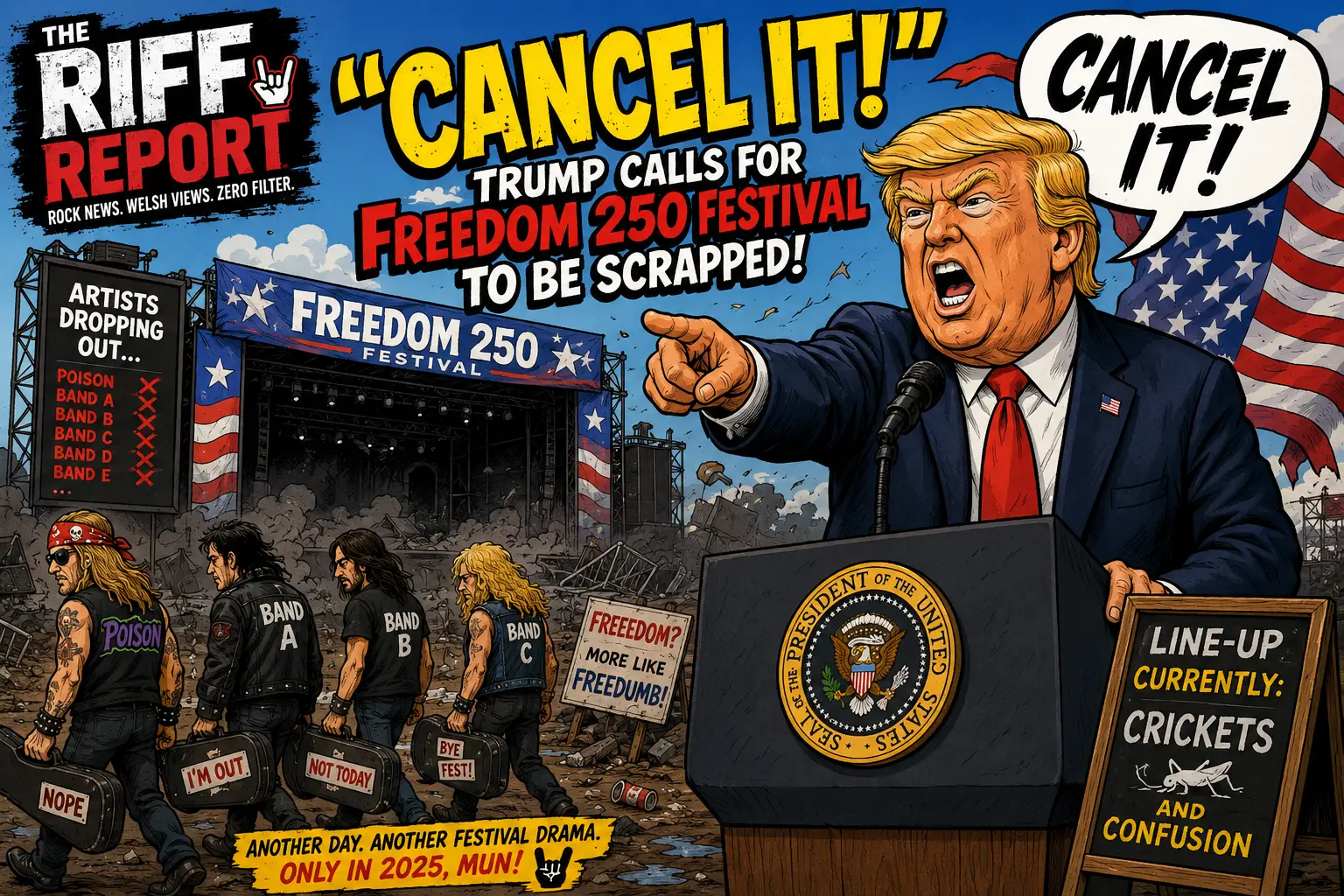
Another Festival Disaster Unfolds As Politics And Music Collide
Well, butt, if you thought festival season couldn’t get any stranger, think again.
What was supposed to be one of America’s biggest celebrations has rapidly transformed into a full-blown public relations nightmare. The controversial Freedom 250 Festival, originally planned as part of the United States’ 250th anniversary celebrations, is now facing mounting uncertainty after a wave of artists pulled out of the event.
And now, the story has become even bigger after former US President Donald Trump reportedly responded to the chaos with two simple words:
“Cancel it.”
When a music festival ends up becoming a headline on international news channels rather than music websites, you know things have gone seriously off the rails.
Grab a coffee, crack open a beer, and let’s dive into one of the strangest festival stories of the year.
🇺🇸 What Was Freedom 250 Supposed To Be?
The Freedom 250 Festival was originally envisioned as a major event celebrating America’s upcoming 250th anniversary.
Organisers promised a huge celebration featuring live music, patriotic themes, entertainment, and cultural events designed to mark a historic milestone for the United States.
On paper, it sounded like a guaranteed success.
Big names.
Big stages.
Big crowds.
Big celebrations.
Unfortunately, reality had other plans.
🎤 Artists Start Heading For The Exit
The problems began when performers started distancing themselves from the festival.
Over recent weeks, a growing list of artists announced they would no longer be appearing at the event.
One of the highest-profile departures came from Poison frontman Bret Michaels, who confirmed he would be withdrawing from the festival.
As news spread, more artists followed.
Each new cancellation fuelled further speculation about the event’s future and raised fresh questions about whether organisers could realistically deliver the spectacle they originally promised.
For fans who had already bought tickets or made travel arrangements, the situation quickly became frustrating.
For organisers, it became a nightmare.
And for the media?
Well, it became headline gold.
🔥 Social Media Goes Into Meltdown Mode
As you’d expect, social media exploded.
Some users applauded artists who chose to leave the event.
Others criticised performers for pulling out.
Many simply sat back and enjoyed the chaos unfold in real time.
Within hours, hashtags related to the festival were trending across multiple platforms, while news organisations around the world picked up the story.
Music fans debated everything from artistic freedom and political influence to whether festivals should ever become associated with political figures in the first place.
As is often the case these days, everyone had an opinion.
And nobody was keeping it to themselves.
🇺🇸 Trump’s Blunt Verdict
Then came the comment that sent the story into another stratosphere.
Asked about the ongoing problems surrounding the festival, Donald Trump reportedly responded with a straightforward assessment:
“Cancel it.”
No lengthy speech.
No detailed explanation.
Just two words.
Whether intended as practical advice or simply an observation on the state of the event, the remark instantly became the headline.
News outlets across America and beyond quickly picked it up, pushing the story far beyond the usual music press bubble.
Suddenly this wasn’t just a festival story anymore.
It had become a political story.
A cultural story.
And one of the most talked-about entertainment controversies of the summer.
🎸 Rock Music Has Always Been Political
For rock and metal fans, none of this should come as a huge surprise.
Music and politics have been sharing stages for decades.
From anti-war protests in the 1960s to punk’s anti-establishment rebellion, from Rage Against The Machine’s political firestorms to modern debates around freedom of expression, artists have never been afraid to speak their minds.
Whether fans agree with them or not is another matter entirely.
The point is that music has always reflected the world around it.
And when major political figures become attached to events, controversy often follows close behind.
Freedom 250 appears to be the latest chapter in that long-running story.
🤔 Can The Festival Recover?
That’s the million-dollar question.
Festivals have survived major setbacks before.
Headliners have cancelled.
Weather has caused havoc.
Organisers have faced financial crises.
Some events bounce back stronger than ever.
Others never recover.
Right now, Freedom 250 finds itself at a crossroads.
Can organisers replace the missing artists?
Can they rebuild public confidence?
Can they convince fans that the event is still worth attending?
Or has too much damage already been done?
Nobody seems entirely sure.
🎟️ Festival Fans Know This Feeling
Let’s be honest for a moment.
Every seasoned festival-goer knows what it’s like when a line-up starts changing.
One minute you’re planning your entire weekend around a favourite band.
The next minute they’ve disappeared from the poster and you’re desperately trying to convince yourself that the replacement is “actually pretty decent.”
It’s part of festival life.
But seeing multiple artists withdraw in such a public and high-profile manner is another level entirely.
This isn’t your favourite third-stage band cancelling because their van broke down on the motorway.
This is a festival facing a genuine identity crisis.
🍺 Imagine The Scenes
You can almost picture it.
Festival organisers staring at their phones.
Fans refreshing social media every five minutes.
Journalists frantically updating articles.
Publicists working overtime.
Meanwhile somewhere in the background, a poor stage manager is probably wondering whether they’ll even need to put the barriers up.
Absolute chaos, mun.
The kind of chaos that makes Download Festival mud look organised.
🤘 The Riff Report’s Take
Regardless of where you stand politically, this story highlights just how complicated the modern festival landscape has become.
Music festivals used to be relatively simple.
Book bands.
Sell tickets.
Build stages.
Crack open the beers.
Job done.
Now organisers must navigate political opinions, social media storms, artist activism, public perception, sponsorship concerns, and an audience ready to dissect every decision in real time.
Freedom 250 has become the latest example of how quickly things can spiral.
One thing’s for certain:
When artists start dropping out, politicians start commenting, and international news organisations start leading with your festival story…
You’ve got problems.
Big problems.
Whether Freedom 250 ultimately survives or disappears altogether remains to be seen.
But one thing is already guaranteed.
This story will be talked about in festival fields, pub beer gardens, backstage dressing rooms, and internet comment sections for a long time yet.
And if there’s one thing rock fans love almost as much as live music…
It’s a bit of festival drama.
🎤 What Do You Think?
Should Freedom 250 continue despite the artist withdrawals?
Were the musicians right to walk away?
Has politics become impossible to separate from major music events?
Let us know in the comments, butt.
Because this story is far from over.
🤘🇺🇸🔥